Real-Time Line Monitoring for Distribution Fault Visibility
By Jack Nevida, P.E. Principal Engineer Distribution Integration, SRP
By Jack Nevida, P.E. Principal Engineer Distribution Integration, SRP
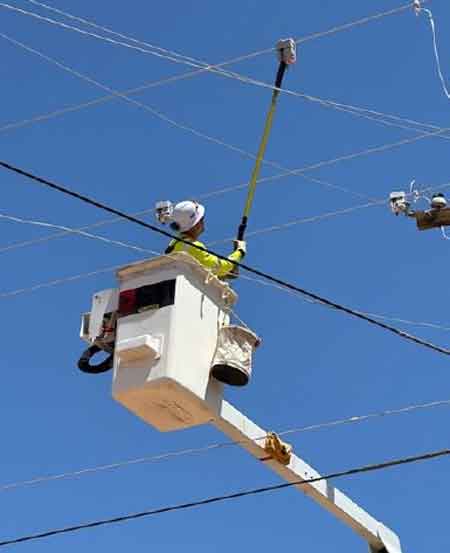
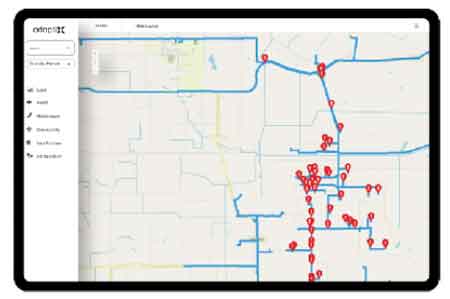
Real-time line monitoring provides continuous visibility into fault current, waveforms, and power flow across distribution feeders, enabling faster restoration, ADMS model validation, and predictive analytics while reducing customer minutes of interruption in high-risk circuits.
Distribution systems are increasingly difficult to observe at the feeder level. Underground expansion, distributed energy resource backfeed, aging electromechanical protection, and wildfire exposure have widened the gap between breaker-level visibility and actual fault location. When operators cannot see beyond the substation, restoration becomes probabilistic rather than deterministic.
Breaker status alone does not explain where a fault occurred, how it propagated, or whether reverse power flow altered its signature. In high-risk circuits, uncertainty translates directly into longer patrol distances, delayed restoration, and greater operational exposure. As feeder complexity increases, the cost of incomplete visibility compounds across reliability metrics and regulatory scrutiny.
Real-time line monitoring addresses this observability gap by injecting current magnitude, directional flow, and waveform evidence into operational workflows. However, once data are integrated into ADMS and feeder models, restoration decisions become accountable to measured reality rather than estimates. Visibility improves speed, but it also increases responsibility.
Real-time line monitoring changes the control room from reactive fault confirmation to directional fault localization. When sensors report current magnitude, direction, and waveform signatures in near real time, dispatch decisions are no longer based solely on breaker status and customer calls. They are based on feeder-level evidence.
In large vertically integrated systems with more than 30,000 distribution miles, patrol distance and notification delay are not marginal variables. They are dominant outage drivers. When fault location uncertainty spans several miles, restoration becomes a search exercise. When the location is narrowed to a defined span between two sensors, restoration becomes a targeted intervention.

Utilities that deploy intelligent line sensors on high-fire-risk feeders and circuits with electromechanical relays have demonstrated measurable reductions in customer minutes of interruption. In one documented high-risk feeder scenario, reducing patrol time lowered interruption duration from 185 minutes to 130 minutes for a 20-customer feeder, resulting in 1100 CMI savings. That reduction is operational, not theoretical.
Real-time line monitoring compresses the diagnostic window. Without sensors, operators observe a breaker trip and dispatch a crew to patrol outward from the substation. With sensors, both the operator and the troubleshooting crew receive simultaneous notification tied to a specific device location.
This changes the outage sequence. The crew begins at the indicated span rather than at the substation. Restoration time becomes a function of fault repair rather than fault discovery.
On circuits monitored under distribution line monitoring, the operational benefit is most visible where terrain, underground segments, or vegetation density complicate access. The reduction in patrol distance is often the dominant reliability gain.
The cascading consequence is clear. If patrol time is reduced on a single feeder, outage duration falls. If repeated across multiple high-risk feeders, annual SAIDI shifts. If integrated into FLISR logic, restoration sequencing changes at the system scale. A localized sensing decision can influence system reliability metrics across an entire district.
Real-time line monitoring is not limited to fault flags. Fault current magnitude and oscillography have been shown to match substation relay waveforms in both duration and magnitude under comparative testing. That alignment establishes credibility for feeder-level waveform analytics.
The control implication is significant. When power flow measurements and fault signatures feed into ADMS, operators gain dynamic feeder visibility beyond static model assumptions.
However, model validation introduces threshold discipline. Sensor accuracy must be evaluated under varying load currents, harmonic distortion, and DER backfeed conditions. If threshold settings are too sensitive, nuisance alarms increase. If thresholds are too conservative, incipient faults may not register.
Integration with grid modeling forces planners to reconcile real measured feeder flows with modeled impedance assumptions. Discrepancies expose latent modeling error. That exposure is productive, but it increases accountability. Incorrect model topology can no longer hide behind estimation.
Deployment is not a plug-and-play exercise. Ownership of provisioning, firmware updates, asset tracking, and cybersecurity responsibilities must be defined early. Devices outside substations do not fit neatly into legacy protection governance models.
Architectural decisions introduce tradeoffs. Cloud-based integration gateways reduce on-premise infrastructure burden but require secure VPN tunnels and coordination with high-security operations centers. Cyber review cycles can extend pilot timelines. If not scheduled early, deployment velocity slows.
Line sensors that harvest power from load current require minimum current thresholds, often around 8 amperes for capacitor-based units. Low-load feeders may require battery-based devices. That constraint affects placement strategy and cost.
Real-time feeds routed through grid edge intelligence platforms enable predictive pattern recognition, but cellular coverage gaps in remote circuits can introduce telemetry latency. Operators must decide whether partial visibility is acceptable or whether redundant communication paths are required.
The most advanced deployments extend beyond restoration speed. Fault waveform libraries and recurring current anomalies can be fed into predictive grid intelligence workflows to identify vegetation contact trends, equipment degradation, or intermittent conductor slap before permanent faults occur.
Yet predictive claims must be constrained. Sensors detect rapid current change. They do not inherently distinguish between transient wildlife contact, conductor galloping, or high-impedance faults without contextual analytics. Overconfidence in prediction increases risk.
Download our FREE Electrical Training Catalog and explore a full range of expert-led electrical training courses.

An operational edge case emerges in circuits with high DER penetration. A reverse power flow can alter the fault current direction and magnitude signatures. If directional logic is not tuned, fault localization may misidentify upstream and downstream segments. Integration with AMI data can refine situational awareness, but only if timestamp synchronization and data latency are controlled.
The decision gravity lies here. Real-time line monitoring improves restoration, enhances visibility, and supports predictive strategies. It also exposes modeling weaknesses, governance ambiguity, and telemetry dependency. Once deployed at scale, withdrawal is not neutral. The organization becomes dependent on sensor-informed operations.
Within the Asset Intelligence channel, real-time line monitoring functions as a feeder-level observability layer. It bridges substation protection and distributed analytics, providing measurable improvement in outage localization while feeding ADMS and predictive models.
It is not a replacement for protection relays. It is a control acceleration mechanism and a model validation instrument. When deployed selectively on critical circuits, in high-fire-risk areas, and on feeders with unknown outage causes, it converts distribution visibility from inferred to measured.
Advantages To Instructor-Led Training – Instructor-Led Course, Customized Training, Multiple Locations, Economical, CEU Credits, Course Discounts.
Request For QuotationWhether you would prefer Live Online or In-Person instruction, our electrical training courses can be tailored to meet your company's specific requirements and delivered to your employees in one location or at various locations.