Why Replacing a Circuit Breaker Can Make Things Worse
By William Conklin, Associate Editor
By William Conklin, Associate Editor
Our customized live online or in‑person group training can be delivered to your staff at your location.

Request for Quotation Service
Buyers Submit Free RFQs to top suppliers, no obligation.
Suppliers Browse real project RFQs directly from buyers.
Trust Electricity Forum 40 years connection buyers and suppliers.
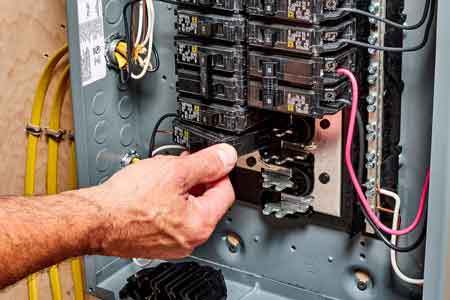
How to replace a circuit breaker depends on more than swapping hardware. Knowing when replacement is appropriate, how tripping relates to overloads or wiring faults, and how panel compatibility and fault current affect safety determines whether replacement reduces or increases fire risk.
A circuit breaker that trips repeatedly is often assumed to be defective, but that assumption is frequently wrong. Breakers respond to conditions downstream, and replacing one without understanding why it is operating can conceal overloads, insulation damage, or coordination problems elsewhere in the system. The mechanical steps are straightforward. The judgment behind replacement is where risk is introduced or avoided.
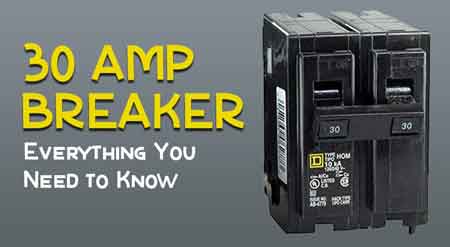
There are legitimate situations where breaker replacement is appropriate. Physical damage, heat deformation, corrosion, internal mechanical failure, or a breaker that will not reset even with all downstream loads disconnected are all signs of a component that has reached the end of its service life. Older panels often contain breakers that have weakened trip mechanisms or degraded contacts after decades of thermal cycling. In those cases, replacement restores the original protective function rather than altering it.
The most common mistake when assessing how to replace a circuit breaker is assuming that nuisance tripping means failure. Breakers that trip repeatedly are usually responding to stress elsewhere in the circuit, not failing on their own. Replacing a breaker to stop tripping without addressing the underlying cause can change how the circuit behaves during a fault, especially in panels where available fault current is higher than expected. That is why understanding available fault current matters before any protection device is changed, as explained in Available Fault Current.
Think you know Electrical Protection? Take our quick, interactive quiz and test your knowledge in minutes.
Many homeowners assume they know how to replace a circuit breaker. They think that replacing a breaker with one of the same amperage is automatically safe. In reality, panel compatibility matters as much as rating. Breakers are tested and listed for use in specific panelboards, and mixing brands or using classified replacements incorrectly can compromise bus connections and fault-clearing performance. These compatibility issues are a frequent cause of overheating at the breaker stub, even when the circuit load appears normal.
There is also a protection coordination dimension that rarely appears in DIY guides. Breakers do not operate in isolation. They are part of a coordinated protection scheme that determines which device opens first during a fault. Changing a breaker can disrupt that balance, especially in installations with upstream devices or supplementary protection. This is why breaker replacement decisions are closely tied to Relay and Circuit Breaker Coordination principles, even in smaller systems.
Repeated tripping is more often a warning than a defect. Overloaded branch circuits, damaged insulation, shared neutrals, or equipment faults can all trigger breakers that are functioning correctly. In some cases, replacing the breaker actually delays failure by allowing excessive heating to continue unnoticed. This is especially relevant in circuits feeding motors or electronic equipment, where overload characteristics matter more than simple overcurrent interruption, as discussed in Motor Overload Protection.
Ground-fault and arc-fault breakers add another layer of complexity. These devices respond to conditions that traditional thermal-magnetic breakers cannot detect, and replacing them with standard breakers to “solve” nuisance trips removes a layer of protection that may be required by code or necessary for occupant safety. Understanding the difference between overcurrent protection and fault detection is critical, and it is covered more broadly in What Is Overcurrent Protection.
Most high-ranking articles focus on procedural steps for "how to replace a circuit breaker." Turn off the main disconnect, remove the panel cover, pull the old breaker, install the new one, and restore power. Those steps are widely available and easily summarized by AI. What those pages rarely address is whether the person performing the replacement can recognize when the breaker is not the problem or when replacement changes the system's protection behavior.
Those sources also gloss over inspection and insurance implications. In many jurisdictions, panel work requires inspection, and unpermitted changes can create complications after an electrical fire or during a property sale. Breaker replacement may appear minor, but it still alters the electrical system's protection scheme, which is why it falls within the broader context of Electrical Protection rather than simple maintenance.
There are clear situations where breaker replacement should not be treated as a casual task. Evidence of arcing, melted insulation, repeated trips under light load, or uncertainty about panel compatibility are all signals to stop and escalate. In larger systems or mixed-use buildings, breaker behavior is often tied to upstream protective devices, transformers, or fault indicators, and changing one component without understanding the rest can lead to unpredictable results. That system-level perspective is central to Power System Protection.
Learning how to replace a circuit breaker is less about installing hardware and more about confirming that the protection strategy remains intact after the change. When replacement restores original protection behavior, it is appropriate. When it masks overloads, wiring defects, or coordination issues, it creates risk. The difference is not visible in a step-by-step guide, but it becomes very clear after a failure.

For readers who want to deepen their understanding of breaker behavior and protection decisions, related context is available in What Is a Circuit Breaker, Short Circuit Protection, and Circuit Protection Devices.
Explore 50+ live, expert-led electrical training courses –