Residual Current Circuit Breaker: A Signal, Not a Safeguard
By William Conklin, Associate Editor
By William Conklin, Associate Editor
Our customized live online or in‑person group training can be delivered to your staff at your location.
Request for Quotation Service
Buyers Submit Free RFQs to top suppliers, no obligation.
Suppliers Browse real project RFQs directly from buyers.
Trust Electricity Forum 40 years connection buyers and suppliers.
A residual current circuit breaker detects current imbalance, not overload or short circuits. Its value lies in what it reveals about hidden fault paths, and its limits matter as much as its protection.
Residual current circuit breakers (RCCB) play a narrow but important role in electrical protection. They are frequently specified, often misunderstood, and regularly credited with capabilities they were never intended to provide. Their real function is not to stop catastrophic faults, but to expose subtle electrical conditions that other devices are designed to ignore.
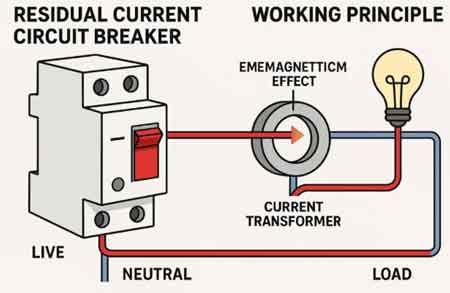
Rather than responding to the current magnitude, a residual current circuit breaker observes a balance. It compares what leaves a circuit with what returns to it. When those values diverge, the device assumes current is escaping the intended path and disconnects the supply. That imbalance may indicate insulation degradation, unintended bonding paths, or developing equipment faults that are otherwise invisible during normal operation.
Confusion usually begins with terminology. RCCB, RCD, and ground-fault protection are often treated as interchangeable terms, even though they serve different design purposes in different system contexts. An RCCB provides leakage detection only. It does not interrupt overloads or short circuits, and it does not replace upstream protection.
Treating it as a complete safety device often masks the need for proper short-circuit control, a gap that becomes evident when reviewing how short circuit protection is actually achieved in coordinated systems.
Because of this limitation, residual current circuit breakers are layered into protection schemes rather than installed alone. They complement devices that manage fault energy, thermal stress, and conductor damage. That division of responsibility becomes clearer when viewed alongside broader circuit protection devices, where each component responds to a specific failure mode rather than providing universal protection.
Think you know Electrical Protection? Take our quick, interactive quiz and test your knowledge in minutes.
A common misconception is that a correctly operating residual current circuit breaker confirms system safety. In reality, a breaker can trip reliably and still leave unresolved risk behind. Leakage current does not describe fault severity, fault location, or stability. In systems with fluctuating loads or electronic equipment, leakage can appear intermittently, leading to trips that are dismissed as nuisance events rather than early warnings of deterioration.
This is particularly relevant where system fault behavior is complex. The presence of leakage does not eliminate the possibility of dangerous fault currents elsewhere in the installation. Understanding how much energy is available when insulation fails requires awareness of prospective fault current, something an residual current circuit breaker neither measures nor limits.
Residual current devices are also frequently confused with ground-fault protection, especially in mixed commercial or industrial environments. While both deal with unintended current paths, their objectives differ. Ground-fault protection often exists to protect equipment and distribution assets, not personnel. That distinction becomes important when RCCBs are installed in systems that already rely on dedicated ground fault protection, where overlapping responses can obscure diagnosis rather than improve safety.
Selection decisions for residual current circuit breakers depend less on ratings and more on system behavior. Sensitivity thresholds, grounding methods, and connected equipment all influence whether leakage detection provides insight or disruption. In motor-driven systems, leakage characteristics can change as insulation ages or drive electronics introduce distortion, intersecting with broader questions of motor overload protection.
Coordination remains one of the most underestimated challenges. Residual current devices do not operate in isolation, even if their detection principle differs. Their interaction with upstream protective elements determines whether a fault is isolated locally or escalates through the system.
What ultimately defines the value of a residual current circuit breaker is interpretation. It does not explain a fault. It reveals that one exists. The judgment lies in deciding whether that signal represents a minor leakage condition, a developing insulation failure, or a systemic protection gap that other devices have not yet exposed.
For readers who need to extend this judgment into system-level decisions, a deeper understanding of protection architecture becomes essential. That transition from device behavior to system intent is where professional expertise matters, particularly when residual current detection interacts with broader fault analysis and protection planning.
Related articles are appropriate at the bottom of this page, but they should point laterally to fault analysis, protection coordination, and system-level decision topics rather than duplicating links already embedded above. This page stands best as a gateway, not a hub.
Residual current circuit breaker operation often raises more questions than it answers. A trip confirms an imbalance, but it does not explain whether the source is insulation breakdown, unintended bonding, system leakage accumulation, or interaction with upstream protection. In real installations, especially those with mixed loads, aging conductors, or complex grounding arrangements, the risk lies in treating leakage detection as a conclusion rather than a signal that demands interpretation.
That interpretive ability does not come from familiarity with the device alone. It develops through understanding how residual current detection fits into broader protection behavior, how it interacts with relays and upstream breakers, and how system conditions shape what a trip actually means. Training such as Basic Protective Relay Training helps clarify how protection elements respond differently to imbalance, overload, and fault energy, while advanced programs like Substation Relay Protection Training build the analytical depth needed to distinguish device response from system-level exposure. For practitioners responsible for ongoing reliability and safety, focused instruction such as Circuit Breaker Maintenance Training reinforces the need to evaluate residual current behavior alongside mechanical condition, coordination intent, and long-term protection strategy.
Download our FREE Electrical Training Catalog and explore a full range of expert-led electrical training courses.

Explore 50+ live, expert-led electrical training courses –