AI Fault Detection in Electrical Distribution Systems Using Waveform Analytics
By Nico Payne, PE - San Diego Gas & Electric Company
By Nico Payne, PE - San Diego Gas & Electric Company
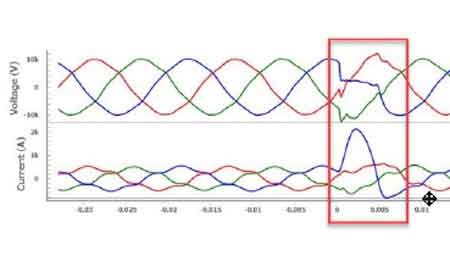
AI fault detection uses waveform analytics and machine learning to identify early electrical failure signatures in distribution systems. Utilities gain predictive insight into incipient faults, asset degradation, and insulation breakdown before protection systems operate.
AI fault detection enables utilities to identify waveform abnormalities that indicate developing electrical faults before protection devices operate.
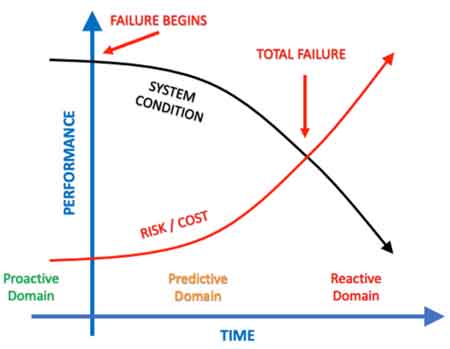
Electrical distribution failures rarely occur without warning. Long before a feeder trips or a cable fails catastrophically, subtle waveform distortions begin to appear in current and voltage signals. These precursor conditions are often identified through advanced incipient fault detection, enabling engineers to detect insulation degradation and electrical instability before sustained fault current develops. Traditional protection logic responds only when thresholds are exceeded. AI-powered fault detection utilities fundamentally change this paradigm by continuously interpreting waveform behavior as an indicator of evolving system health, rather than waiting for protection events to confirm failure.
This shift represents a transition from event-based protection to intelligence-based prediction. Instead of responding to faults after they occur, utilities can now detect the electrical signatures of insulation breakdown, conductor degradation, loose connections, and equipment stress while systems remain energized and operational.
Every energized conductor produces a waveform shaped by system impedance, load dynamics, and equipment condition. As system integrity deteriorates, these waveforms subtly change. Partial discharge activity introduces high-frequency noise. Insulation deterioration creates harmonic distortion. Mechanical looseness produces intermittent asymmetry. Continuous interpretation of these waveform characteristics provides the technical foundation for modern electrical fault detection, enabling utilities to maintain constant awareness of system stability and fault conditions.
Historically, engineers relied on post-event analysis using disturbance recordings or oscillography to understand failures. This approach confirmed faults after protection systems had already operated, leaving little opportunity for preventive action. AI fault detection changes this sequence by continuously analyzing waveform behavior as it evolves. Instead of waiting for fault current magnitude or protection thresholds to be exceeded, ai based fault detection interprets subtle waveform instability as an early indicator of insulation stress, conductor deterioration, or equipment weakening. This allows engineers to investigate emerging risks while infrastructure remains operational.
Download our FREE Electrical Training Catalog and explore a full range of expert-led electrical training courses.

Key waveform characteristics evaluated include:
• Harmonic content variation
• Transient impulse signatures
• Phase angle instability
• Waveform asymmetry between phases
• High-frequency transient activity
These characteristics provide early insight into asset stress that conventional protection systems cannot detect.
This intelligence complements established protective functions such as those described in protective relay testing, but operates at a different level. Protection devices remain essential for clearing faults. AI systems provide advanced warning so utilities can intervene before protective action becomes necessary.
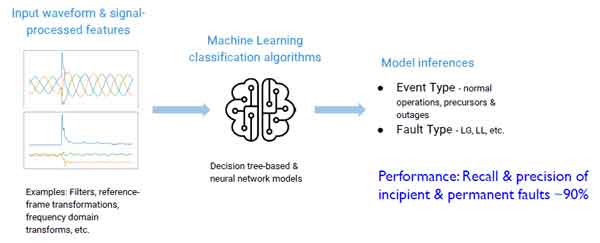
The effectiveness of AI fault detection utilities depends on their ability to recognize waveform patterns associated with specific failure mechanisms. Machine learning models are trained using thousands of waveform samples collected during known fault conditions, including cable insulation failure, transformer winding degradation, and conductor contact faults.
These models learn to distinguish between normal operational variability and abnormal waveform behavior. This distinction is critical because distribution systems experience constant load variation, switching events, and transient disturbances. AI systems must identify meaningful indicators without generating excessive false alarms.
Unlike traditional monitoring approaches that rely on static thresholds, AI models evaluate waveform behavior contextually. They assess relationships between waveform features rather than individual parameter values. This approach enables the detection of subtle precursor conditions that static threshold systems cannot identify. Once abnormal waveform signatures are identified, engineers rely on structured fault analysis in power system processes to determine fault origin, severity, and required engineering response.
This predictive capability strengthens utility engineering decision-making by enabling earlier investigation of abnormal conditions identified through analysis similar to that used in fault current calculation, but extended to predictive pattern recognition rather than fault magnitude estimation.
It is important to distinguish AI fault detection utilities from conventional monitoring systems. Monitoring infrastructure focuses on measurement and data acquisition. Fault detection focuses on interpretation and prediction.
Monitoring systems capture waveform data. AI systems analyze waveform behavior to determine whether the equipment condition is deteriorating.
Utilities have long used learning algorithms for waveform-capture systems to analyze disturbances and verify compliance with performance standards, such as those described in power-quality analysis. However, these systems traditionally require engineers to manually interpret waveform data driven events occur.
Fault detection utilities automate this interpretation. They continuously identify abnormal waveform behavior and generate actionable engineering insights without manual analysis.
This distinction is essential. AI systems do not replace measurement systems. They transform waveform data into predictive intelligence.
Different failure mechanisms produce distinct waveform signatures. AI models trained on waveform libraries can identify these signatures and associate them with specific equipment conditions.
Examples include:
• Cable insulation breakdown, indicated by repetitive transient discharge patterns
• Loose electrical connections, identified through intermittent waveform distortion
• Transformer winding degradation, revealed by harmonic pattern evolution
• Conductor contact faults, indicated by irregular waveform asymmetry
This diagnostic capability enables utilities to prioritize field investigation and maintenance resources more effectively.
When integrated with engineering analysis practices such as transformer condition assessment, waveform-based AI analysis provides a more complete picture of asset health.
Instead of reacting to failure, utilities can address underlying causes before reliability is compromised.
The operational value of waveform intelligence increases significantly when integrated into engineering decision workflows. AI fault detection provides GenAI copilots with continuously interpreted waveform insight, enabling the automatic identification and prioritization of abnormal electrical behavior. Rather than presenting engineers with raw oscillography or transient records, fault detection enables copilots to explain waveform deviations in terms of probable failure mechanisms.
Think you know GenAI Copilots, Knowledge & Workforce? Take our quick, interactive quiz and test your knowledge in minutes.
This capability is central to the evolution of an AI-augmented utility workforce, where engineers rely on continuously interpreted electrical intelligence to guide operational and maintenance decisions.
These copilots function as engineering intelligence systems, augmenting human expertise rather than replacing it. Engineers retain full decision authority while benefiting from continuous waveform interpretation.
This integration aligns with the broader evolution of intelligent protection strategies, complementing engineering practices such as overcurrent protection device coordination, but extending protection awareness into predictive territory.
Fault detection represents a fundamental shift in distribution system reliability management. By continuously interpreting waveform behavior rather than reacting only to protection events, fault detection enables utilities to detect developing electrical faults at their earliest stages. This predictive capability plays a critical role in maintaining long-term power system reliability by allowing utilities to intervene before electrical degradation escalates into equipment failure or service interruption.
This predictive capability reduces unplanned outages, improves maintenance prioritization, and strengthens system reliability.
More importantly, waveform-based AI transforms electrical infrastructure from a passive system requiring reactive protection into an intelligent system capable of signaling its own degradation.
As utilities modernize grid operations, waveform intelligence will become an essential engineering function. AI fault-detection utilities provide the analytical foundation that enables engineers to anticipate failures, proactively protect infrastructure, and maintain distribution reliability in increasingly complex electrical networks.
Advantages To Instructor-Led Training – Instructor-Led Course, Customized Training, Multiple Locations, Economical, CEU Credits, Course Discounts.
Request For QuotationWhether you would prefer Live Online or In-Person instruction, our electrical training courses can be tailored to meet your company's specific requirements and delivered to your employees in one location or at various locations.