Digital Twin Power System for Real-time Grid Ops
By Kyle Comstock, Senior Vice President, Grid Modernization, Itron
By Kyle Comstock, Senior Vice President, Grid Modernization, Itron

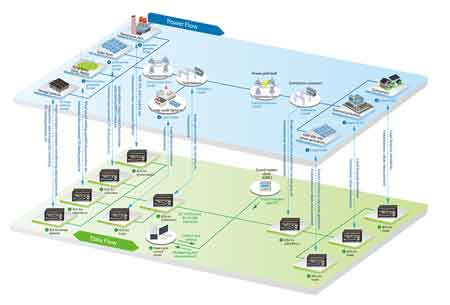
A digital twin power system is a real-time virtual model of the electrical grid that synchronizes SCADA data, topology, and system conditions to enable continuous simulation, predictive analysis, and operational decision support for transmission and distribution networks.
A digital twin power system is a synchronized virtual representation of the physical grid, continuously updated with real-time data. It is used for simulation, monitoring, and decision support, forming a closed operational loop between system conditions and operator actions.
This solves a core operational problem in modern power systems. Utilities cannot fully trust system visibility due to telemetry gaps, delayed updates, and model drift. As a result, decisions are often made using incomplete or outdated system states, increasing operational risk.
A digital twin eliminates this gap by maintaining a continuously aligned model of the as-operated grid. It ensures that topology, device states, and electrical conditions reflect reality at all times, allowing operators to act based on current system behavior rather than assumptions.
A digital twin power system operates as a continuous loop: physical grid conditions are captured through sensors and SCADA, ingested into a data layer, synchronized with a network model, processed through simulation, and fed back into operator decisions.
The defining requirement is synchronization. The model must reflect breaker positions, switching states, feeder configurations, and load conditions in near real time. If this alignment breaks, the system reverts to a static model and loses operational value.
This architecture extends the role of grid modeling by enforcing continuous alignment rather than periodic updates. The model becomes an always-current representation of the grid, not a planning artifact.
Stay informed with our FREE Digital Twins, Simulation & Planning Newsletter — get the latest news, breakthrough technologies, and expert insights, delivered straight to your inbox.
The system also depends on disciplined data ingestion and validation. High-frequency telemetry must be filtered, validated, and reconciled before updating the model. Without this, simulation outputs become unreliable, leading to incorrect operational decisions.
A digital twin power system must be clearly distinguished from adjacent tools.
A distribution system modeling environment defines network topology and electrical characteristics, but does not maintain real-time synchronization with field conditions.
A power system simulation platform evaluates scenarios such as contingencies or load forecasts, but operates on assumed or staged conditions rather than the live system state.
A digital twin combines both capabilities and adds continuous synchronization. It is not a snapshot or scenario engine. It is a live operational system that reflects current grid conditions and supports ongoing decisions.
A grid simulation tool can analyze system behavior, but without real-time alignment, it cannot support control room operations.
The core mechanism of a digital twin power system is a continuous cause and effect loop.
Real-time data updates the model. The model reflects current topology and conditions. Simulation runs continuously to evaluate system behavior. Predictions identify risks or constraints. Operators take action based on those predictions.
This loop transforms how decisions are made.
For example, a feeder approaches thermal limits due to rising load. The digital twin updates conductor loading in real time and simulates switching options. It identifies a reconfiguration that redistributes load and avoids overload. The operator executes switching with confidence because the action has already been validated against the current system state.
Without a synchronized digital twin, operators are effectively making decisions on delayed or incomplete system information.
A digital twin power system improves visibility by aligning the model with actual system conditions. Operators gain a near-complete view of system state, including topology, voltage, loading, and device status.
This enables predictive operation. Voltage instability, overload conditions, and abnormal system behavior can be detected before they escalate into faults.
In planning contexts such as a grid interconnection study, the digital twin provides a more accurate baseline by reflecting actual operating conditions rather than static assumptions.
Similarly, a hosting capacity analysis becomes more reliable when based on live system behavior rather than simplified models.
The effectiveness of a digital twin power system depends on model integrity. The model must not only be synchronized but also validated continuously against real system behavior.
An as-operated network model is required in which the topology, device states, and asset behavior match field conditions. This requires disciplined processes for data governance, model maintenance, and validation.
Continuous testing is essential. The model must be validated against real-world scenarios, including switching events, load changes, and fault conditions. Without rigorous validation, the digital twin introduces risk rather than reducing it.
Data governance is equally critical. Inconsistent or incomplete data leads to incorrect model updates, which can propagate errors into operational decisions.
A digital twin power system reduces decision latency and improves operational accuracy.
Model updates that previously took hours can occur in seconds, allowing operators to respond faster to changing system conditions. This reduces the time between event detection and corrective action.
Outage prevention is a key outcome. By identifying overloads or instability before protective devices operate, operators can take corrective action and avoid service interruptions.
Think you know Digital Twins, Simulation & Planning? Take our quick, interactive quiz and test your knowledge in minutes.
The result is a shift from reactive operation to predictive control, where system behavior is anticipated and managed rather than observed after failure.
Explore 50+ live, expert-led electrical training courses –