District Energy System Architecture And Energy Optimization
By Luca Ferrari, Program Manager, Optit Corp
By Luca Ferrari, Program Manager, Optit Corp
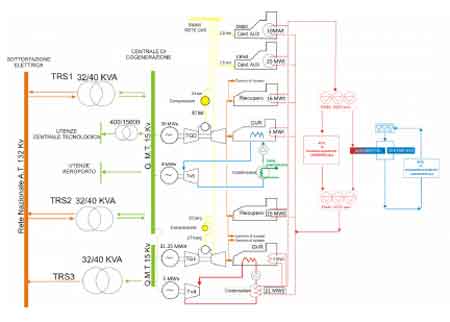

A district energy system is a centralized multi-energy network supplying heating and cooling to multiple buildings, improving efficiency, load balancing, and system optimization while integrating thermal production with electricity generation and market-driven dispatch decisions.
A district energy system is a centralized, multi-energy infrastructure that produces thermal energy at a central plant and distributes heating or cooling through a network to multiple buildings, while coordinating electricity generation, demand variability, and market interactions. It enables system-level optimization rather than isolated building operation, directly affecting efficiency, fuel use, and operating margin.
Unlike decentralized systems, where each building operates independently, a district energy system links production, distribution, and consumption into a single controlled environment. Thermal demand anchors system operation, while electrical output and market signals influence how assets are dispatched.
This creates a tightly coupled system where centralized generation, load diversity, and optimization decisions determine both technical performance and economic outcomes.
A district energy system consists of a central plant, a thermal distribution network, and multiple connected buildings. The plant typically includes combined cycle units, boilers, electric chillers, absorption chillers, and thermal energy storage.
In advanced systems, the central plant produces both thermal and electrical energy, forming a tri generation configuration. Thermal energy is delivered to buildings through controlled flow and temperature, while electricity is consumed locally or exported.
This architecture transforms the system into an integrated energy platform. Centralized generation increases efficiency because equipment operates under more stable, higher-load conditions. At the same time, the system introduces dependency across all connected buildings.

A failure in a major generating unit does not affect a single building. It affects the entire network.
Energy flow is driven by aggregated demand across buildings with different operating patterns. Offices, terminals, and industrial loads do not peak simultaneously.
Load diversity reduces peak demand and smooths system operation. A smoother demand profile reduces ramping requirements for generation assets, improving efficiency and lowering fuel consumption.
This creates a direct chain of impact. Load diversity reduces variability, stabilizes generation, improves equipment efficiency, and reduces operating cost.
Thermal storage strengthens this behavior. Stored energy can be used during peak demand, reducing the need for additional generation and allowing operators to shift load across time.
The result is higher system utilization and reduced infrastructure oversizing.
District energy systems often operate as combined heat and power or tri generation systems. This introduces a second control dimension beyond thermal demand.
Electricity production can be increased when market prices are favorable, provided thermal demand constraints are satisfied. This creates a dynamic relationship between thermal obligations and electrical revenue.
When electricity prices rise, the system may increase combined cycle utilization. Increased utilization raises electricity output, which can improve revenue but also increases fuel consumption.
This creates a trade-off among fuel costs, thermal demand, and market opportunity.
These interactions require coordination similar to Grid Interconnection Study, where export capability and grid constraints must be respected.
Modern district energy systems rely on a connected decision engine that integrates forecasting, physical modeling, and optimization.
Forecasting predicts thermal demand, electricity prices, and environmental conditions. Physical models and machine learning represent actual plant behavior, including deviations from ideal performance.
Optimization models then determine the best dispatch strategy across all assets. This includes when to run combined cycle units, when to activate boilers, and how to use thermal storage.
This process is not a single calculation. It is a continuous system that evaluates thousands of operating conditions across time.
These capabilities are developed using methods similar to Power System Simulation, in which system performance is evaluated over extended time horizons.
Digital representation of the system allows operators to compare expected performance with actual operation through tools such as Digital Twin Power System.
The effectiveness of a district energy system depends on how quickly optimized decisions can be executed.
Operational control follows a structured cycle. Data is collected from SCADA systems, cleaned, and used to update system models. Forecasts are generated for demand, weather, and energy prices.
Day-ahead optimization produces a dispatch plan for the upcoming period. During operation, intra-day re-optimization adjusts the plan as conditions change.
This creates a continuous loop of measurement, prediction, and control.
The key challenge is not only computing the optimal solution. It is ensuring that operators understand and trust the result quickly enough to act on it.
As system complexity increases, the bottleneck shifts from computation to interpretation. Operators must evaluate model outputs, validate assumptions, and commit to decisions under time pressure.
This introduces a human system constraint that directly affects performance.
The centralized nature of a district energy system poses a risk of cascading failure.
If a primary generation asset, such as a combined cycle unit or main boiler, fails, thermal supply capacity is immediately reduced. If backup capacity is insufficient, multiple buildings experience simultaneous service loss.
Think you know Digital Twins, Simulation & Planning? Take our quick, interactive quiz and test your knowledge in minutes.
This can lead to temperature-control failures, operational disruptions, and increased reliance on emergency systems.
The impact is amplified because the system is interconnected. A single failure propagates across all dependent loads.
This requires redundancy planning and contingency operation strategies to maintain reliability.
District energy systems operate under multiple constraints, including equipment capacity, environmental regulations, fuel availability, and network limitations.
One key tradeoff is between efficiency and flexibility. Running high efficiency units continuously improves fuel use but reduces the ability to respond to rapid demand changes.
Another tradeoff involves thermal storage. Increasing storage improves peak management and flexibility but adds capital cost and system complexity.
Planning must also consider system expansion. Adding new buildings increases demand, which may require upgrades to both generation capacity and distribution infrastructure.
These decisions are evaluated using approaches similar to Distribution System Modeling, where system limits and expansion scenarios are analyzed.
Optimized district energy systems can deliver measurable improvements in both technical and economic performance.
In one system, optimization increased thermal production by approximately 8 percent and electricity production by over 30 percent through better use of combined cycle generation and improved dispatch decisions.
At the same time, operating margin improved by more than 20 percent due to better alignment between generation, demand, and market conditions.
These results demonstrate that system level optimization directly influences both efficiency and profitability.
A district energy system concentrates efficiency gains and operational risk into a single integrated system.
Centralized control improves performance, but it also increases dependency on accurate modeling, forecasting, and decision execution.
If optimization logic, forecasting accuracy, or operator interpretation fails, the impact is not localized. It affects all connected buildings simultaneously.
This creates a critical engineering requirement. The system must be continuously monitored, modeled, and adjusted to maintain both reliability and performance.
Accurate representation of system behavior is essential and often requires detailed analysis, such as Grid Modeling, to ensure predictable operation under changing conditions.
Explore 50+ live, expert-led electrical training courses –