Grid Interconnection Study Feasibility and Cost Risk
By Feng Chen, President, Power System Engineering, E Source
By Feng Chen, President, Power System Engineering, E Source
A grid interconnection study determines system impact, upgrade requirements, cost allocation, and feasibility for new generation or load, while addressing voltage limits, thermal constraints, stability risks, and timing uncertainties in power system decisions.
A grid interconnection study evaluates whether a new generator, load, or energy resource can connect to the power system without violating voltage limits, thermal ratings, protection coordination, or system stability.
It determines which upgrades are required, how much they will cost, and whether the project is viable under real-world system conditions.
This is a binding engineering decision process. Results drive capital commitments, regulatory approval, and long-term operational risk. Once upgrade obligations are assigned, they cannot be reversed even if costs increase later in the process.
A grid interconnection study converts a proposed project into measurable system impact and then into required infrastructure, cost allocation, and timeline.
The process begins with a defined asset such as a wind plant, solar facility, battery system, data center, or large industrial load. That asset changes how power flows through the network and how voltage and fault conditions behave.
The engineering relationship is direct.
A new generator increases current on transmission paths. If those paths exceed thermal limits, congestion occurs and system upgrades are required.
A new load increases demand at a node. This can cause voltage drop and reactive power deficiency, requiring reinforcement through capacitors, transformers, or network expansion.
The outcome is not theoretical. The study determines whether the system can support the project or whether infrastructure must be built to enable it.

A grid interconnection study evaluates how a new project affects the electric grid by analyzing its interaction with the transmission system under real operating conditions.
As electricity generators or large loads are introduced, the study process determines whether system limits are exceeded and what infrastructure is required to maintain reliability.
This includes reviewing interconnection requests in the context of existing system capacity, ensuring that new connections do not create instability, congestion, or protection issues.
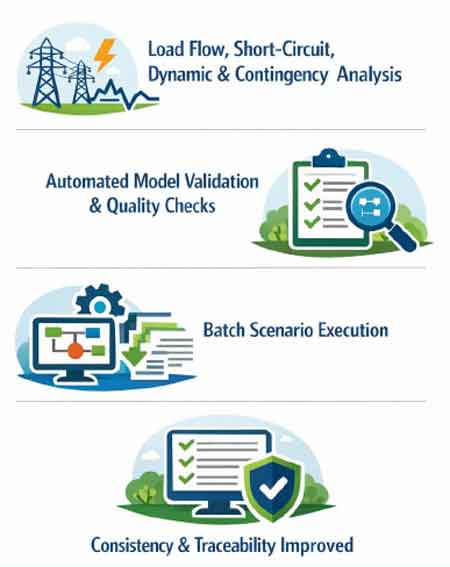
A grid interconnection study is built on four required analytical layers.
Power flow analysis evaluates steady state system conditions and identifies overloads and voltage violations.
Contingency analysis tests system performance under equipment outages to ensure reliability standards are maintained.
Fault analysis calculates short circuit levels and verifies equipment ratings and protection coordination.
Stability analysis evaluates dynamic response to disturbances, confirming the system can maintain synchronism and recover from faults.
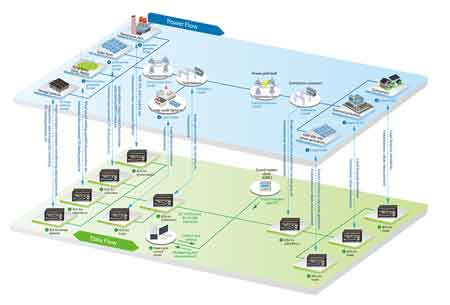
These analyses depend on an accurate system representation developed through grid modeling, where network topology, equipment ratings, and operating conditions define the study baseline.
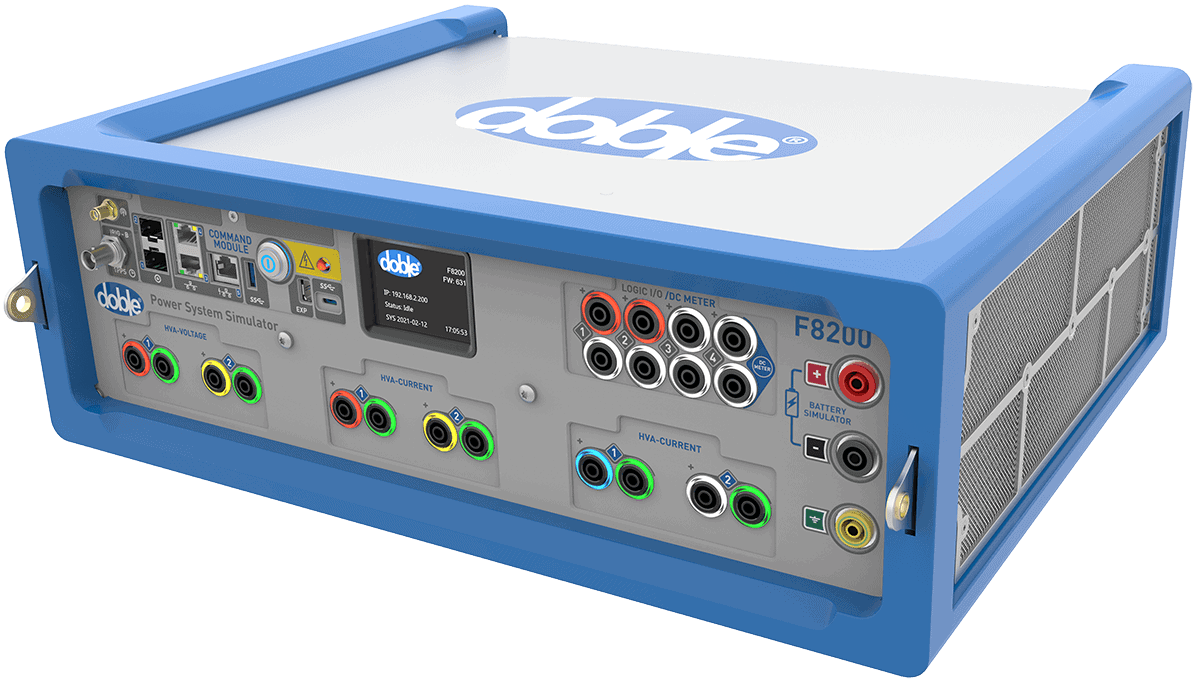
Execution of these scenarios relies on power system simulation tools that evaluate multiple operating conditions and contingencies.
The defining characteristic of a grid interconnection study is cost exposure tied to system upgrades.
Required upgrades are assigned across projects within an interconnection queue. These costs are not fixed. They depend on how many projects share the same system constraints.
Small changes in project participation can produce large shifts in cost.
When multiple projects share an upgrade, the cost is distributed among them. If projects withdraw, the upgrade may still be required, but the cost is reassigned to fewer participants.
This creates a cascading effect.
Cluster dropout leads to upgrade redistribution. Upgrade redistribution leads to cost concentration. Cost concentration forces high-risk decisions under time pressure.
A project that appears economically viable early in the study can become uneconomic later without any change to its design or output.
In real cases, cost exposure has increased from tens of millions to hundreds of millions within a single study cycle due to cluster changes and upgrade reallocation.
A grid interconnection study is highly sensitive to assumptions.
Load forecasts, generation dispatch patterns, outage scenarios, and system topology all influence results. Small changes in these inputs can change which constraints are identified and what upgrades are required.
This creates model dependency.
If assumptions are incorrect, upgrade requirements may be incorrect. This can lead to unnecessary infrastructure investment or unresolved system violations after construction.
Advanced environments such as digital twin power system improve model validation by aligning study conditions with actual system behavior.
However, uncertainty cannot be eliminated. It must be managed through scenario testing and engineering judgment.
Interconnection studies operate under strict timelines with limited opportunity to validate results.
Developers often face compressed decision windows with limited time to review assumptions, challenge results, or request alternative scenarios.
At the same time, restudies are common.
When projects enter or exit the interconnection queue, the system must be re-evaluated. This can change upgrade requirements, cost allocation, and project feasibility.
The risk is not only technical. It is driven by timing.
A developer may be required to commit to a project before the system conditions that determine its final cost are stable.
Download our FREE Electrical Training Catalog and explore a full range of expert-led electrical training courses.

Because of these dynamics, interconnection studies require iterative scenario evaluation.
Different assumptions about project participation, dispatch conditions, and system configuration must be tested to understand potential outcomes.
Tools such as grid simulation enable rapid execution of multiple study cases, allowing engineers to assess both expected and worst-case scenarios.
At the distribution level, distribution system modeling may be required to evaluate localized impacts for large loads or distributed energy resources.
This multi-layer evaluation ensures that both transmission and distribution constraints are captured in the final decision.
A grid interconnection study is not a screening tool. It is a hosting capacity analysis that estimates approximate system limits under simplified assumptions.
A study determines the exact system impact, required upgrades, and binding cost allocation under full operating conditions.
This distinction is critical.
Screening tools guide early development decisions. The interconnection study determines whether the project proceeds.
A study combines engineering analysis with financial exposure under time constraints.
In real-world scenarios, cost exposure has shifted from approximately 40 million dollars to 500 million dollars within a single study cycle due to changes in cluster participation and upgrade allocation.
Developers had limited time to validate assumptions and were forced into a binary decision.
Proceed and accept uncertain and potentially escalating costs, or withdraw under pressure and lose project position.
This is the defining outcome of the interconnection process.
A study does not simply evaluate a project. It determines whether that project should proceed under real system risk.
Large-scale systems such as district energy system integration can introduce similar complexity when interfacing with the grid, requiring coordinated evaluation across multiple system layers.
The interconnection study is where all technical, financial, and timing factors converge into a single binding decision.
Explore 50+ live, expert-led electrical training courses –