Grid Simulation for Electrical Grid Behavior
By Colin Vignon, Smart Grid Analyst, EDF Innovation Lab
By Colin Vignon, Smart Grid Analyst, EDF Innovation Lab
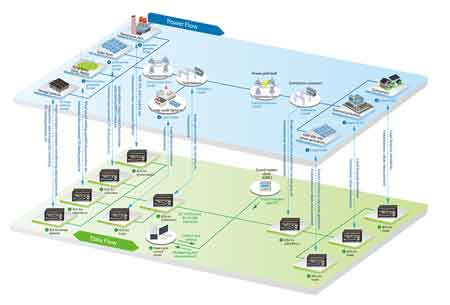
Grid simulation uses mathematical models to reproduce power system behavior under changing conditions. It calculates voltage, current, power flow, faults, stability, and DER scenarios to support planning decisions, reliability analysis, and safe grid operation.
Grid simulation is the process of using a mathematical and computational model of an electrical grid to reproduce system behavior under different operating conditions and scenarios. It calculates how voltage, current, real and reactive power flow, and system stability respond to changes in load, generation, faults, and network configuration, and failure to simulate these behaviors accurately can lead to protection errors, voltage instability, and system outages.
Engineers rely on grid simulation because real-world testing of abnormal conditions, such as faults, switching events, or high DER penetration, is not feasible without risk. Simulation provides a controlled environment to evaluate system response before changes are applied to a live network.
As electrical systems evolve with increasing load demand, electrification, and distributed generation, grid simulation becomes essential for predicting system behavior across short-term operations and long-term planning horizons.
Grid simulation follows a structured workflow that converts system data into measurable outputs. A network model represents buses, lines, transformers, loads, and generation sources.
Inputs define system conditions such as load demand, generation dispatch, switching states, and fault locations. The simulation engine applies electrical relationships between voltage V, current I, real power P, reactive power Q, and system impedance. Power flow behavior depends on voltage magnitude and impedance across the network, and small changes in reactive power can significantly affect voltage stability.
Stay informed with our FREE Digital Twins, Simulation & Planning Newsletter — get the latest news, breakthrough technologies, and expert insights, delivered straight to your inbox.
Scenarios are constructed to reflect operating conditions such as peak demand, contingency events, or high DER penetration. The simulation produces outputs including voltage profiles, thermal loading, fault currents, and stability margins that determine whether the system can operate within limits.
The reliability of these results depends on accurate distribution system modeling, since incorrect system representation directly leads to incorrect simulation outcomes.
Grid simulation includes several types of analysis, each focused on a different aspect of system behavior. Steady-state simulation evaluates load flow to determine how power is distributed and whether voltage remains within acceptable limits.
Dynamic simulation analyzes how the system responds over time following disturbances such as generator trips or large load changes. These studies are required to assess system stability and recovery.
Transient simulation focuses on fast events such as switching operations and fault clearing. It is used to evaluate equipment stress and protection performance under extreme electrical conditions.
Time-series simulation evaluates system behavior over extended periods, incorporating load variation, renewable generation patterns, and operational scenarios. This approach is essential for aligning with broader power system simulation studies and long-term system planning.
Grid simulation must be clearly distinguished from related concepts. Grid simulation analyzes how the system behaves under defined conditions.
Grid modeling defines the structure and parameters of the electrical network. A grid modeling framework provides the topology and electrical characteristics used by simulation but does not produce behavioral results.
A digital twin extends simulation into real-time operation by synchronizing models with live system data. A digital twin power system reflects current conditions, while grid simulation evaluates future or hypothetical scenarios.
This distinction ensures that simulation remains focused on scenario analysis rather than system definition or real-time monitoring.
Grid simulation is applied across planning, operations, and system validation. Engineers use it to perform fault analysis, determine fault currents, and verify that protection systems will operate correctly.
Load flow studies rely on simulation to evaluate voltage regulation, feeder loading, and system losses. These results support equipment sizing, network design, and system expansion decisions.
Stability analysis is increasingly critical as distributed energy resources reduce system inertia. Lower inertia means the system responds more rapidly to disturbances, increasing the risk of instability. Simulation is required to evaluate whether the system can maintain synchronism under these conditions and avoid cascading failures.
Modern grid environments operate with extremely large data volumes, with advanced metering and monitoring systems generating millions of data points that must be reflected in simulation scenarios. This allows engineers to model realistic operating conditions and capture variability in load, generation, and system behavior.
Simulation also supports system integration and capacity evaluation. Results from a grid interconnection study and hosting capacity analysis depend on accurate simulation of system limits and response.
Grid simulation prevents failures by identifying system limits before they are exceeded. Without it, engineering decisions would rely on incomplete assumptions, increasing the likelihood of system stress and outages.
An incorrect load-flow result can underestimate the voltage drop, leading to undervoltage conditions and equipment malfunction. An under- or over-calculated fault current can cause protection devices to trip incorrectly or fail to isolate faults.
In systems with high DER penetration, failure to simulate reverse power flow and voltage rise can lead to equipment stress, protection miscoordination, and instability. These issues are often only identified after deployment if the simulation is not performed correctly.

Grid simulation enables evaluation of these risks in advance, ensuring that system behavior is understood before changes are implemented.
Grid simulation follows a direct cause and effect chain that determines engineering outcomes. A defined scenario is applied to the model, producing a system response that is analyzed to support engineering decisions.
If system impedance or load characteristics are incorrectly modeled, fault current calculations may be inaccurate. This can result in protection relay misoperation, where faults are not cleared properly and propagate through the system.
This propagation increases thermal stress on equipment, expands outage areas, and reduces system reliability. Similarly, inaccurate DER modeling can lead to voltage instability, in which voltage rises beyond acceptable limits and damages equipment.
These cascading effects demonstrate that simulation accuracy directly influences system safety and performance.
Grid simulation is limited by the accuracy of its models and assumptions. Real systems include variability from weather, equipment aging, and customer behavior that cannot be fully captured.
Modern grids also face increasing complexity due to electrification and distributed resources. Simulation must balance accuracy with computational efficiency, often requiring simplifications that limit precision in certain scenarios.
Despite these limitations, grid simulation remains essential for evaluating system performance before implementation. It supports coordinated planning across interconnected infrastructure, including integration with systems such as a district energy system, where electrical and thermal networks interact under varying operating conditions.
Advantages To Instructor-Led Training – Instructor-Led Course, Customized Training, Multiple Locations, Economical, CEU Credits, Course Discounts.
Request For QuotationWhether you would prefer Live Online or In-Person instruction, our electrical training courses can be tailored to meet your company's specific requirements and delivered to your employees in one location or at various locations.