High Voltage Maintenance Training Online
Our customized live online or in‑person group training can be delivered to your staff at your location.
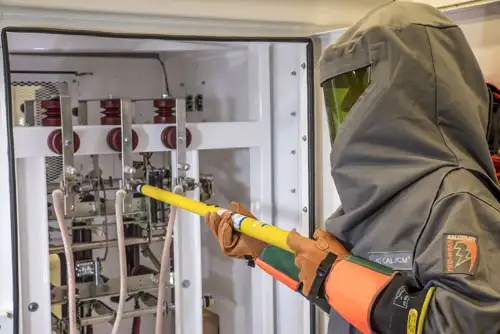
- Live Online
- 12 hours Instructor-led
- Group Training Available
Regular Price:
$599
Coupon Price:
$499
European offshore wind power posts a 54% surge, as EWEA reports new turbines, windfarms, and 1,000 MW capacity gains. UK and Germany lead, backed by EU policy, the European Investment Bank, and Round 3 build-out.
The Main Points
A European sector adding MW-scale capacity via offshore windfarms, driven by EU policy and EIB finance.
- EWEA reports a 54% rise in new offshore generation since 2008.
- 199 turbines installed across eight new European windfarms in 2009.
- 1,000 MW forecast from 10 new offshore projects in the year ahead.
- UK and Germany lead builds; EU policy and EIB financing spur investment.
- 25 GW UK Round 3 and 16,000 MW consented signal strong future growth.
Almost 200 offshore wind turbines with a combined power-generating capacity of 577-megawatts (MW) were connected to the grid in Europe in 2009.
The latest figures from the European Wind Energy Association (EWEA) show a 54% increase in new wind generation from 2008, when 373 MW was installed and connected. Last year saw 199 turbines installed at eight new windfarms. For the year ahead, the association predicts that 10 additional European offshore windfarms will be completed, adding 1,000 MW in power generation capacity and bringing a 75% increase from 2009.
"This is an incredibly good result, considering the continued difficulties of obtaining project finance for large projects," said Christian Kjaer, EWEA chief executive. "Independent project developers, in particular, are still struggling. For the offshore wind power industry to continue its development, it is vital that governments and the European Commission provide policy frameworks that stimulate investor interest and allow project developers to move their plans forward."
In 2009, five countries built new offshore windfarms as the offshore wind industry slowly improved in Europe: the United Kingdom (284 MW), Denmark (230 MW), Sweden (30 MW), Germany (30 MW) and Norway (2.3 MW).
Today, 17 offshore windfarms, with a combined generation capacity of more than 3,500 MW, are under construction in Europe. Slightly less than half of these are being built in UK waters. The UK also looks set to dominate the next wave of offshore windfarm construction, following the recent announcement of winning bidders for the country's Round 3 phase of windfarm development. Round 3 will see a massive 25 gigawatts (GW) of offshore wind power added in the coming decade, aligned with its 2020 renewables target to expand clean energy.
According to the EWEA, 52 offshore windfarms have won full consent in European waters, totalling more than 16,000 MW, with just over half of this capacity planned in Germany. Germany has a fledgling offshore wind power market, but the government is determined to make wind a key part of its renewable energy ambitions. The country's first offshore windfarm, the 60-MW Alpha Ventus project, began construction last July and is owned by a consortium of companies that includes E.ON AG; Vattenfall Europe, part of Swedish utility Vattenfall AB; and EWE AG, a German energy and gas provider.
In 2009, the turnover of the offshore wind industry was approximately 1.5 billion euros, and EWEA predicts this will double to 3 billion euros this year. Strong support from the European Union and the European Investment Bank has played a key role in the offshore rush.
Kjaer said, "The push given by the decision to inject 255 million euros under the European Union's European Economic Recovery Plan into the offshore wind sector showed that decision-makers understand that offshore wind is key to Europe's future energy supplies. The European Investment Bank's increased involvement will also be instrumental for the future success of offshore wind's contribution to European recovery, job creation and technology leadership."
Related News
Britain breaks record for coal-free power generation - but what does this mean for your energy bills?
UK Coal-Free Electricity Record highlights rapid growth in renewables as National Grid phases out coal;…
View more
Investigation underway to determine cause of Atlanta Airport blackout
Atlanta Airport Power Outage disrupts Hartsfield-Jackson as an underground fire cripples switchgear redundancy, canceling flights…
View more
Chinese-built electricity poles plant inaugurated in South Sudan
Juba Power Distribution Expansion accelerates grid rehabilitation in South Sudan, adding concrete poles, medium and…
View more
IAEA Reviews Belarus’ Nuclear Power Infrastructure Development
Belarus Nuclear Power Infrastructure Review evaluates IAEA INIR Phase 3 readiness at Ostrovets NPP, VVER-1200…
View more
Energy freedom and solar’s strategy for the South
South Carolina Energy Freedom Act lifts net metering caps, reforms PURPA, and overhauls utility planning…
View more
First Nuclear Reactors Built in 30 Years Take Shape at Georgia Power Plant
Vogtle Units 3 and 4 are Westinghouse AP1000 nuclear reactors under construction in Waynesboro, Georgia,…
View more
Sign Up for Electricity Forum’s Newsletter
Stay informed with our FREE Newsletter — get the latest news, breakthrough technologies, and expert insights, delivered straight to your inbox.
Electricity Today T&D Magazine Subscribe for FREE

Stay informed with the latest T&D policies and technologies.
- Timely insights from industry experts
- Practical solutions T&D engineers
- Free access to every issue
