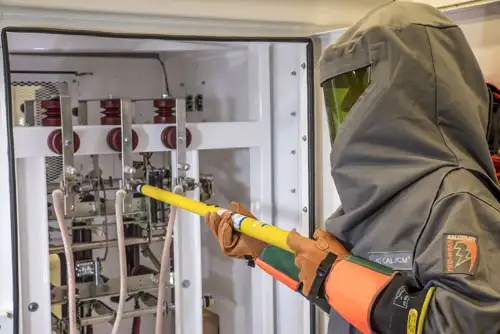
High Voltage Maintenance Training Online
Our customized live online or in‑person group training can be delivered to your staff at your location.
- Live Online
- 12 hours Instructor-led
- Group Training Available
Regular Price:
$599
Coupon Price:
$499
At an intimate House of Commons reception on a balmy evening, the Minister for Energy, Malcolm Wicks, addressed some of the UK's biggest players in the nuclear world.
He was speaking passionately about the need to press on with the construction of a new generation of nuclear reactors. “Let's take them on,” he exhorted his guests, referring to environmental campaigners like Greenpeace who were trying to block the plans. The audience, which included former energy minister Brian Wilson and the chief executive of British Energy, Bill Coley, nodded approvingly.
But while politicians and campaigners slug it out over new reactors that won't be built for at least 10 years, the issue of how to clean up Britain's old plants now is far more pressing for the industry - and the taxpayer. Astonishingly, almost half the entire budget - over £1.5bn this year - of Wicks' Department for Business, Enterprise and Regulatory Reform (Berr) is spent on decommissioning the UK's old reactors and nuclear facilities.
Nuclear consultant Ian Jackson estimates, in his new book Nukenomics: The Commercialisation of Britain's Nuclear Industry, that the total being spent on decommissioning is equivalent to an extra 1p in the pound on income tax.
The government set up the Nuclear Decommissioning Authority (NDA) to oversee and fund this massive 100-year clean-up program covering the UK's 20 state-owned nuclear sites. Its latest estimate for the total bill is £73bn, but this figure is expected to rise.
In early July, the NDA will announce the winner of the biggest contract - to begin cleaning up Sellafield - which could eventually be worth up to £20bn. But the NDA has had to suspend its plans to issue contracts for the rest of its sites after an initial lack of interest in cleaning up some of its old Magnox reactors. Because of higher costs, it has also cut back decommissioning work on these reactors in order to concentrate resources at Sellafield.
Unions estimate that 1,000 workers have lost their jobs as a result. But some of those who still have jobs have little to do. Mike Graham, national secretary of the Prospect union, says: “There are a number of people who are going into work twiddling their thumbs because there is no money available for decommissioning work to be carried out, and no money to pay people off.”
Earlier this year, a committee of MPs also warned that the way the NDA was funded was 'unsustainable'. There is growing concern that unless the clean-up program gets back on track - and the NDA gets enough money to fund it - then it will be harder to convince the public to accept new reactors and the waste they will produce. Peter Luff MP, chairman of the Parliamentary select committee on Berr, says: “If people do not have confidence that existing waste is being dealt with properly then it will shake public confidence in new-build.”
The scale of the NDA's task is daunting. It has inherited the UK's most decrepit stations: the 11 Magnox plants, only two of which are still operating, and every one of which is slightly different from the others. Sellafield, for which NDA is also responsible, is full of swimming-pool-sized 'ponds' where encased waste has lain for decades.
Just over half the NDA's £2.8bn budget this year comes from the government. The rest is supposed to come from income earned by its two operating Magnox plants - soon to close - and its Thorp reprocessing plant. But Thorp has spent most of the past three years closed after a huge radioactive leak. In February the NDA had to go cap in hand to the government for a £400m funding top-up, partly because its commercial income was not as high as expected.
Companies involved in the decommissioning market - which include Amec and Serco from Britain and Bechtel, Fluor and Washington Group from the US - also complain about the uncertainty over whether the NDA will have enough money to fund its program. The authority only knows how much it will get from the government two or three years in advance. In its recent business plan for the next three years, the NDA only spells out how it will spend its money in the first year.
Joe McHugh, head of radioactive waste at the Environment Agency, says: “These programs are much longer-term than this two- or three-year time frame. They are relying on innovation and competition to get costs down. But companies won't come into the market without more certainty that the funding will be there in the long term.”
There is also concern that the total clean-up bill for the taxpayer will rise as the delays lengthen. McHugh adds: “The ‘hotel costs’ to maintain mothballed reactors, like Magnox, where decommissioning has not yet started, are substantial. The experience in the US is that it's better to spend more money up front.”
The NDA insists that the temporary suspension of some clean-up work won't delay completion of the program. But it acknowledges that changes need to be made in how it is funded. The organization says: “Given the knowledge and experience gained from the first three years of NDA's operation, and the desire to build stakeholder and supply chain confidence, the NDA and government believe it is timely to review the NDA funding model to ensure that it is facilitating the NDA's efficient operations.”
The NDA's difficult job has not been helped, it has been said, by the high level of turnover in its senior management - a claim that the authority disputes. It took more than six months to find a new chairman last year, while five of its 18 directors have left this year. The Observer also revealed that its chief executive, Ian Roxburgh, will step down at the end of the year.
Some executives have also queried whether a new and relatively small public-sector body can hold its own against wily private-sector companies.
The National Audit Office has expressed concern that taxpayers will foot the bill for any cost overruns in the clean-up work because companies can apply to the NDA for reimbursement. But unions and companies are cautiously optimistic about how the Sellafield competition is being run. McHugh of the Environment Agency, which earlier this year warned that the NDA risked losing stakeholders' confidence, adds: “The NDA, on the whole, is doing a good job in difficult circumstances. It is addressing problems which are long overdue.”
The government seems obsessed with finding a private-sector solution to every problem. But the state created the billions of pounds of these decommissioning liabilities. As the NDA's commercial income falls, the government will have to increase its financial involvement if any meaningful inroads are to be made into the £73bn program.
As Professor Ian Fells, professor of energy conversion at Newcastle University, says: “Ultimately, the government will have to provide more funding for the NDA and pay for the decommissioning work itself.”
Related News

New Jersey, New York suspending utility shut-offs amid coronavirus pandemic
NY & NJ Utility Shutoff Moratorium suspends power, heat, and water disconnections amid COVID-19, as…
View more

Trudeau vows to regulate oil and gas emissions, electric car sales
Canada Oil and Gas Emissions Cap sets five-year targets to cut sector emissions toward net-zero…
View more
Overturning statewide vote, Maine court energizes Hydro-Quebec's bid to export power
Maine Hydropower Transmission Line revived by high court after referendum challenge, advancing NECEC, Hydro-Quebec supply,…
View more

Hurricane Michael by the numbers: 32 dead, 1.6 million homes, businesses without power
Hurricane Michael Statistics track catastrophic wind speed, storm surge, rainfall totals, power outages, evacuations, and…
View more

Joni Ernst calls Trump's wind turbine cancer claim 'ridiculous'
Wind Turbine Cancer Claim debunked: Iowa Republican senators back wind energy as fact-checks and DOE…
View more
Here are 3 ways to find out where your electricity comes from
US energy mix shows how the electric grid blends renewables, fossil fuels, nuclear, and hydro,…
View more
Sign Up for Electricity Forum’s Newsletter
Stay informed with our FREE Newsletter — get the latest news, breakthrough technologies, and expert insights, delivered straight to your inbox.
Electricity Today T&D Magazine Subscribe for FREE

Stay informed with the latest T&D policies and technologies.
- Timely insights from industry experts
- Practical solutions T&D engineers
- Free access to every issue
