NFPA 70E Training
Our customized live online or in‑person group training can be delivered to your staff at your location.

- Live Online
- 6 hours Instructor-led
- Group Training Available
Regular Price:
$199
Coupon Price:
$149
Iqaluit Power Outage highlights Nunavut's diesel generating station risks, lack of backup grid, high electricity rates, and Qulliq Energy's infrastructure funding needs amid Far North sovereignty goals and harsh winters near -30 Celsius.
The Core Facts
An August 19 blackout exposed risks in Iqaluit's diesel plant and Nunavut's isolated, high-cost power system.
- Diesel station taken offline for safety; entire capital lost power.
- Qulliq Energy cites aging plants and no territorial backup grid.
- Upgrades need ratepayer or territorial debt amid high rates.
On a day when Canada's prime minister was touring the country's Far North to promote national sovereignty and economic development in the vast region, the town he was staying in got a blunt reminder of the need to upgrade its creaky infrastructure.
The power went out across Iqaluit for about two hours on August 19, highlighting how rolling blackouts can disrupt routines, just after Stephen Harper and other top federal politicians had left the small community on Baffin Island to tour a military training exercise in the area.
Workers at Iqaluit's aging main diesel-powered generating station took the facility off line after discovering a problem in one of its systems, a move the utility said was prompted by safety concerns and the need to avoid further problems.
An official at Qulliq Energy Corp said it was rare for the territorial capital to entirely lose power, as Canada's electrical grid undergoes major changes, but it was a reminder of the need for Nunavut's public power company to upgrade the 27 generating stations that serve Nunavut's small, far-flung communities.
The utility would have to fund any upgrades by using ratepayer- or territorial-supported debt, but electricity rates are already very high in a region that has a higher poverty rate than the rest of Canada, with some urging more electricity for heat despite costs, Qulliq officials said.
"If Canada is serious about sovereignty, and power being one of the essential services, something is going to have to be done about that," Vice-President Jamie Flaherty told reporters after a tour of the plant.
Each community is served by its own generating station, with no backup grid to support them during failure. Because the communities are so isolated — Nunavut is almost as large as Alaska and Texas combined — building such a grid, unlike the strain-tested Ontario power grid that has looked to Quebec for help, would be prohibitively expensive, Flaherty said.
An official with the territorial government said Nunavut has no capital spending planned to replace or add generating capacity, but the outage was a timely reminder of its calls for for more infrastructure aid from Ottawa.
Power outages often happen in the dead of winter, when the temperature routinely dips below -30 Celsius (-22 Fahrenheit), posing a major safety risk, and concerns about winter reliability are never far from mind, said the official who asked not to be identified because he was not authorized to speak on the record.
Earlier this month, a plant in the hamlet of Grise Fiord, which is just 1,500 km (935 miles) from the North Pole, had to be shut down for more than a day after it was flooded by melting glacier water, despite workers' desperate attempts to block the inflow with plywood.
Prime Minister Harper has said the federal government is very aware of the need to address the tough economic and social conditions in the Far North, where a nuclear power option has been mulled, and has pledged that a recently announced economic development agency for the Far North would be headquartered in Iqaluit.
Most residents of Iqaluit, a town of about 7,250 people, took the morning's power outage in stride with many using it to take a cigarette break outside and chat with neighbors and co-workers. The shutdown did not affect Harpers visit.
By afternoon the four generators in the brick building overlooking Iqaluit were running noisily away and officials were trying to figure out what caused the system failure and how much it would take to repair amid a power crunch elsewhere.
Related News
Related News
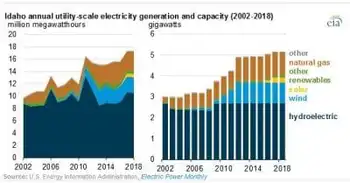
Idaho gets vast majority of electricity from renewables, almost half from hydropower
Idaho Renewable Energy 2018 saw over 80% in-state utility-scale power from hydropower, wind, solar, biomass,…
View more
Entergy Creates COVID-19 Emergency Relief Fund to Help Customers in Need
Entergy COVID-19 Emergency Relief Fund provides financial assistance to ALICE households, low-income seniors, and disabled…
View more
UK Emergency energy plan not going ahead
National Grid Demand Flexibility Service helps stabilise the UK grid during tight supply, offering discounts…
View more
Nearly $1 Trillion in Investments Estimated by 2030 as Power Sector Transitions to a More Decarbonized and Flexible System
Distributed Energy Resources (DER) are surging as solar PV, battery storage, and demand response decarbonize…
View more
Analysis: Out in the cold: how Japan's electricity grid came close to blackouts
Japan Electricity Crunch exposes vulnerabilities in a liberalised power market as LNG shortages, JEPX price…
View more
Hydro One delivery rates go up
Hydro One Rate Hike reflects Ontario Energy Board approval for higher delivery charges, impacting seasonal…
View more
Sign Up for Electricity Forum’s Newsletter
Stay informed with our FREE Newsletter — get the latest news, breakthrough technologies, and expert insights, delivered straight to your inbox.
Electricity Today T&D Magazine Subscribe for FREE

Stay informed with the latest T&D policies and technologies.
- Timely insights from industry experts
- Practical solutions T&D engineers
- Free access to every issue

