Court questions Electrical Market oversight

By Associated Press


NFPA 70b Training - Electrical Maintenance

Our customized live online or in‑person group training can be delivered to your staff at your location.
  • Live Online
  • 12 hours Instructor-led
  • Group Training Available
Regular Price:
$699
Coupon Price:
$599
Reserve Your Seat Today
A federal appeals court recently questioned the US government's oversight of New York state's electricity market in a $67 million legal fight between power companies and their suppliers.

Consolidated Edison and other power companies in New York state have sued the Federal Energy Regulatory Commission to recoup $67 million they claim energy suppliers overcharged them for power reserves.

The power companies say they were overcharged for a period of about six weeks in 2000, and want FERC to authorize retroactive rebates, which the agency has refused to do.

New York State Electric & Gas Corp. and Niagara Mohawk joined Con Ed in seeking the rebates.

FERC lawyer Larry Gasteiger argued the agency's decision was justified, insisting transactions made years ago between buyers and sellers of electricity and reserve power should not be revisited with 20/20 hindsight.

Related News
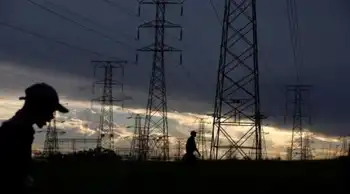
Power Outage Disrupts Morning Routine for Thousands in London

London, Ontario Power Outage disrupts the electricity grid, causing a citywide blackout, stalled commuters, dark traffic signals, and closed businesses, as London Hydro crews race restoration after a transformer malfunction and infrastructure failures.


Key Points

A blackout caused by a transformer malfunction, disrupting commuters, businesses, and traffic across London, Ontario.

✅ Traffic signals dark; delays and congestion citywide

✅ London Hydro crews repairing malfunctioning transformer

✅ Businesses closed; transit routes delayed and rerouted


A widespread power outage early Monday morning left thousands of residents in London, Ontario, without electricity, causing significant disruption for commuters and businesses at the start of the workday. The outage, which affected several neighborhoods across the city, lasted for hours, creating a chaotic morning as residents scrambled to adjust to the unexpected interruption.

The Outage Strikes

The power failure was first reported at approximately 6:30 a.m., catching many off guard as they began their day. The affected areas included several busy neighborhoods, with power lines down and substations impacted, issues that windstorms often exacerbate for utilities. Early reports indicated that the outage was caused by a combination of issues, including technical failures and possible equipment malfunctions. London Hydro, the city's primary electricity provider, responded quickly to the situation, assuring residents that crews were dispatched to restore power as soon as possible.

"Crews are on site and working hard to restore power to those affected," a spokesperson for London Hydro said. "We understand the frustration this causes and are doing everything we can to get the power back on as soon as possible."

Impact on Commuters and Businesses

The power outage had an immediate impact on the morning commute. Traffic lights across the affected areas were down, leading to delays and rush-hour disruptions at major intersections. Drivers were forced to navigate through intersections without traffic control, creating an additional layer of complexity for those trying to get to work or school.

Public transit was also affected, with some bus routes delayed due to the power loss at key transit stations. The situation added further stress to commuters already dealing with the challenges of a typical Monday morning rush.

Businesses in the affected neighborhoods faced a variety of challenges. Some were forced to close early or delay their opening hours due to a lack of electricity. Many shops and offices struggled with limited access to the internet and phone lines, which hindered their ability to process orders and serve customers. Local coffee shops, often a go-to for busy workers, were also unable to operate their coffee machines or provide basic services, forcing customers to go without their usual morning caffeine fix.

"For a lot of people, it's their first stop in the morning," said one local business owner. "It’s frustrating because we rely on power to function, and with no warning, we had to turn away customers."

The Response

As the hours ticked by, residents were left wondering when the power would return. London Hydro’s social media accounts were filled with updates, keeping residents informed about the restoration efforts, a practice echoed when BC Hydro crews responded during an atypical storm. The utility company urged those who were experiencing issues to report them online to help prioritize repair efforts.

"We are aware that many people are affected, and our teams are working tirelessly to restore power," the utility posted on Twitter. "Please stay safe, and we thank you for your patience."

Throughout the morning, the power was gradually restored to different areas of the city. However, some parts remained without electricity well into the afternoon, a situation reminiscent of extended outages that test city resilience. London Hydro confirmed that the outage was caused by a malfunctioning transformer, and the necessary repairs would take time to complete.

Long-Term Effects and Community Concerns

While the immediate effects of the outage were felt most acutely during the morning hours, some residents expressed concern about the potential long-term effects. The city’s reliance on a stable electricity grid became a focal point of discussion, with many wondering if similar outages could occur in the future, as seen in the North Seattle outage earlier this year.

"I understand that things break, but it’s frustrating that it took so long for power to come back," said a London resident. "This isn’t the first time something like this has happened, and it makes me wonder about the reliability of our infrastructure."

City officials responded by reassuring residents that efforts are underway to upgrade the city's infrastructure to prevent such outages from happening in the future. A report released by London Hydro highlighted ongoing investments in upgrading transformers and other key components of the city's power grid. Province-wide, Hydro One restored power to more than 277,000 customers after damaging storms, underscoring the scale of upgrades needed. Despite these efforts, however, experts warn that older infrastructure in some areas may still be vulnerable to failure, especially during extreme weather events or other unforeseen circumstances.

The morning outage serves as a reminder of how reliant modern cities are on stable electricity networks. While the response from London Hydro was swift and effective in restoring power, it’s clear that these types of events can cause significant disruptions to daily life. As the city moves forward, many are calling for increased investment in infrastructure and proactive measures to prevent future outages, especially after Toronto outages persisted following a spring storm in the region.

In the meantime, Londoners have adapted, finding ways to go about their day as best they can. For some, it’s a reminder of the importance of preparedness in an increasingly unpredictable world. Whether it’s an extra flashlight or a backup power source, residents are learning to expect the unexpected and be ready for whatever the next workday might bring.


Related News

View more

British carbon tax leads to 93% drop in coal-fired electricity

Carbon Price Support, the UK carbon tax on power, slashed coal generation, cut CO2 emissions, boosted gas and imports via interconnectors, and signaled effective electricity market decarbonization across Great Britain and the EU.


Key Points

A UK power-sector carbon tax that drove coal off the grid, cut emissions, and shifted generation toward gas and imports.

✅ Coal generation fell from 40% to 3% in six years

✅ Rate rose to £18/tCO2 in 2015, boosting the coal-to-gas switch

✅ Added ~£39 to 2018 bills; imports via interconnectors eased prices


A tax on carbon dioxide emissions in Great Britain, introduced in 2013, has led to the proportion of electricity generated from coal falling from 40% to 3% over six years, a trend mirrored by global coal decline in power generation, according to research led by UCL.

British electricity generated from coal fell from 13.1 TWh (terawatt hours) in 2013 to 0.97 TWh in September 2019, and was replaced by other less emission-heavy forms of generation such as gas, as producers move away from coal in many markets. The decline in coal generation accelerated substantially after the tax was increased in 2015.

In the report, 'The Value of International Electricity Trading', researchers from UCL and the University of Cambridge also showed that the tax—called Carbon Price Support—added on average £39 to British household electricity bills, within the broader context of UK net zero policies shaping the energy transition, collecting around £740m for the Treasury, in 2018.

Academics researched how the tax affected electricity flows to connected countries and interconnector (the large cables connecting the countries) revenue between 2015—when the tax was increased to £18 per tonne of carbon dioxide—and 2018. Following this increase, the share of coal-fired electricity generation fell from 28% in 2015 to 5% in 2018, reaching 3% by September 2019. Increased electricity imports from the continent, alongside the EU electricity demand outlook across member states, reduced the price impact in the UK, and meant that some of the cost was paid through a slight increase in continental electricity prices (mainly in France and the Netherlands).

Project lead Dr. Giorgio Castagneto Gissey (Bartlett Institute for Sustainable Resources, UCL) said: "Should EU countries also adopt a high carbon tax we would likely see huge carbon emission reductions throughout the Continent, as we've seen in Great Britain over the last few years."

Lead author, Professor David Newbery (University of Cambridge), said: "The Carbon Price Support provides a clear signal to our neighbours of its efficacy at reducing CO2 emissions."

The Carbon Price Support was introduced in England, Scotland and Wales at a rate of £4.94 per tonne of carbon dioxide-equivalent and is now capped at £18 until 2021.The tax is one part of the Total Carbon Price, which also includes the price of EU Emissions Trading System permits and reflects global CO2 emissions trends shaping policy design.

Report co-author Bowei Guo (University of Cambridge) said: "The Carbon Price Support has been instrumental in driving coal off the grid, but we show how it also creates distortions to cross-border trade, making a case for EU-wide adoption."

Professor Michael Grubb (Bartlett Institute for Sustainable Resources, UCL) said: "Great Britain's electricity transition is a monumental achievement of global interest, and has also demonstrated the power of an effective carbon price in lowering dependence on electricity generated from coal."

The overall report on electricity trading also covers the value of EU interconnectors to Great Britain, measures the efficiency of cross-border electricity trading and considers the value of post-Brexit decoupling from EU electricity markets, setting these findings against the global energy transition underway.

Published today, the report annex focusing on the Carbon Price Support was produced by UCL to focus on the impact of the tax on British energy bills, with comparisons to Canadian climate policy debates informing grid impacts.


Related News

View more

During this Pandemic, Save Money - How To Better Understand Your Electricity Bill

Commercial Electric Tariffs explain utility rate structures, peak demand charges, kWh vs kW pricing, time-of-use periods, voltage, delivery, capacity ratchets, and riders, guiding facility managers in tariff analysis for accurate energy savings.


Key Points

Commercial electric tariffs define utility pricing for energy, demand, delivery, time-of-use periods, riders, and ratchet charges.

✅ Separate kWh charges from kW peak demand fees.

✅ Verify time-of-use windows and demand interval length.

✅ Review riders, capacity ratchets, and minimum demand clauses.


Especially during these tough economic times, as major changes to electric bills are debated in some states, facility executives who don’t understand how their power is priced have been disappointed when their energy projects failed to produce expected dollar savings. Here’s how not to be one of them.

Your electric rate is spelled out in a document called a “tariff” that can be downloaded from your utility’s web page. A tariff should clearly spell out the costs for each component that is part of your rate, reflecting cost allocation practices in your region. Don’t be surprised to learn that it contains a bunch of them. Unlike residential electric rates, commercial electric bills are not based solely on the quantity of kilowatt-hours (kWh) consumed in a billing period (in the United States, that’s a month). Instead, different rates may apply to how your power is supplied, how it is delivered via electricity delivery charges, when it was consumed, its voltage, how fast it was used (in kW), and other factors.

If a tariff’s lingo and word structure are too opaque, spend some time with a utility account rep to translate it. Many state utility commissions also have customer advocates that may assist as they explore new utility rate designs that affect customers. Alternatively, for a fee, facility managers can privately chat with an energy consultant.

Common mistakes

Many facility managers try to estimate savings based on an averaged electric rate, i.e., annual electric spend divided by annual kWh. However, in markets where electricity demand is flat, such a number may obscure the fastest rising cost component: monthly peak demand charges, measured in dollars per kW (or kilo-volt-amperes, kVA).

This charge is like a monthly speeding ticket, based solely on the highest speed you drove during that time. In some areas, peak demand charges now account for 30 to 60 percent of a facility’s annual electric spend. When projecting energy cost savings, failing to separately account for kW peak demand and kWh consumption may result in erroneous results, and a lot of questions from the C-suite.

How peak demand charges are calculated varies among utilities. Some base it on the highest average speed of use across one hour in a month, while others may use the highest average speed during a 15- or 30-minute period. Others may average several of the highest speeds within a defined time period (for example, 8 a.m. to 6 p.m. on weekdays). It is whatever your tariff says it is.

Because some power-consuming (or producing) devices, including those tied to smart home electricity networks, vary in their operation or abilities, they may save money on a few — but not all — of those rate components. If an equipment vendor calculates savings from its product by using an average electric rate, take pause. Tell the vendor to return after the proposal has been redone using tariff-based numbers.

When a vendor is the only person calculating potential savings from using a product, there’s also a built-in conflict of interest: The person profiting from an equipment sale should not also be the one calculating its expected financial return. Before signing any energy project contracts, it’s essential that someone independent of the deal reviews projected savings. That person (typically an energy or engineering consultant) should be quite familiar with your facility’s electric tariff, including any special provisions, riders, discounts, etc., that may pertain. When this doesn’t happen, savings often don’t occur as planned. 

For example, some utilities add another form of demand charge, based on the highest kW in a year. It has various names: capacity, contract demand, or the generic term “ratchet charge.” Some utilities also have a minimum ratchet charge which may be based on a percent of a facility’s annual kW peak. It ensures collection of sufficient utility revenue to cover the cost of installed transmission and distribution even when a customer significantly cuts its peak demand.


Related News

View more

Opinion: With deregulated electricity, no need to subsidize nuclear power

Pennsylvania Electricity Market Deregulation has driven competitive pricing, leveraged low-cost natural gas, and spurred private investment, jobs, and efficient power plants, while nuclear subsidies threaten wholesale market signals and long-term consumer savings.


Key Points

Policy that opens generation to competition, leverages cheap gas, lowers rates, and resists subsidies for nuclear plants.

✅ Competitive wholesale pricing benefits consumers statewide

✅ Gas-driven plants add efficient, flexible capacity and jobs

✅ Nuclear subsidies distort market signals and raise costs


For decades, the government regulation of Pennsylvania's electricity markets dictated all aspects of power generation resources in the state, thus restricting market-driven prices for consumers and hindering new power plant development and investment.

Deregulation has enabled competitive markets to drive energy prices downward, as recent grid auction payouts fell 64% indicate, which has transformed Pennsylvania from a higher-electricity-cost state to one with prices below the national average.

Recently, the economic advantage of abundant low-cost natural gas has spurred an influx of billions of dollars of private capital investment and thousands of jobs to construct environmentally responsible natural gas power generation facilities throughout the commonwealth — including our three power generation facilities in operation and one presently under construction.

Calpine is an independent power provider with a national portfolio of 80 highly efficient power plants in operation or under construction with an electric generating capacity of approximately 26,000 megawatts. Collectively, these resources can provide sufficient power for more than 30 million residential homes. We are not a regulated utility receiving a guaranteed rate of return on investment. Rather, Calpine competes to sell wholesale power into the electric markets, and the economics of supply and demand are fundamental to the success of our business.

Pennsylvania's deregulated electricity market is working. Consumers are benefiting from low-cost natural gas, as broader evidence shows competition benefits consumers and the environment across markets, and companies such as Calpine are investing billions of dollars and creating thousands of jobs to build advanced, energy efficient, environmentally responsible and flexible power generating facilities.

There are presently seven electric generating projects under construction in the commonwealth, representing about a $7 billion capital investment that will produce about 7,000 megawatts of efficient electrical power, with additional facilities being planned.

Looking back 20 years following the enactment of the Pennsylvania Electricity Generation Customer Choice and Competition Act, Pennsylvania's regulators and policymakers must conclude that the results of a free and fair market-driven structure have delivered indisputable benefits to the consumer, even amid potential winter rate spikes for residents, and the Pennsylvania economy.

While consumers are now reaping the benefits of open and competitive electricity markets, we see challenges on the horizon that could threaten the foundation of those markets. Due to pressure from nuclear power generators, state policymakers throughout the nation have been increasing efforts to impact the generation mix in their respective states by offering ratepayer funded subsidies to existing nuclear generation resources or by considering a market structure overhaul in New England.

Subsidizing one power generation type over others is having a significant, negative impact on wholesale electric markets, competitive retails markets and ultimately the cost the consumer will have to pay, and can exacerbate disruptions in coal and nuclear industries that strain the economy and risk brownouts.

In Pennsylvania, these subsidies would follow nearly $9 billion already paid by ratepayers to help the commonwealth's nuclear industry transition from regulated to competitive energy markets.

The deregulation of Pennsylvania's electricity markets in the late 1990s allowed the nuclear industry to receive billions of dollars from ratepayers to recover "stranded costs" related to investments in the commonwealth's nuclear plants. These costs were negotiated amounts based on settlements with Pennsylvania's Public Utility Commission to allow the nuclear industry to prepare and transition to competitive electricity markets.

Enough is enough. Regulatory or governmental interference in well functioning markets does not lead to better outcomes. Pennsylvania's state Legislature should not pick winners and losers by enacting legislation that would create an uneven playing field that subsidizes nuclear generating resources in the commonwealth.

William Ferguson is regional vice president for Calpine Corp.


Related News

View more

Texas's new set of electricity regulators begins to take shape in wake of deep freeze, power outages

Texas PUC Appointments signal post-storm reform as Gov. Greg Abbott taps Peter Lake and advances Will McAdams for Senate confirmation, affecting ERCOT oversight, grid reliability, wholesale power pricing, and securitization for co-ops.


Key Points

Texas PUC appointments add Peter Lake and Will McAdams to steer ERCOT, grid reliability, and market policy.

✅ Peter Lake nominated chair to replace Arthur D'Andrea.

✅ Will McAdams advances toward Senate confirmation.

✅ Focus on ERCOT oversight, price cap debate, grid resilience.


A new set of Texas electricity regulators began to take shape Monday, as Gov. Greg Abbott nominated a finance expert to be the next chairman of the Public Utility Commission while his earlier choice of a PUC member moved toward Senate confirmation.

The Republican governor put forward Peter Lake of Austin, who has spent more than five years as an Abbott appointee to the Texas Water Development Board, as his second commission pick in as many weeks.

“I am confident he will bring a fresh perspective and trustworthy leadership to the PUC,” Abbott said of Lake, who once worked as a trader of futures and derivatives for a firm belonging to the Chicago Mercantile Exchange and more recently has eagerly promoted bonds for the State Water Implementation Fund for Texas.

“Peter’s expertise in the Texas energy industry and business management will make him an asset to the agency,” Abbott, who has touted grid readiness in recent months, said in a written statement. “I urge the Senate to swiftly confirm Peter’s appointment.”

On Monday, the Senate appeared to be moving quickly to confirm Abbott’s April 1 selection for the PUC, Will McAdams, president of Associated Builders and Contractors of Texas and a former legislative aide who helped write policy for regulated industries such as electricity.

McAdams was among the 129 nominees that the Senate Nominations Committee voted out, 8-0. His nomination heads now to the Senate floor.

All three of Abbott’s handpicked PUC commissioners who were in place before and during February’s calamitous winter storm have since quit or said they’re resigning, even as Sierra Club criticism of Abbott's demands intensified in the aftermath.

February’s polar vortex left in its wake physical and financial wreckage after a nonprofit grid operator answering to the PUC, amid calls for market reforms to avoid blackouts, shut off electricity to more than 4 million Texans, causing the deaths of at least 125 people, 13 of them in the Dallas-Fort Worth area.

Gov. Greg Abbott on Thursday named Will McAdams to the embattled Public Utility Commission of Texas. McAdams is a construction industry lobbyist with strong ties to the GOP-controlled Legislature. In Feb. 17 file photo, winter storm's snowfall andn large electrical transmission lines in South Arlington are pictured.

In a 45-minute confirmation hearing, McAdams, as lawmakers discussed ways to improve electricity reliability statewide, drew praise – and few tough questions.

McAdams, who previously worked for three GOP senators, testified that had he been on the commission in February, he would not have kept in place a controversial, $9,000-per-megawatt hour price cap on wholesale power for about 32 hours on Feb. 18-19.

“I don’t see myself making that decision,” he said.

McAdams, though, hedged slightly, saying he’s not privy to all information that the Electric Reliability Council of Texas, or ERCOT, and the PUC may have had at their disposal during the crisis.

The comments were notable because Lt. Gov. Dan Patrick and the Senate have fought with Abbott and the House over $16 billion in overcharges that, according to an independent market monitor, wrongly accrued near the end of the Feb. 15-19 outages.

Sen. Charles Schwertner, R-Georgetown, said the commission’s former chairwoman, DeAnn Walker, and Bill Magness, president of ERCOT, decided to hold the high cap in place because there “was still great concern about grid stability, even though there was significant reserves.”

He pressed McAdams to call that incorrect, which McAdams did.

“Given the fact pattern that I’m privy to, senator,” it wasn’t the right move, he said. “But again, there may be other facts out there. There probably are.”

McAdams acknowledged many homeowners and businesses were traumatized.

“The public’s confidence in the ability of the PUC to effectively regulate our electric markets has been badly damaged and shaken,” he said.

McAdams spoke favorably of renewable energy, calling wind and solar “absolutely valuable resources,” as the electricity sector faces profound change nationwide. To whatever extent those are not available, the PUC should “firm that up” with “dispatchable forms of generation,” such as gas, coal and nuclear, McAdams said.

He also called for lawmakers to consider providing electricity market bailout through “securitization,” or low-interest bond financing, to rural electric co-ops that were unable to pay the massive wholesale power bills they racked up during the February crisis.

“It would prevent those systems from having to front-load those costs onto their own members and smooth that out over a term of years,” while preventing an “uplift” of costs to other market participants who wisely hedged against soaring prices, McAdams said.

Noting that more than 400 bills have been filed to change ERCOT and how it’s governed, and as Texans prepare to vote on grid modernization funding this year, McAdams told the Senate panel, “It is clear to me that the Legislature wants meaningful changes to the status quo – to ensure that something positive comes out of this tragedy.”

Lake, who if confirmed by the Senate would replace Arthur D’Andrea as PUC chairman, grew up in Tyler. He attended prep school in New England and earned an undergraduate degree from the University of Chicago and a master of business administration degree from Stanford University.

He then worked for a commodities trading firm, a behavioral health company and as a business consultant before he became director of business development for Tyler-based Lake Ronel Oil Co. in 2014.

In late 2015, Abbott named Lake to the Texas Water Development Board and in February 2018 picked him to be the chairman of the three-member board that seeks to ensure water supplies for a fast-growing state.

Lake has steered the water board as it rolled out additional loans for water projects, approved by the Legislature and voters in 2013, and took the lead after Hurricane Harvey on flood control planning and infrastructure financing.

He’s posted exuberantly on Twitter as he toured agricultural water installations, lakes in West Texas and river authorities.

If confirmed, Lake and McAdams each would make $189,500 a year.


Related News

View more

Utilities commission changes community choice exit fees; what happens now in San Diego?

CPUC Exit Fee Increase for CCAs adjusts the PCIA, affecting utilities, San Diego ratepayers, renewable energy procurement, customer equity, and cost allocation, while providing regulatory certainty for Community Choice Aggregation programs and clean energy goals.


Key Points

A CPUC-approved change raising PCIA exit fees paid by CCAs to utilities, balancing cost shifts and customer equity.

✅ PCIA rises from about 2.5c to roughly 4.25c per kWh in San Diego

✅ Aims to reduce cost shifts and protect non-CCA customers

✅ Offers regulatory certainty for CCA launches and clean energy goals


The California Public Utilities Commission approved an increase on the exit fees charged to customers who take part in Community Choice Aggregation -- government-run alternatives to traditional utilities like San Diego Gas & Electric.

After reviewing two competing exit fee proposals, all five commissioners voted Thursday in favor of an adjustment that many CCA advocates predicted could hamper the growth of the community choice movement.

But minutes after the vote was announced, one of the leading voices in favor of the city San Diego establishing its own CCA said the decision was good news because it provides some regulatory certainty.

"For us in San Diego, it's a green light to move forward with community choice," said Nicole Capretz, executive director of the Climate Action Campaign. "For us, it's let's go, let's launch and let's give families a choice. We no longer have to wait."

Under the CCA model, utilities still maintain transmission and distribution lines (poles and wires, etc.) and handle customer billing. But officials in a given local government entity make the final decisions about what kind of power sources are purchased.

Once a CCA is formed, its customers must pay an exit fee -- called a Power Charge Indifference Adjustment -- to the legacy utility serving that particular region. The fee is included in customers' monthly bills.

The fee is required to offset the costs of the investments utilities made over the years for things like natural gas power plants, renewable energy facilities and other infrastructure.

Utilities argue if the exit fee is set too low, it does not fairly compensate them for their investments; if it's too high, CCAs complain it reduces the financial incentive for their potential customers.

The Public Utilities Commission chose to adopt a proposal that some said was more favorable to utilities, leading to complaints from CCA boosters.

"We see this will really throw sand in the gears in our ability to do things that can move us toward (climate change) goals," Jim Parks, staff member of Valley Clean Energy, a CCA based in Davis, said before the vote.

Commissioner Carla Peterman, who authored the proposal that passed, said she supports CCAs but stressed the commission has a "legal obligation" to make sure increased costs are not shouldered by "customers who do not, or cannot, join a CCA. Today's proposal ensures a more level playing field between customers."

As for what the vote means for the exit fee in San Diego, Peterman's office earlier in the week estimated the charge would rise from 2.5 cents a kilowatt-hour to about 4.25 cents.

The Clear the Air Coaltion, a San Diego County group critical of CCAs, said the newly established exit fee -- which goes into effect starting next year -- is "a step in the direction."

But the group, which includes the San Diego Regional Chamber of Commerce, the San Diego County Taxpayers Association and lobbyists for Sempra Energy (the parent company of SDG&E), repeated concerns it has brought up before.

"If the city of San Diego decides to get into the energy business this decision means ratepayers in National City, Chula Vista, Carlsbad, Imperial Beach, La Mesa, El Cajon and all other neighboring communities would see higher energy bills, and San Diego taxpayers would be faced with mounting debt," coalition spokesman Tony Manolatos said in an email.

CCA supporters say community choice is critical in ensuring San Diego meets the pledge made by Mayor Kevin Faulconer to adopt the city's Climate Action Plan, mandating 100 percent of the city's electricity needs must come from renewable sources by 2035.

Now attention turns to Faulconer, who promised to make a decision on bringing a CCA proposal to the San Diego City Council only after the utilities commission made its decision.

A Faulconer spokesman said Thursday afternoon that the vote "provides the clarity we've been waiting for to move forward" but did not offer a specific time table.

"We're on schedule to reach Mayor Faulconer's goal of choosing a pathway that achieves our renewable energy goals while also protecting ratepayers, and the mayor looks forward to making his recommendation in the next few weeks," said Craig Gustafson, a Faulconer spokesman, in an email.

A feasibility study released last year predicted a CCA in San Diego has the potential to deliver cheaper rates over time than SDG&E's current service, while providing as much as 50 percent renewable energy by 2023 and 80 percent by 2027.

"The city has already figured out we are still capable of launching a program, having competitive, affordable rates and finally offering families a choice as to who their energy provider is," said Capretz, who helped draft an initial blueprint of the climate plan as a city staffer.

SDG&E has come to the city with a counterproposal that offers 100 percent renewables by 2035.

Thus far, the utility has produced a rough outline for a "tariff" program that would charge ratepayers the cost of delivering more clean sources of energy over time.

Some council members have expressed frustration more specifics have not been sketched out.

SDG&E officials said they will take the new exit fee into account as they go forward with their counterproposal to the city council.

Speaking in general about the utility commission's decision, SDG&E spokeswoman Helen Gao called it "a victory for our customers, as it minimizes the cost shifts that they have been burdened with under the existing fee formula.

"As commissioners noted in rendering their decision, reforming the (exit fee) addresses a customer-to-customer equity issue and has nothing to do with increasing profits for investor-owned utilities," Gao said in an email.


Related News

View more

Sign Up for Electricity Forum’s Newsletter

Stay informed with our FREE Newsletter — get the latest news, breakthrough technologies, and expert insights, delivered straight to your inbox.

Electricity Today T&D Magazine Subscribe for FREE

Stay informed with the latest T&D policies and technologies.
  • Timely insights from industry experts
  • Practical solutions T&D engineers
  • Free access to every issue

Live Online & In-person Group Training

Advantages To Instructor-Led Training – Instructor-Led Course, Customized Training, Multiple Locations, Economical, CEU Credits, Course Discounts.

Request For Quotation

Whether you would prefer Live Online or In-Person instruction, our electrical training courses can be tailored to meet your company's specific requirements and delivered to your employees in one location or at various locations.