Texas Restructuring Plan Best in U.S.

By Business Wire


Arc Flash Training CSA Z462 - Electrical Safety Essentials

Our customized live online or in‑person group training can be delivered to your staff at your location.
  • Live Online
  • 6 hours Instructor-led
  • Group Training Available
Regular Price:
$249
Coupon Price:
$199
Reserve Your Seat Today
The Texas approach to restructuring its electric market is the best in the United States, according to a new study conducted by the Center for the Advancement of Energy Markets (CAEM).

In its most recent biannual industry report card the Retail Energy Deregulation (RED) Index, CAEM ranks states according to 22 attributes the Center has identified as the foundation for an effective transition to competition.

Texas, which more than doubled its 2001 score, leads all other states with a score of 69. "The RED Index update illustrates that when it comes to electric restructuring, Texas is doing it right," said Rebecca Klein, chairman of the Public Utility Commission of Texas (PUC) - the agency responsible for overseeing the transition to a competitive electric market in Texas.

"For most people, shopping for electricity is still a new concept, but more and more Texans are taking advantage of new options available to them - and they're saving money as a result," Klein said. "There is still work to be done, but, overall, we're pleased with the way things are going." Texas' retail electric market opened for full competition on January 1, 2002.

Related News
Solar + Wind = 10% of US Electricity Generation in 1st Half of 2018

US Electricity Generation H1 2018 saw wind and solar gains but hydro declines, as natural gas led the grid mix and coal fell; renewables' share, GWh, emissions, and capacity additions shaped the power sector.


Key Points

It is the H1 2018 US power mix, where natural gas led, coal declined, and wind and solar grew while hydro fell.

✅ Natural gas reached 32% of generation, highest share

✅ Coal fell; renewables roughly tied nuclear at ~20%

✅ Wind and solar up; hydro output down vs 2017


To complement our revival of US electricity capacity reports, here’s a revival of our reports on US electricity generation.

As with the fresh new capacity report, things are not looking too bright when it comes to electricity generation. There’s still a lot of grey — in the bar charts below, in the skies near fossil fuel power plants, and in the human and planetary outlook based on how slowly we are cutting fossil fuel electricity generation.

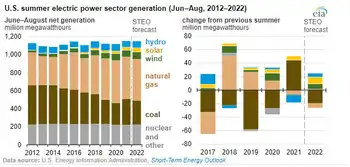
As you can see in the charts above, wind and solar energy generation increased notably from the first half of 2017 to the first half of 2018, and the EIA expected larger summer solar and wind generation in subsequent months, reinforcing that momentum.

A large positive when it comes to the environment and human health is that coal generation dropped a great deal year over year — by even more than renewables increased, though the EIA later noted an increase in coal-fired generation in a subsequent year, complicating the trend. However, on the down side, natural gas soared as it became the #1 source of electricity generation in the United States (32% of US electricity). Furthermore, coal was still solidly in the #2 position (27% of US electricity). Renewables and nuclear were essentially in a tie at 19.8% of generation, with renewables just a tad above nuclear.

Actually, combined with an increase in nuclear power generation, natural gas electricity production increased so much that the renewable energy share of electricity generation actually dropped in the first half of 2018 versus the first half of 2017, even amid declining electricity use in some periods. It was 19.8% this year and 20% last year.

Again, solar and wind saw a significant growth in its market share, from 9% to 9.9%, but hydro brought the whole category down due to a decrease from 9% to 8%.

The visuals above are probably the best way to examine it all. The H1 2018 chart was still dominated by fossil fuels, which together accounted for approximately 60% of electricity generation, even though by 2021 non-fossil sources supplied about 40% of U.S. electricity, highlighting the longer-term shift. In H1 2017, the figure was 59.7%. Furthermore, if you switch to the “Change H1 2018 vs H1 2017 (GWh)” chart, you can watch a giant grey bar representing natural gas take over the top of the chart. It almost looks like it’s part of the border of the chart. The biggest glimmer of positivity in that chart is seeing the decline in coal at the bottom.

What will the second half of the year bring? Well, the gigantic US electricity generation market shifts slowly, even as monthly figures can swing, as January generation jumped 9.3% year over year according to the EIA, reminding us about volatility. There is so much base capacity, and power plants last so long, that it takes a special kind of magic to create a rapid transition to renewable energy. As you know from reading this quarter’s US renewable energy capacity report, only 43% of new US power capacity in the first half of the year was from renewables. The majority of it was from natural gas. Along with other portions of the calculation, that means that electricity generation from natural gas is likely to increase more than electricity generation from renewables.

Jump into the numbers below and let us know if you have any more thoughts.


Related News

View more

BC announces grid development, job creation

BC Hydro Power Pathway accelerates electrification with clean energy investments, new transmission lines, upgraded substations, and renewable projects like wind and solar, strengthening the grid, supporting decarbonization, and creating jobs across British Columbia's growing economy.


Key Points

A $36B, 10-year BC Hydro plan to expand clean power infrastructure, accelerate electrification, and support jobs.

✅ $36B for new lines, substations, dam upgrades, and distribution

✅ Supports 10,500-12,500 jobs per year across B.C.

✅ Adds wind and solar, leveraging hydro to balance renewables


BC Hydro is gearing up for a decade of extensive construction to enhance British Columbia's electrical system, supporting a burgeoning clean economy and community growth while generating new employment opportunities.

Premier David Eby emphasized the necessity of expanding the electrical system for industrial growth, residential needs, and future advancements. He highlighted the role of clean, affordable energy in reducing pollution, securing well-paying jobs, and fostering economic growth.

At the B.C. Natural Resources Forum in Prince George, Premier Eby unveiled a $36-billion investment plan for infrastructure projects in communities and regions and green energy solutions to provide clean, affordable electricity for future generations.

The Power Pathway: Building BC’s Energy Future, BC Hydro’s revised 10-year capital plan, involves nearly $36 billion in investments across the province from 2024-25 to 2033-34. This marks a 50% increase from the previous plan of $24 billion and includes a substantial rise in electrification and emissions-reduction projects (nearly $10 billion, up from $1 billion).

These upcoming construction projects are expected to support approximately 10,500 to 12,500 jobs annually. The plan is set to bolster and sustain BC Hydro’s capital investments as significant projects like Site C are near completion.

The plan addresses the increasing demand for electricity due to population and housing growth, industrial development, such as a major hydrogen project, and the transition from fossil fuels to clean electricity. Key projects include constructing new high-voltage transmission lines from Prince George to Terrace, building or expanding substations in high-growth areas, and upgrading dams and generating facilities for enhanced safety and efficiency.

Minister of Energy, Mines, and Low Carbon Innovation Josie Osborne stated that this plan aims to build a clean energy future and support EV charging expansion while creating construction jobs. With BC Hydro’s capital plan allocating almost $4 billion annually for the next decade, it will drive economic growth and ensure access to clean, affordable electricity.

BC Hydro aims to add new clean, renewable energy sources like wind and solar, while acknowledging power supply challenges that must be managed as capacity grows. B.C.’s hydroelectric dams, functioning as batteries, enable the integration of intermittent renewables into the grid, providing reliable backup.

Chris O’Riley, president and CEO of BC Hydro, said the grid is one of the world’s cleanest. The new $36 billion capital plan encompasses investments in generation assets, large transmission infrastructure, and local distribution networks.

In partnership with BC Hydro, Premier Eby also announced a new streamlined approval process to expedite electrification for high-demand industries and support job creation, complementing measures like the BC Hydro rebate and B.C. Affordability Credit that help households.

Minister of Environment and Climate Change Strategy George Heyman highlighted the importance of rapid electrification in collaboration with the private sector to achieve CleanBC climate goals by 2030, including corridor charging via the BC's Electric Highway, and maintain the competitiveness of B.C. industries. The new process will streamline approvals for industrial electrification projects, enhancing efficiency and funding certainty.


Related News

View more

Hydro One shares jump 5.7 per cent after U.S. regulators reject $6.7B takeover

Hydro One Avista takeover rejection signals Washington regulators blocking a utility acquisition over governance risk, EPS dilution, and balance sheet impact, as investors applaud share price gains and a potential US$103M break fee.


Key Points

A regulator-led block of Hydro One's Avista bid, citing EPS dilution, balance sheet risk, and governance concerns.

✅ Washington denies approval; Idaho, Oregon decisions pending.

✅ EPS dilution avoided; balance sheet strength preserved.

✅ Shares rise 5.7%; US$103M break fee if deal collapses.


Opposition politicians may not like it but investors are applauding the rejection of Hydro One Ltd.'s $6.7-billion Avista takeover of U.S.-based utility Avista Corp.

Shares in the power company controlled by the Ontario government, which has also proposed a bill redesign to simplify statements, closed at $21.53, up $1.16 or 5.7 per cent, on the Toronto Stock Exchange on Thursday.

On Wednesday, Washington State regulators said they would not allow Ontario's largest utility to buy Avista over concerns about political risk that the provincial government, which owns 47 per cent of Hydro One's shares, might meddle in Avista's operations.

Financial analysts had predicted investors would welcome the news because the deal, announced in July 2017, would have eroded earnings per share and weakened Hydro One's balance sheet.

"The Washington regulator's denial of Avista is a positive development for the shares, in our opinion," said analyst Ben Pham of BMO Capital Markets in a report on Wednesday.

"While this may sound odd, we note that the Avista deal is expected to be EPS dilutive and result in a weaker balance sheet for (Hydro One). Not acquiring Avista and refocusing its attention on its core Ontario franchise ... along with related interprovincial arrangements such as the Ontario-Quebec electricity deal under discussion would likely be viewed positively if the deal ultimately breaks."

Decisions are yet to come from Idaho and Oregon state regulators, but Washington was probably the most important as the state contains customers making up about 60 per cent of Avista's rate base, Pham said.

He pointed out that a US$103-million break fee is to be paid to Avista if the deal collapses due to a failure to obtain regulatory approval.

CIBC analyst Robert Catellier raised his 12-month Hydro One target price by 25 cents and said many shareholders will feel "relieved" that the deal had failed.

He warned that the company's earnings power could deteriorate as the province seeks to reduce power bills by 12 per cent, despite an Ontario-Quebec hydro deal that may not lower costs.


Related News

View more

Japan opens part of last town off-limits since nuclear leaks

Futaba Partial Reopening marks limited access to the Fukushima exclusion zone, highlighting radiation decontamination progress, the train station restart, and regional recovery ahead of the Tokyo Olympics after the 2011 nuclear disaster and evacuation.


Key Points

A lift of entry bans in Futaba, signaling Fukushima recovery, decontamination progress, and a train station restart.

✅ Unrestricted access to 2.4 km² around Futaba Station

✅ Symbolic step ahead of Tokyo Olympics torch relay

✅ Decommissioning and decontamination to span decades


Japan's government on Wednesday opened part of the last town that had been off-limits due to radiation since the Fukushima nuclear disaster nine years ago, in a symbolic move to show the region's recovery ahead of the Tokyo Olympics, even as grid blackout risks have drawn scrutiny nationwide.

The entire population of 7,000 was forced to evacuate Futaba after three reactors melted down due to damage at the town's nuclear plant caused by a magnitude 9. 0 quake and tsunami March 11, 2011.

The partial lifting of the entry ban comes weeks before the Olympic torch starts from another town in Fukushima, as new energy projects like a large hydrogen system move forward in the prefecture. The torch could also arrive in Futaba, about 4 kilometres (2.4 miles) from the wrecked nuclear plant.

Unrestricted access, however, is only being allowed to a 2.4 square-kilometre (less than 1 square-mile) area near the main Futaba train station, which will reopen later this month to reconnect it with the rest of the region for the first time since the accident. The vast majority of Futaba is restricted to those who get permission for a day visit.

The three reactor meltdowns at the town's Fukushima Dai-ichi nuclear power plant spewed massive amounts of radiation that contaminated the surrounding area and at its peak, forced more than 160,000 people to flee, even as regulators later granted TEPCO restart approval for a separate Niigata plant elsewhere in Japan.

The gate at a checkpoint was opened at midnight Tuesday, and Futaba officials placed a signboard at their new town office, at a time when the shutdown of Germany's last reactors has reshaped energy debates abroad.

“I'm overwhelmed with emotion as we finally bring part of our town operations back to our home town," said Futaba Mayor Shiro Izawa. “I pledge to steadily push forward our recovery and reconstruction."

Town officials say they hope to see Futaba’s former residents return, but prospects are grim because of lingering concern about radiation, and as Germany's nuclear exit underscores shifting policies abroad. Many residents also found new jobs and ties to communities after evacuating, and only about 10% say they plan to return.

Futaba's registered residents already has decreased by 1,000 from its pre-disaster population of 7,000. Many evacuees ended up in Kazo City, north of Tokyo, after long bus trips, various stopovers and stays in shelters at an athletic arena and an abandoned high school. The town's government reopened in a makeshift office in another Fukushima town of Iwaki, while abroad projects like the Bruce reactor refurbishment illustrate long-term nuclear maintenance efforts.

Even after radiation levels declined to safe levels, the region's farming and fishing are hurt by lingering concerns among consumers and retailers. The nuclear plant is being decommission in a process that will take decades, with spent fuel removal delays extending timelines, and it is building temporary storage for massive amounts of debris and soil from ongoing decontamination efforts.


Related News

View more

Why rolling back European electricity prices is tougher than appears

EU Energy Price Crisis drives soaring electricity bills as natural gas sets pay-as-clear power prices; leaders debate price caps, common gas purchasing, market reform, renewables, and ETS changes amid Ukraine war supply shocks.


Key Points

A surge in gas-driven power costs linked to pay-as-clear pricing, supply shocks, and policy rifts across the EU market.

✅ Gas sets marginal power price via pay-as-clear mechanism

✅ Spain pushes decoupling and temporary price caps

✅ EU weighs joint gas buying, efficiency, more renewables


Nothing grabs politicians' attention faster than angry voters, and they've had plenty to be furious about as natural gas and electricity bills have soared to stomach-churning levels in recent months, as this UK natural gas analysis illustrates across markets.

That's led to a scramble to figure out ways to get those costs down, with emergency price-limiting measures under discussion — but that's turning out to be very difficult, so the likeliest result is that EU leaders meeting later this week won't come up with any solutions.

“There is no single easy answer to tackle the high electricity prices given the diversity of situations among Member States. Some options are only suitable for specific national contexts,” the European Commission said on Wednesday. “They all carry costs and drawbacks.” 

The initial problem was a surge in gas demand in Asia last year coupled with lower-than-normal Russian gas deliveries that left European gas storage at unusually low levels. Now the war in Ukraine is making matters even worse, as pressure grows for the bloc to rapidly cut its imports of Russian oil, coal and natural gas — although some national leaders reject the economic costs that would entail.

"We will end this dependence as quickly as we can, but to do that from one day to the next would mean plunging our country and all of Europe into a recession," German Chancellor Olaf Scholz warned on Wednesday.

The problem for the bloc is that its liberalized electricity market is tightly tied to the price of natural gas; power prices are set by the final input needed to balance demand — called pay-as-clear — which in most cases is set by natural gas. That's led to countries with large amounts of cheaper renewable or nuclear energy seeing sharp spikes in power prices thanks to the cost of that final bit of gas-fired electricity.

A Spanish-led coalition that includes Portugal, Belgium and Italy wants deep reforms to the EU price model, fueling a broader electricity market revamp debate in Brussels.

Others, such as the Netherlands and Germany, strongly oppose such an approach, echoing how nine countries oppose reforms at the EU level, and want to focus on cushioning the effects of the high prices on consumers and businesses, while letting the market operate. 

A third group, largely in Central Europe, wants to use the price spike to revamp or scrap the bloc's Emissions Trading System and to rethink its Fit for 55 climate legislation.

The European Commission has been holding the middle ground — arguing that the current market model makes sense, but encouraging countries to boost the amount of renewable electricity, in a wake-up call to ditch fossil fuels for Europe, to cut energy use and increase efficiency.

In draft conclusions of this week's European Council summit, seen by POLITICO, EU leaders, amid a France-Germany tussle over reform, call for things like a common approach to buying gas, aimed at preventing countries from competing against each other. But there's no big movement on electricity prices.

“It does not seem realistic to expect a result on the energy discussion at this European Council,” one diplomat said, stressing that the governments will need to see more analysis before committing to any more steps.

Looking for action
Spain wanted a much more robust response. Madrid has been arguing since last summer for “decoupling” gas from the electricity market; together with Portugal, it also mulled limiting the wholesale price of electricity to €180 per megawatt-hour — a proposal that Spain abandoned under fire from industry and consumer groups. 

Now Madrid is pushing to get a specific permission in the summit's final conclusions that would allow countries to voluntarily apply certain short-term solutions such as gas price cap strategies, according to a draft with track changes seen by POLITICO.

The issue with a cap is if gas prices are higher than the cap, Spain might not be able to buy any gas.


Related News

View more

Australian operator warns of reduced power reserves

Australia Electricity Supply Shortfall highlights AEMO's warning of reduced reserves as coal retirements outpace capacity, risking load shedding. Calls for 1GW strategic reserves and investment in renewables, storage, and dispatchable power in Victoria.


Key Points

It is AEMO's forecast of reduced reserves, higher outage risk, and a need for 1GW strategic backup capacity.

✅ Coal retirements outpacing firm, dispatchable capacity

✅ AEMO urges 1GW strategic reserves in Victoria and South Australia

✅ Investment needed: renewables, storage, grid and reliability services


Australia’s electricity operator has warned of threats to electricity supply including a shortfall in generation and reduced power reserves on the horizon.

The Australian Energy Market Operator (AEMO) has called for further investment in the country’s energy portfolio as retiring coal plants are replaced by intermittent renewables poised to eclipse coal, leaving the grid with less back-up capacity.

AEMO has said this increases the chances of supply interruption and load shedding.

It added the federal government should target 1GW of strategic reserves in the states most at risk – Victoria and South Australia, even as the Prime Minister has ruled out taxpayer-funded power plants in the current energy battle.

CEO of the Clean Energy Council, Kane Thornton, said the shortfall in generation, reflected in a short supply of electricity, was due a decade of indecisiveness and debate leading to a “policy vacuum”.

He added: “The AEMO report revealed that the new projects added to the system under the renewable energy target will help to improve reliability over the next few years.

“We need to accept that the energy system is in transition, with lessons from dispatchable power shortages in Europe, and long term policy is now essential to ensure private investment in the most efficient new energy technology and solutions.”


Related News

View more

Sign Up for Electricity Forum’s Newsletter

Stay informed with our FREE Newsletter — get the latest news, breakthrough technologies, and expert insights, delivered straight to your inbox.

Electricity Today T&D Magazine Subscribe for FREE

Stay informed with the latest T&D policies and technologies.
  • Timely insights from industry experts
  • Practical solutions T&D engineers
  • Free access to every issue

Live Online & In-person Group Training

Advantages To Instructor-Led Training – Instructor-Led Course, Customized Training, Multiple Locations, Economical, CEU Credits, Course Discounts.

Request For Quotation

Whether you would prefer Live Online or In-Person instruction, our electrical training courses can be tailored to meet your company's specific requirements and delivered to your employees in one location or at various locations.