By CUPE and CEP represent 650,000 Canadians - 250,000 are Ontario members.


Protective Relay Training - Basic

Our customized live online or in‑person group training can be delivered to your staff at your location.

  • Live Online
  • 12 hours Instructor-led
  • Group Training Available
Regular Price:
$699
Coupon Price:
$599
Reserve Your Seat Today
TORONTO -- The Communications, Energy and Paperworkers Union of Canada (CEP) and the Canadian Union of Public Employees (CUPE) said today that incoming Premier Ernie Eves should stop the privatization of Hydro One - the province's publicly owned electricity grid - because they say the government does not have the legal authority to do so. To press their demand, the unions have started legal proceedings to stop the sale of shares in Hydro One.

"This is an essential service, as important as water and public health care, and cannot be left to private interests who will put profits first," said CUPE National President Judy Darcy. "We're deeply concerned about the impact of privatizing Hydro One on our families, our environment and our economy. It's a reckless plan and it must be stopped."

The unions argue that the province does not have the power to relinquish public control of Hydro One by offering its shares for sale to investors.

They have also urged the Ontario Securities Commission (OSC) to refuse its approval for the sale on public interest grounds, and because the government has not fully explained its case to investors. They have called upon the Ontario Energy Board to hold hearings to also judge whether the sale of Hydro One will undermine security of supply, environmental protection and consumer interests.

"We can't wait until April 15th for Ernie Eves to take over as Premier - he should announce that the government will stop this deal today," said Brian Payne, President of CEP. "Otherwise he will be coming into office with a cloud of impropriety hanging over his administration."

The unions noted that in June of 1998, Minister of Energy Jim Wilson stated that the Tory government never intended to privatize Ontario Hydro utility. In an about face, the government is moving swiftly ahead with privatization without any public hearings.

"For 95 years every person in Ontario has relied on the Hydro One transmission and distribution grid," said Cecil Makowski, CEP's Ontario Region Vice-President. "If Harris and Eves think they can move swiftly ahead with this deal - they can't - we will fight it with all legal means."

Related News

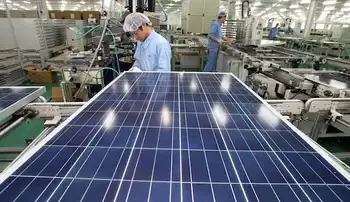
China's electric power woes cast clouds on U.S. solar's near-term future

China Power Rationing disrupts the solar supply chain as coal shortages, price controls, and dual-control emissions policy curb electricity, squeezing polysilicon, aluminum, and module production and raising equipment costs amid surging post-Covid industrial demand.


Key Points

China's electricity curbs from coal shortages, price caps, and emissions targets disrupt solar output and materials.

✅ Polysilicon and aluminum output cut by power rationing

✅ Coal price spikes and power price caps squeeze generators

✅ Dual-control emissions policy triggers provincial curbs


The solar manufacturing supply chain is among the industries being affected by a combination of soaring power demand, coal shortages, and carbon emission reduction measures which have seen widespread power cuts in China.

In Yunnan province, in southwest China, producers of the silicon metal which feeds polysilicon have been operating at 10% of the output they achieved in August. They are expected to continue to do so for the rest of the year as provincial authorities try to control electricity demand with a measure that is also affecting the phosphorus industry.

Fellow solar supply chain members from the aluminum industry in Guangxi province, in the south, have been forced to operate just two days per week, alongside peers in the concrete, steel, lime, and ceramics segments. Manufacturers in neighboring Guangdong have access to normal power supplies only on Fridays and Saturdays with electricity rationed to a 15% grid security load for the rest of the time.

pv magazine USA reported that a Tier 1 solar module manufacturer warned customers in an email that energy shortages in China have forced it to reduce or stop production at its Chinese manufacturing sites. The company warned the event will also affect output from its downstream cell and module production facilities in Southeast Asia.

The memo said that in order to recover from the effects of the “potential Force Majeure event,” it may delay or stop equipment delivery or seek to renegotiate contracts to pass through higher prices.

Raw material sourcing
With reports of drastic power shortages emerging from China in recent days, the country has actually been experiencing problems since late June, and similar pressures have seen India ration coal supplies this year, but rationing is not unusual during the peak summer hours.

What has changed this time is that the outages have continued and prompted rationing measures across 19 of the nation’s provinces for the rest of the year. The problems have been caused by a combination of rising post-Covid electricity demand at a time when the politically-motivated ban on imports of Australian coal has tightened supply; and the manner in which Beijing controls power prices, with the situation further exacerbated by carbon emissions reduction policy.

Demand
Electricity demand from industry, underscoring China’s electricity appetite, was 13.5 percentage points higher in the first eight months of the year than in the same period of 2020, at 3,585 TWh. That reflected a 13.8% year-on-year rise in total consumption, following earlier power demand drops when coronavirus shuttered plants, to 5.47 PWh, according to data from state energy industry trade body the China Electricity Council.

Figures produced by the China General Administration of Customs tell the same story: a rebound driven by the global recovery from the pandemic, as global power demand surges above pre-pandemic levels, with China recording import and export trade worth RMB2.48 trillion ($385 billion) in January-to-August. That was up 23.7% on the same period of last year and 22.8% higher than in the first eight months of 2019.

With Beijing having enforced an unofficial ban on imports of Australian coal for the last year or so – as the result of an ongoing diplomatic spat with Australia – rising demand for coal (which provided around 73% of Chinese electricity in the first half of the year) has further raised prices for the fossil fuel.

The problem for Chinese coal-fired power generators is that Beijing maintains strict controls on the price of electricity. As a result, input costs cannot be passed on to consumers. The mismatch between a liberalized coal market and centrally controlled end-user prices is illustrated by the current situation in Guangdong. There, a coal price of RMB1,560 per ton ($242) has pushed the cost of coal-fired electricity up to RMB0.472 per kilowatt-hour ($0.073). With coal power companies facing an electricity price ceiling of around RMB0.463/kWh ($0.071), generators are losing around RMB0.12 for every kilowatt-hour they generate. In that situation, rationing electricity supplies is an obvious remedy.

The crisis has been worsened by the introduction of China’s “dual control” energy policy, which aims to help meet President Xi Jinping’s climate change pledge of hitting peak carbon emissions this decade and a net zero economy by 2060, and to reduce coal power production over time. Dual control refers to attempts to wind down greenhouse gas emissions at both a national level and in more local areas, such as provinces and cities.

Red status
With the finer details of the carbon reduction policy yet to be ironed out, government departments and provincial and city authorities have started to set their own emission-reduction targets. In mid-August, state planning body the China National Development and Reform Commission (NDRC) published a table of the energy control situation across the nation. With nine provinces marked red for their energy consumption, and a further 10 highlighted as yellow, officials received another motivation to introduce power rationing.

China’s solar industry is being impacted by coal shortages for electric power generation. In this 2014 photo, a thermal generating plant’s cooling towers loom over a street in Henan Province.
Image: flickr/V.T. Polywoda

The current approach of rolling blackouts seems unlikely to be a sustainable solution, as surging electricity demand strains power systems worldwide, given the damage it could inflict on industry and the resentment it would cause in parts of the nation already preparing for winter.

The choice facing China’s policymakers is whether to ramp up coal supplies to force prices down by using decommissioned domestic supplies and halting the ban on Australian imports, or to raise electricity prices to prompt generators to get the lights back on. While the drawbacks of raising household electricity bills seem obvious, the first approach of using more coal could endanger the nation’s climate change commitments on the even of the COP26 meeting in Glasgow, Scotland, in November. Sources close to the NDRC have suggested the electricity price may be set to rise soon.

GDP
What is clear is the effect the energy crisis is having on the Chinese economy and on the solar supply chain. Leading up to a  national day holiday in China, the coal price in northern China rose to around RMB2,000 per ton ($310), three times higher than at the beginning of the year.

Investment bank China International Capital Corp. blamed the dual control emission reduction policy for the electricity shortages. It predicted a 0.1-0.15 percentage point impact on economic growth in the last quarter of 2021.  Morgan Stanley has put that figure at 1% in the current quarter, if industrial output restrictions continue. And Japan’s Nomura Securities revised down its annual forecast on Chinese growth from 8.2% to 7.7%. It now expects GDP gains in the third and fourth quarters to cool from 5.1% to 4.7%, and from 4.4% to 3%, respectively.


Related News

View more

New clean energy investment in developing nations slipped sharply last year: report

Developing Countries Clean Energy investment fell as renewable energy financing slowed in China; solar and wind growth lagged while coal power hit new highs, raising emissions risks for emerging markets and complicating climate change goals.


Key Points

Renewables investment and power trends in emerging nations: solar, wind, coal shifts, and steps toward decarbonization.

✅ Investment fell to $133b; China dropped to $86b

✅ Coal power rose to 6,900 TWh; 47% generation share

✅ New coal builds declined to 39 GW, decade low


New clean energy investment slid by more than a fifth in developing countries last year due to a slowdown in China, while the amount of coal-fired power generation jumped to a new high, reflecting global power demand trends, a recent annual survey showed.

Bloomberg New Energy Finance (BNEF) surveyed 104 emerging markets and found that developing nations were moving towards cleaner, low-emissions sources in many regions, but not fast enough to limit carbon dioxide emissions or the effects of climate change.

New investment in wind, solar and other clean energy projects dropped to $133 billion last year from $169 billion a year earlier, mainly due to a slump in Chinese investment, even as electricity investment globally surpasses oil and gas for the first time, the research showed.

China’s clean energy investment fell to $86 billion from $122 billion a year earlier, with dynamics in China's electricity sector also in focus. Investment by India and Brazil also declined, mainly due to lower costs for solar and wind.

However, the volume of coal-fired power generation produced and consumed in developing countries increased to a new high of 6,900 terrawatt hours (TWh) last year, even as renewables are poised to eclipse coal globally, from 6,400 TWh in 2017.

The increase of 500 TWh is equivalent to the power consumed in the U.S. state of Texas in one year, underscoring how surging electricity demand is putting power systems under strain. Coal accounted for 47% of all power generation across the 104 countries.

“The transition from coal toward cleaner sources in developing nations is underway,” said Ethan Zindler, head of Americas at BNEF. “But like trying to turn a massive oil tanker, it takes time.”

Despite the spike in coal-fired generation, the amount of new coal capacity which was added to the grid in developing countries declined, with Europe's renewables crowding out gas offering a contrasting pathway. New construction of coal plants fell to its lowest level in a decade last year of 39 gigawatts (GW).

The report comes a week ahead of United Nations climate talks in Madrid, Spain, where more than 190 countries will flesh out the details of an accord to limit global warming.


Related News

View more

KHNP is being considered for Bulgarian Nuclear Power Plant Project

KHNP Shortlisted for Belene Nuclear Power Plant, named by the Bulgarian Energy Ministry alongside Rosatom and CNNC; highlights APR1400 reactor expertise, EPC credentials, and expansion into the European nuclear energy market.


Key Points

KHNP is a strategic investor candidate for Bulgaria's Belene NPP, leveraging APR1400 and European market entry.

✅ Selected with Rosatom and CNNC by Bulgarian Energy Ministry

✅ Builds on APR1400 reactor design and EPC track record

✅ Positions KHNP for EU nuclear projects and O&M services


Korea Hydro & Nuclear Power (KHNP) has been selected as one of the three strategic investor candidates for a Bulgarian nuclear power plant project amid global nuclear project milestones worldwide.

The Bulgarian Energy Ministry selected KHNP of Korea, RosAtom of Russia and CNNC of China as strategic investor candidates for the construction of the Belene Nuclear Power Plant, KHNP said on Dec. 20. The Belene Nuclear Power Plant is the second nuclear power plant that Bulgaria plans to build following the 2,000-megawatt Kozloduy Nuclear Power Plant built in 1991 during the Soviet Union era. The project budget is estimated at 10 billion euros.

By being included in the shortlist for the Bulgarian project, KHNP has boosted the possibility of making a foray into the European nuclear power plant market, as India takes steps to get nuclear back on track worldwide. KHNP began to export nuclear power plants in 2009 by winning the UAE Barakah Nuclear Power Plant Project, with Barakah Unit 1 reaching 100% power as it moves toward commercial operations. The UAE plant will be based on the APR1400, a next-generation Korean nuclear reactor that is used in Shin Kori Units 3 and 4 in Korea.

The ARP1400 is a Korean nuclear reactor developed by KHNP with investment of about 230 billion won for 10 years from 1992. The nuclear reactor became the first non-U.S. type reactor to receive a design certificate (DC) from the U.S. Nuclear Regulatory Commission (NRC), as China's nuclear energy program continues on a steady development track globally. By receiving the DC, its safety was internationally recognized. In June, the company also won the maintenance project for the Barakah Nuclear Power Plant, completing the entire cycle from the construction of the nuclear power plant to its design, operation and maintenance. However, U.S. and U.K. companies took part of the maintenance project for the nuclear power plant.

In July, KHNP officials visited Turkey and contacted local energy officials to prepare for nuclear power plant projects to be launched in that country, as Bangladesh develops nuclear power with IAEA assistance in the region. Earlier in May, the company also submitted a proposal to participate in the construction of a new nuclear power plant in Kazakhstan, while Kenya moves forward with plans for a $5 billion plant.


Related News

View more

Coronavirus puts electric carmakers on alert over lithium supplies

Western Lithium Supply Localization is accelerating as EV battery makers diversify from China, boosting lithium hydroxide sourcing in North America and Europe, amid Covid-19 disruptions and rising prices, with geothermal brines and local processing.


Key Points

An industry shift to source lithium and processing near EV hubs, reducing China reliance and supply chain risk.

✅ EV makers seek North American and European lithium hydroxide

✅ Prices rise amid Covid-19 and logistics constraints

✅ New extraction: geothermal and oilfield brine projects


The global outbreak of coronavirus will accelerate efforts by western carmakers to localise supplies of lithium for electric car batteries, according to US producer Livent.

The industry was keen to diversify away from China, which produces the bulk of the world’s lithium, a critical material for lithium-ion batteries, said Paul Graves, Livent’s chief executive.

“It’s a conversation that’s starting to happen that was not happening even six months ago,” especially in the US, the former Goldman Sachs banker added.

China produced about 79 per cent of the lithium hydroxide used in electric car batteries last year, according to consultancy CRU, a supply chain that has been disrupted by the virus outbreak and EV shortages in some markets.

Prices for lithium hydroxide rose 3.1 per cent last month, their first increase since May 2018, according to Benchmark Mineral Intelligence, due to the impact of the Covid-19 bug.

Chinese lithium producer Ganfeng Lithium, which supplies major carmakers from Tesla to Volkswagen, said it had raised prices by less than 10 per cent, due to higher production costs and logistical difficulties.

“We can get lithium from lots of places . . . is that really something we’re prepared to rely upon?” Mr Graves said. “People are going to relook at supply chains, including battery recycling initiatives that enhance resilience, and relook at their integrity . . . and they’re going to say is there something we need to do to change our supply chains to make them more shockproof?”

General Motors last week said it was looking to source battery minerals such as lithium and nickel from North America for its new range of electric cars that will use cells made in Ohio by South Korea’s LG Chem.

“Some of these critical minerals could be challenging to obtain; it’s not just cobalt you need to be concerned about but also battery-grade nickel and lithium as well,” said Andy Oury, a lead engineer for batteries at GM. “We’re doing all of this with an eye to sourcing as much of the raw material from North America as possible.”

However, George Heppel, an analyst at CRU, warned it would be difficult to compete with China on costs. “China is always going to be the most competitive place to buy battery raw materials. That’s not likely to change anytime soon,” he said.

Livent, which extracts lithium from brines in northern Argentina, is looking at extracting the mineral from geothermal resources in the US and also wants to build a processing plant in Europe.

The Philadelphia-based company is also working with Canadian start-up E3 Metals to extract lithium from brines in Alberta's oil and gasfields for new projects in Canada.

“We’ll look at doing more in the US and more in Europe,” said Mr Graves, underscoring evolving Canada-U.S. collaboration across EV supply chains.


Related News

View more

Renewable energy now cheapest option for new electricity in most of the world: Report

Renewable Energy Cost Trends highlight IRENA data showing solar and wind undercut coal, as utility-scale projects drive lower levelized electricity costs worldwide, with the Middle East and UAE advancing mega solar parks.


Key Points

They track how solar and wind undercut new fossil fuels as utility-scale costs drop and investment accelerates.

✅ IRENA reports renewables cheapest for new installations

✅ Solar and wind LCOE fell sharply since 2010

✅ Middle East and UAE scale mega utility projects


Renewable energy is now the cheapest option for new electricity installation in most of the world, a report from the International Renewable Energy Agency (IRENA) on Tuesday said.

Renewable power projects have undercut traditional coal fuel plants, with solar and wind power costs in particular falling as record-breaking growth continues worldwide.

“Installing new renewables increasingly costs less than the cheapest fossil fuels. With or without the health and economic crisis, dirty coal plants were overdue to be consigned to the past, said Francesco La Camera, director-general of IRENA said in the report.

In 2019, renewables accounted for around 72 percent of all new capacity added worldwide, IRENA said, following a 2016 record year that highlighted the momentum, with lowering costs and technological improvements in solar and wind power helping this dynamic. For solar energy, IRENA notes that the cost for electricity from utility-scale plants fell by 82 percent in the decade between 2010 and 2019, as China's solar PV growth underscored in 2016.

“More than half of the renewable capacity added in 2019 achieved lower electricity costs than new coal, while new solar and wind projects are also undercutting the cheapest and least sustainable of existing coal-fired plants,” Camera added.

Costs for solar and wind power also fell year-on-year by 13 and 9 percent, respectively, with offshore wind costs showing steep declines as well. In 2019, more than half of all newly commissioned utility-scale renewable power plants provided electricity cheaper than the lowest cost of a new fossil fuel plant.

The Middle East

In mid-May, a report by UK-based law firm Ashurst suggested the Middle East is the second most popular region for renewable energy investment after North America, at a time when clean energy investment is outpacing fossil fuels.

The region is home to some of the largest renewable energy bets in the world, with Saudi wind expansion gathering pace. The UAE, for instance, is currently developing the Mohammed Bin Rashid Solar Park, the world’s largest concentrated solar power project in the world.

Around 26 percent of Middle East respondents in Ashurst’s survey said that they were presently investing in energy transition, marking the region as the most popular for current investment in renewables, while 11 percent added that they were considering investing.

In North America, the most popular region, 28 percent said that they were currently investing, with 11 percent stating they are considering investing.


Related News

View more

Chief Scientist: we need to transform our world into a sustainable ‘electric planet’

Hydrogen Energy Transition advances renewable energy integration via electrolysis, carbon capture and storage, and gas hybrids to decarbonize industry, steel, and transport, enable grid storage, replace ammonia feedstocks, and export clean power across continents.


Key Points

Scaling clean hydrogen with renewables and CCS to cut emissions in power and industry, and enable clean transport.

✅ Electrolysis and CCS provide low-emission hydrogen at scale.

✅ Balances renewables with storage and flexible gas assets.

✅ Decarbonizes steel, ammonia, heavy transport, and exports.


I want you to imagine a highway exclusively devoted to delivering the world’s energy. Each lane is restricted to trucks that carry one of the world’s seven large-scale sources of primary energy: coal, oil, natural gas, nuclear, hydro, solar and wind.

Our current energy security comes at a price, as Europe's power crisis shows, the carbon dioxide emissions from the trucks in the three busiest lanes: the ones for coal, oil and natural gas.

We can’t just put up roadblocks overnight to stop these trucks; they are carrying the overwhelming majority of the world’s energy supply.

But what if we expand clean electricity production carried by the trucks in the solar and wind lanes — three or four times over — into an economically efficient clean energy future?

Think electric cars instead of petrol cars. Think electric factories instead of oil-burning factories. Cleaner and cheaper to run. A technology-driven orderly transition. Problems wrought by technology, solved by technology.

Read more: How to transition from coal: 4 lessons for Australia from around the world

Make no mistake, this will be the biggest engineering challenge ever undertaken. The energy system is huge, and even with an internationally committed and focused effort the transition will take many decades.

It will also require respectful planning and retraining to ensure affected individuals and communities, who have fuelled our energy progress for generations, are supported throughout the transition.

As Tony, a worker from a Gippsland coal-fired power station, noted from the audience on this week’s Q+A program:

The workforce is highly innovative, we are up for the challenge, we will adapt to whatever is put in front of us and we have proven that in the past.

This is a reminder that if governments, industry, communities and individuals share a vision, a positive transition can be achieved.

The stunning technology advances I have witnessed in the past ten years, such as the UK's green industrial revolution shaping the next waves of reactors, make me optimistic.

Renewable energy is booming worldwide, and is now being delivered at a markedly lower cost than ever before.

In Australia, the cost of producing electricity from wind and solar is now around A$50 per megawatt-hour.

Even when the variability is firmed with grid-scale storage solutions, the price of solar and wind electricity is lower than existing gas-fired electricity generation and similar to new-build coal-fired electricity generation.

This has resulted in substantial solar and wind electricity uptake in Australia and, most importantly, projections of a 33% cut in emissions in the electricity sector by 2030, when compared to 2005 levels.

And this pricing trend will only continue, with a recent United Nations report noting that, in the last decade alone, the cost of solar electricity fell by 80%, and is set to drop even further.

So we’re on our way. We can do this. Time and again we have demonstrated that no challenge to humanity is beyond humanity.

Ultimately, we will need to complement solar and wind with a range of technologies such as high levels of storage, including gravity energy storage approaches, long-distance transmission, and much better efficiency in the way we use energy.

But while these technologies are being scaled up, we need an energy companion today that can react rapidly to changes in solar and wind output. An energy companion that is itself relatively low in emissions, and that only operates when needed.

In the short term, as Prime Minister Scott Morrison and energy minister Angus Taylor have previously stated, natural gas will play that critical role.

In fact, natural gas is already making it possible for nations to transition to a reliable, and relatively low-emissions, electricity supply.

Look at Britain, where coal-fired electricity generation has plummeted from 75% in 1990 to just 2% in 2019.

Driving this has been an increase in solar, wind, and hydro electricity, up from 2% to 27%. At the same time, and this is key to the delivery of a reliable electricity supply, electricity from natural gas increased from virtually zero in 1990 to more than 38% in 2019.

I am aware that building new natural gas generators may be seen as problematic, but for now let’s assume that with solar, wind and natural gas, we will achieve a reliable, low-emissions electricity supply.

Is this enough? Not really.

We still need a high-density source of transportable fuel for long-distance, heavy-duty trucks.

We still need an alternative chemical feedstock to make the ammonia used to produce fertilisers.

We still need a means to carry clean energy from one continent to another.

Enter the hero: hydrogen.


Hydrogen could fill the gaps in our energy needs. Julian Smith/AAP Image
Hydrogen is abundant. In fact, it’s the most abundant element in the Universe. The only problem is that there is nowhere on Earth that you can drill a well and find hydrogen gas.

Don’t panic. Fortunately, hydrogen is bound up in other substances. One we all know: water, the H in H₂O.

We have two viable ways to extract hydrogen, with near-zero emissions.

First, we can split water in a process called electrolysis, using renewable electricity or heat and power from nuclear beyond electricity options.

Second, we can use coal and natural gas to split the water, and capture and permanently bury the carbon dioxide emitted along the way.

I know some may be sceptical, because carbon capture and permanent storage has not been commercially viable in the electricity generation industry.

But the process for hydrogen production is significantly more cost-effective, for two crucial reasons.

First, since carbon dioxide is left behind as a residual part of the hydrogen production process, there is no additional step, and little added cost, for its extraction.

And second, because the process operates at much higher pressure, the extraction of the carbon dioxide is more energy-efficient and it is easier to store.

Returning to the electrolysis production route, we must also recognise that if hydrogen is produced exclusively from solar and wind electricity, we will exacerbate the load on the renewable lanes of our energy highway.

Think for a moment of the vast amounts of steel, aluminium and concrete needed to support, build and service solar and wind structures. And the copper and rare earth metals needed for the wires and motors. And the lithium, nickel, cobalt, manganese and other battery materials needed to stabilise the system.

It would be prudent, therefore, to safeguard against any potential resource limitations with another energy source.

Well, by producing hydrogen from natural gas or coal, using carbon capture and permanent storage, we can add back two more lanes to our energy highway, ensuring we have four primary energy sources to meet the needs of the future: solar, wind, hydrogen from natural gas, and hydrogen from coal.

Read more: 145 years after Jules Verne dreamed up a hydrogen future, it has arrived

Furthermore, once extracted, hydrogen provides unique solutions to the remaining challenges we face in our future electric planet.

First, in the transport sector, Australia’s largest end-user of energy.

Because hydrogen fuel carries much more energy than the equivalent weight of batteries, it provides a viable, longer-range alternative for powering long-haul buses, B-double trucks, trains that travel from mines in central Australia to coastal ports, and ships that carry passengers and goods around the world.

Second, in industry, where hydrogen can help solve some of the largest emissions challenges.

Take steel manufacturing. In today’s world, the use of coal in steel manufacturing is responsible for a staggering 7% of carbon dioxide emissions.

Persisting with this form of steel production will result in this percentage growing frustratingly higher as we make progress decarbonising other sectors of the economy.

Fortunately, clean hydrogen can not only provide the energy that is needed to heat the blast furnaces, it can also replace the carbon in coal used to reduce iron oxide to the pure iron from which steel is made. And with hydrogen as the reducing agent the only byproduct is water vapour.

This would have a revolutionary impact on cutting global emissions.

Third, hydrogen can store energy, as with power-to-gas in pipelines solutions not only for a rainy day, but also to ship sunshine from our shores, where it is abundant, to countries where it is needed.

Let me illustrate this point. In December last year, I was privileged to witness the launch of the world’s first liquefied hydrogen carrier ship in Japan.

As the vessel slipped into the water I saw it not only as the launch of the first ship of its type to ever be built, but as the launch of a new era in which clean energy will be routinely transported between the continents. Shipping sunshine.

And, finally, because hydrogen operates in a similar way to natural gas, our natural gas generators can be reconfigured in the future as hydrogen-ready power plants that run on hydrogen — neatly turning a potential legacy into an added bonus.

Hydrogen-powered economy
We truly are at the dawn of a new, thriving industry.

There’s a nearly A$2 trillion global market for hydrogen come 2050, assuming that we can drive the price of producing hydrogen to substantially lower than A$2 per kilogram.

In Australia, we’ve got the available land, the natural resources, the technology smarts, the global networks, and the industry expertise.

And we now have the commitment, with the National Hydrogen Strategy unanimously adopted at a meeting by the Commonwealth, state and territory governments late last year.

Indeed, as I reflect upon my term as Chief Scientist, in this my last year, chairing the development of this strategy has been one of my proudest achievements.

The full results will not be seen overnight, but it has sown the seeds, and if we continue to tend to them, they will grow into a whole new realm of practical applications and unimagined possibilities.


Related News

View more

Sign Up for Electricity Forum’s Newsletter

Stay informed with our FREE Newsletter — get the latest news, breakthrough technologies, and expert insights, delivered straight to your inbox.

Electricity Today T&D Magazine Subscribe for FREE

Stay informed with the latest T&D policies and technologies.
  • Timely insights from industry experts
  • Practical solutions T&D engineers
  • Free access to every issue

Live Online & In-person Group Training

Advantages To Instructor-Led Training – Instructor-Led Course, Customized Training, Multiple Locations, Economical, CEU Credits, Course Discounts.

Request For Quotation

Whether you would prefer Live Online or In-Person instruction, our electrical training courses can be tailored to meet your company's specific requirements and delivered to your employees in one location or at various locations.