Protective Relay Training - Basic
Our customized live online or in‑person group training can be delivered to your staff at your location.

- Live Online
- 12 hours Instructor-led
- Group Training Available
Regular Price:
$699
Coupon Price:
$599
TORONTO
—
Ontario Grid Modernization gains momentum as industry leaders urge policy measures to accelerate smart grid deployment, strengthen supply chain resilience, and expand domestic transformer manufacturing following meetings with provincial officials and energy portfolio leaders.
What You Need to Know
-
Advocacy meetings press modernization and supply chain policy
-
Focus on transformer lead times, input costs, import risks
-
Calls for efficiency, digital upgrades, and regulatory certainty
Electro-Federation Canada (EFC) has stepped up its engagement with Ontario decision-makers to accelerate electricity grid modernization and strengthen the province's electrical equipment supply chain. In a series of meetings with provincial officials, the association emphasized that long-term, coordinated policy is needed to support investment across transmission, distribution, demand-side management, and grid technologies as Ontario prepares for sustained load growth. The group tied these objectives to system reliability goals highlighted in related coverage such as canada grid reliability investment to frame the broader industry context.
A key session brought EFC representatives together with Sam Oosterhoff, Associate Minister of Energy-Intensive Industries, whose new portfolio supports the Minister of Energy and Mines. Participating from the industry and the association were Katie Manu of Northern Transformer, Frank Magisano of Hubbell, Adrian Thomas of Hammond Power Solutions, and EFC's Cherith Sinasac and Carol McGlogan. EFC underscored the need for sustained investment that advances electrification, economic competitiveness, infrastructure expansion, and energy reliability across the province.
EFC outlined several priorities for Ontario's electricity transition: building domestic manufacturing and supply chain capacity for critical equipment; committing capital to grid modernization and digital infrastructure; expanding programs that improve energy efficiency and reduce demand; accelerating updates to codes, standards, and regulations; and providing durable policy certainty to catalyze private investment. For readers tracking security considerations around connected infrastructure, see our related analysis on iot security canada for additional context on digital risk management.
On May 13, EFC also met with officials from the Office of the Premier of Ontario and the Ministry of Energy & Electricity, Distribution, Conservation, and Innovation Policy Division. The association introduced its national report, Building Canada's Future Electricity Grid: A Supply Chain and Policy Roadmap, as a framework for discussion. Conversations focused on ongoing supply chain pressures facing utilities and manufacturers, including extended lead times for transformers, switchgear, and other critical components; rising input costs for electrical steel, copper, transformer cores, and related materials; and risks posed by global disruptions and import dependence. Readers interested in provincial contrasts may also reference developments covered in western canada grid for a broader Canadian picture.
EFC further highlighted the importance of regulatory frameworks that enable smart grid technologies, demand flexibility, and utility modernization. The association encouraged continued collaboration among government, utilities, and industry to align planning, accelerate deployment, and meet rising electricity demand while maintaining affordability, reliability, and competitiveness. For perspective on policy currents shaping equipment markets and cross-sector investment, see energize america for related North American insights.
Later in the week, EFC's Joint Transformer Section leadership met with officials from the Ministry of Energy and Mines to introduce new ministry staff and review sector priorities. Participants reiterated that transformer supply chain constraints remain a top barrier to grid expansion and modernization, with cost and schedule implications across the sector. EFC also pointed to positive collaboration, including efforts to harmonize energy-efficiency transformer standards and coordinate responses to shared challenges. For readers following market structure discussions that can influence project pacing and procurement, related context is available in atlantica reform, underscoring how regional policy evolution can intersect with Ontario's modernization goals.
Related News
Opinion: Would we use Site C's electricity?
Site C Dam Electricity Demand underscores B.C.'s decarbonization path, enabling electrification of EVs, heat pumps,…
View more
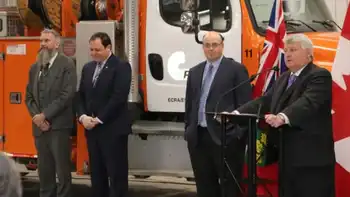
Federal government spends $11.8M for smart grid technology in Sault Ste. Marie
Sault Ste. Marie Smart Grid Investment upgrades PUC Distribution infrastructure with federal funding, clean energy…
View more

Kaspersky Lab Discovers Russian Hacker Infrastructure
Crouching Yeti APT targets energy infrastructure with watering-hole attacks, compromising servers to steal credentials and…
View more
Canada report links interprovincial power ties to stronger grid resilience
Interprovincial Interties report finds wider provincial grid connections can reduce outage risks, lower system costs…
View more
Power Outage in Northeast D.C.
Northeast D.C. Power Outage highlights Pepco substation equipment failure, widespread service disruptions, grid reliability concerns,…
View more

Coal CEO blasts federal agency's decision on power grid
FERC Rejects Trump Coal Plan, denying subsidies for coal-fired and nuclear plants as energy policy…
View more
Sign Up for Electricity Forum’s Newsletter
Stay informed with our FREE Newsletter — get the latest news, breakthrough technologies, and expert insights, delivered straight to your inbox.
Electricity Today T&D Magazine Subscribe for FREE

Stay informed with the latest T&D policies and technologies.
- Timely insights from industry experts
- Practical solutions T&D engineers
- Free access to every issue
