By PJM, the country's first fully functioning regional transmission organization, operates the world's largest competitive wholesale electricity market and North America's largest power grid. The company currently coordinates a pooled generating capacity


Arc Flash Training CSA Z462 - Electrical Safety Essentials

Our customized live online or in‑person group training can be delivered to your staff at your location.

  • Live Online
  • 6 hours Instructor-led
  • Group Training Available
Regular Price:
$249
Coupon Price:
$199
Reserve Your Seat Today
-- The PJM Interconnection detected and took action last week to correct a power trading practice that increased prices.

PJM acted because of the large and growing discrepancy between contract and actual power flows at its interface with American Electric Power (AEP) and its interface with Dominion Virginia Power. PJM was subjected to loop flows in excess of 3,000 MW. The loop flows distorted congestion prices and could have required transmission loading relief (TLR) steps. TLRs curtail transactions that cause loop flows that could overload the transmission system.

"The significant economic distortions needed to be addressed immediately," said Joe Bowring, manager of PJM's independent market monitoring unit. "The result of PJM's action is to align actual power flows more closely with prices, which allows market forces to correct the problem. Our market, using locational marginal pricing, will self-correct for conditions like this when AEP and Dominion become part of PJM."

On July 19, PJM issued a policy that all power sale transactions to or from two North American Electric Reliability Council regions west of PJM would be assigned the price at the PJM-AEP interface regardless of the contract path. The two regions are the East Central Area Reliability Coordination Agreement (ECAR) and the Mid-America Interconnected Network, Inc. (MAIN). The policy was authorized by the PJM Operating Agreement, which states that pricing for sales into PJM should be based on "appropriate flow analysis."

Contracts scheduled through ties between PJM and FirstEnergy (FE) are not affected; they will continue to receive the PJM-FE interface price.

Related News

DOE Announces $34 Million to Improve America?s Power Grid

DOE GOPHURRS Grid Undergrounding accelerates ARPA-E innovations to modernize the power grid, boosting reliability, resilience, and security via underground power lines, AI-driven surveying, robotic tunneling, and safer cable splicing for clean energy transmission and distribution.


Key Points

A DOE-ARPA-E program funding undergrounding tech to modernize the grid and improve reliability and security.

✅ $34M for 12 ARPA-E projects across 11 states

✅ Underground power lines to boost reliability and resilience

✅ Robotics, AI, and safer splicing to cut costs and risks


The U.S. Department of Energy (DOE) has earmarked $34 million for 12 innovative projects across 11 states to bolster and modernize the nation’s power grid, complementing efforts like a Washington state infrastructure grant announced to strengthen resilience.

Under the Grid Overhaul with Proactive, High-speed Undergrounding for Reliability, Resilience, and Security (GOPHURRS) program, this funding is focused on developing efficient and secure undergrounding technologies. The initiative is aligned with President Biden’s vision to strengthen America's energy infrastructure and advance smarter electricity infrastructure priorities, thereby creating jobs, enhancing energy and national security, and advancing towards a 100% clean electricity grid by 2035.

U.S. Secretary of Energy Jennifer M. Granholm emphasized the criticality of modernizing the power grid to facilitate a future powered by clean energy, including efforts to integrate more solar into the grid nationwide, thus reducing energy costs and bolstering national security. This development, she noted, is pivotal in bringing the grid into the 21st Century.

The U.S. electric power distribution system, comprising over 5.5 million line miles and over 180 million power poles, is increasingly vulnerable to weather-related damage, contributing to a majority of annual power outages. Extreme weather events, intensified by climate change impacts across the nation, exacerbate the frequency and severity of these outages. Undergrounding power lines is an effective measure to enhance system reliability for transmission and distribution grids.

Managed by DOE’s Advanced Research Projects Agency-Energy (ARPA-E), the newly announced projects include contributions from small and large businesses, national labs, and universities. These initiatives are geared towards developing technologies that will lower costs, expedite undergrounding operations, and enhance safety. Notable projects involve innovations like Arizona State University’s water-jet construction tool for deploying electrical cables underground, GE Vernova Advanced Research’s robotic worm tunnelling construction tool, and Melni Technologies’ redesigned medium-voltage power cable splice kits.

Other significant projects include Oceanit’s subsurface sensor system for avoiding utility damage during undergrounding and Pacific Northwest National Laboratory’s AI system for processing geophysical survey data. Prysmian Cables and Systems USA’s project focuses on a hands-free power cable splicing machine to improve network reliability and workforce safety, complementing state efforts like California's $500 million grid investment to upgrade infrastructure.

Complete descriptions of these projects can be found on the ARPA-E website, while a recent grid report card highlights challenges these efforts aim to address.

ARPA-E’s mission is to advance clean energy technologies with high potential and impact, playing a strategic role in America’s energy security, including military preparedness for grid cyberattacks as a priority. This commitment ensures the U.S. remains a global leader in developing and deploying advanced clean energy technologies.


Related News

View more

Egypt Plans Power Link to Saudis in $1.6 Billion Project

Egypt-Saudi Electricity Interconnection enables cross-border power trading, 3,000 MW capacity, and peak-demand balancing across the Middle East, boosting grid stability, reliability, and energy security through an advanced electricity network, interconnector infrastructure, and GCC grid integration.


Key Points

A 3,000 MW grid link letting Egypt and Saudi Arabia trade power, balance peak demand, and boost regional reliability.

✅ $1.6B project; Egypt invests ~$600M; 2-year construction timeline

✅ 3,000 MW capacity; peak-load shifting; cross-border reliability

✅ Links GCC grid; complements Jordan and Libya interconnectors


Egypt will connect its electricity network to Saudi Arabia, joining a system in the Middle East that has allowed neighbors to share power, similar to the Scotland-England subsea project that will bring renewable power south.

The link will cost about $1.6 billion, with Egypt paying about $600 million, Egypt’s Electricity Minister Mohamed Shaker said Monday at a conference in Cairo, as the country pursues a smart grid transformation to modernize its network. Contracts to build the network will be signed in March or April, and construction is expected to take about two years, he said. In times of surplus, Egypt can export electricity and then import power during shortages.

"It will enable us to benefit from the difference in peak consumption,” Shaker said. “The reliability of the network will also increase.”

Transmissions of electricity across borders in the Gulf became possible in 2009, when a power grid connected Qatar, Kuwait, Saudi Arabia and Bahrain, a dynamic also seen when Ukraine joined Europe's grid under emergency conditions. The aim of the grid is to ensure that member countries of the Gulf Cooperation Council can import power in an emergency. Egypt, which is not in the GCC, may have been able to avert an electricity shortage it suffered in 2014 if the link with Saudi Arabia existed at the time, Shaker said.

The link with Saudi Arabia should have a capacity of 3,000 megawatts, he said. Egypt has a 450-megawatt link with Jordan and one with Libya at 200 megawatts, the minister said. Egypt will seek to use its strategic location to connect power grids in Asia, where the Philippines power grid efforts are raising standards, and elsewhere in Africa, he said.

In 2009, a power grid linked Qatar, Kuwait, Saudi Arabia and Bahrain, allowing the GCC states to transmit electricity across borders, much like proposals for a western Canadian grid that aim to improve regional reliability. 


Related News

View more

Global CO2 emissions 'flatlined' in 2019, says IEA

2019 Global CO2 Emissions stayed flat, IEA reports, as renewable energy growth, wind and solar deployment, nuclear output, and coal-to-gas switching in advanced economies offset increases elsewhere, supporting climate goals and clean energy transitions.


Key Points

33 gigatonnes, unchanged YoY, as advanced economies cut power emissions via renewables, gas, and nuclear.

✅ IEA reports emissions flat at 33 Gt despite 2.9% GDP growth

✅ Advanced economies cut power-sector CO2 via wind, solar, gas

✅ Nuclear restarts and mild weather aided reductions


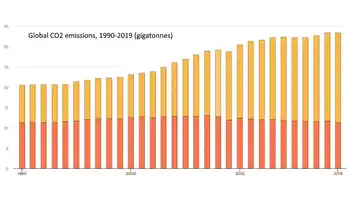
Despite widespread expectations of another increase, global energy-related CO2 emissions stopped growing in 2019, according to International Energy Agency (IEA) data released today. After two years of growth, global emissions were unchanged at 33 gigatonnes in 2019, a notable marker in the global energy transition narrative even as the world economy expanded by 2.9%.

This was primarily due to declining emissions from electricity generation in advanced economies, thanks to the expanding role of renewable sources (mainly wind and solar across many markets), fuel switching from coal to natural gas, and higher nuclear power generation, the Paris-based organisation says in the report.

"We now need to work hard to make sure that 2019 is remembered as a definitive peak in global emissions, not just another pause in growth," said Fatih Birol, the IEA's executive director. "We have the energy technologies to do this, and we have to make use of them all."

Higher nuclear power generation in advanced economies, particularly in Japan and South Korea, avoided over 50 Mt of CO2 emissions. Other factors included milder weather in several countries, and slower economic growth in some emerging markets. In China, emissions rose but were tempered by slower economic growth and higher output from low-carbon sources of electricity. Renewables continued to expand in China, and 2019 was also the first full year of operation for seven large-scale nuclear reactors in the country.

A significant decrease in emissions in advanced economies in 2019 offset continued growth elsewhere. The USA recorded the largest emissions decline on a country basis, with a fall of 140 million tonnes, or 2.9%. US emissions are now down by almost 1 gigatonne from their peak in 2000. Emissions in the European Union fell by 160 million tonnes, or 5%, in 2019 driven by reductions in the power sector as electricity producers move away from coal in the generation mix. Japan’s emissions fell by 45 million tonnes, or around 4%, the fastest pace of decline since 2009, as output from recently restarted nuclear reactors increased.

Emissions in the rest of the world grew by close to 400 million tonnes in 2019, with almost 80% of the increase coming from countries in Asia where coal-fired power generation continued to rise, and in Australia emissions rose 2% due to electricity and transport. Coal-fired power generation in advanced economies declined by nearly 15%, reflecting a sharp fall in coal-fired electricity across multiple markets, as a result of growth in renewables, coal-to-gas switching, a rise in nuclear power and weaker electricity demand.

The IEA will publish a World Energy Outlook Special Report in June that will map out how to cut global energy-related carbon emissions by one-third by 2030 and put the world on track for longer-term climate goals, a pathway that, in Canada, will require more electricity to hit net-zero. It will also hold an IEA Clean Energy Transitions Summit in Paris on 9 July, bringing together key government ministers, CEOs, investors and other major stakeholders.

Birol will discuss the results published today tomorrow at an IEA Speaker Series event at its headquarters with energy and climate ministers from Poland, which hosted COP24 in Katowice; Spain, which hosted COP25 in Madrid; and the UK, which will host COP26 in Glasgow this year, as greenhouse gas concentrations continue to break records worldwide.


Related News

View more

India is now the world’s third-largest electricity producer

India Electricity Production 2017 surged to 1,160 BU, ranking third globally; rising TWh output with 334 GW capacity, strong renewables and thermal mix, 7% CAGR in generation, and growing demand, investments, and FDI inflows.


Key Points

India's 2017 power output reached 1,160 BU, third globally, supported by 334 GW capacity, rising renewables, and 7% CAGR.

✅ 1,160 BU generated; third after China and the US

✅ Installed capacity 334 GW; 65% thermal, rising renewables

✅ Generation CAGR ~7%; demand, FDI, investments rising


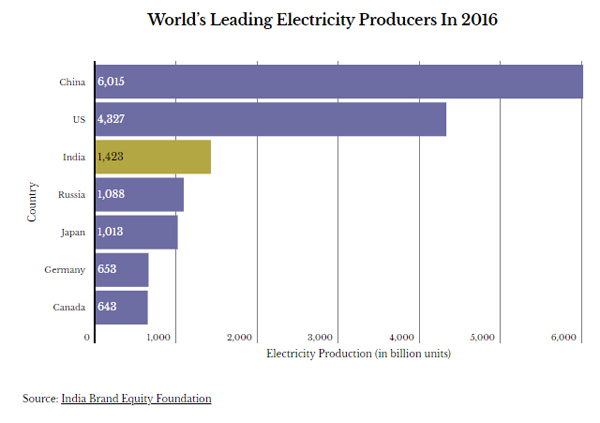
India now generates around 1,160.1 billion units of electricity in financial year 2017, up 4.72% from the previous year, and amid surging global electricity demand that is straining power systems. The country is behind only China which produced 6,015 terrawatt hours (TWh. 1 TW = 1,000,000 megawatts) and the US (4,327 TWh), and is ahead of Russia, Japan, Germany, and Canada.


India’s electricity production grew 34% over seven years to 2017, and the country now produces more energy than Japan and Russia, which had 27% and 8.77% more electricity generation capacity installed, respectively, than India seven years ago.

India produced 1,160.10 billion units (BU) of electricity–one BU is enough to power 10 million households (one household using average of about 3 units per day) for a month–in financial year (FY) 2017. Electricity production stood at 1,003.525 BU between April 2017-January 2018, according to a February 2018 report by India Brand Equity Foundation (IBEF), a trust established by the commerce ministry.

#google#

With a production of 1,423 BU in FY 2016, India was the third largest producer and the third largest consumer of electricity in the world, behind China (6,015 BU) and the United States (4,327 BU).

With an annual growth rate of 22.6% capacity addition over a decade to FY 2017, renewables beat other power sources–thermal, hydro and nuclear. Renewables, however, made up only 18.79% of India’s energy, up 68.65% since 2007, and globally, low-emissions sources are expected to cover most demand growth in the coming years. About 65% of installed capacity continues to be thermal.

As of January 2018, India has installed power capacity of 334.4 gigawatt (GW), making it the fifth largest installed capacity in the world after European Union, China, United States and Japan, and with much of the fleet coal-based, imported coal volumes have risen at times amid domestic supply constraints.

The government is targeting capacity addition of around 100 GW–the current power production of United Kingdom–by 2022, as per the IBEF report.
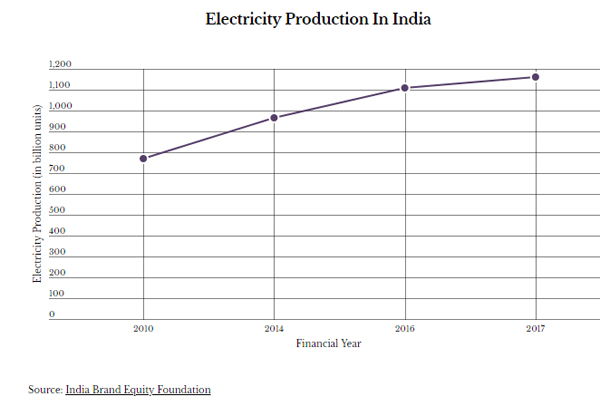


Electricity generation grew at 7% annually

India achieved a 34.48% growth in electricity production by producing 1,160.10 BU in 2017 compared to 771.60 BU in 2010–meaning that in these seven years, electricity production in India grew at a compound annual growth rate (CAGR) of 7.03%, while thermal power plants' PLF has risen recently amid higher demand and lower hydro.


Generation capacity grew at 10% annually

Of 334.5 GW installed capacity as of January 2018–up 60% from 132.30 GW in 2007–thermal installed capacity was 219.81 GW. Hydro and renewable energy installed capacity totaled 44.96 GW and 62.85 GW, respectively, said the report.

The CAGR in installed capacity over a decade to 2017 was 10.57% for thermal power, 22.06% for renewable energy–the fastest among all sources of power–2.51% for hydro power and 5.68% for nuclear power.


Growing demand, higher investments will drive future growth

Growing population and increasing penetration of electricity connections, along with increasing per-capita usage would provide further impetus to the power sector, said the report.

Power consumption is estimated to increase from 1,160.1 BU in 2016 to 1,894.7 BU in 2022, as per the report, though electricity demand fell sharply in one recent period.

Increasing investment remained one of the driving factors of power sector growth in the country.

Power sector has a 100% foreign direct investment (FDI) permit, which boosted FDI inflows in the sector.

Total FDI inflows in the power sector reached $12.97 billion (Rs 83,713 crore) during April 2000 to December 2017, accounting for 3.52% of FDI inflows in India, the report said.


Related News

View more

New York Finalizes Contracts for 23 Renewable Projects Totaling 2.3 GW

New York Renewable Energy Contracts secure 23 projects totaling 2.3 GW, spanning offshore wind, solar, and battery storage under CLCPA goals, advancing 70% by 2030, a carbon-free 2040 grid, grid reliability, and green jobs.


Key Points

State agreements securing 23 wind, solar, and storage projects (2.3 GW) to meet CLCPA clean power targets.

✅ 2.3 GW across 23 wind, solar, and storage projects statewide

✅ Supports 70% renewables by 2030; carbon-free grid by 2040

✅ Drives emissions cuts, grid reliability, and green jobs


In a significant milestone for the state’s clean energy ambitions, New York has finalized contracts with 23 renewable energy projects, as part of large-scale energy projects underway in New York, totaling a combined capacity of 2.3 gigawatts (GW). This move is part of the state’s ongoing efforts to accelerate its transition to renewable energy, reduce carbon emissions, and meet the ambitious targets set under the Climate Leadership and Community Protection Act (CLCPA), which aims to achieve a carbon-free electricity grid by 2040.

A Strong Commitment to Renewable Energy

The 23 projects secured under these contracts represent a diverse range of renewable energy sources, including wind, solar, and battery storage. Together, these projects are expected to contribute significantly to New York’s energy grid, generating enough clean electricity to power millions of homes. The deal is a key component of New York’s broader strategy to achieve a 70% renewable energy share in the state’s electricity mix by 2030 and to reduce greenhouse gas emissions by 85% by 2050.

Governor Kathy Hochul celebrated the agreements as a major step forward in the state’s commitment to combating climate change while creating green jobs and economic opportunities. “New York is leading the nation in its clean energy goals, and these projects will help us meet our bold climate targets while delivering reliable and affordable energy to New Yorkers,” Hochul said in a statement.

The Details of the Contracts

The 23 projects span across various regions of the state, with an emphasis on areas that are well-suited for renewable energy development, such as upstate New York, which boasts vast open spaces ideal for large-scale solar and wind installations and the state is investigating sites for offshore wind projects along the coast. The contracts finalized by the state will ensure a steady supply of clean power from these renewable sources, helping to stabilize the grid and reduce reliance on fossil fuels.

A significant portion of the new renewable capacity will come from offshore wind projects, which have become a cornerstone of New York’s renewable energy strategy. Offshore wind has the potential to provide large amounts of electricity, and the state recently greenlighted the country's biggest offshore wind farm to date, taking advantage of the state's proximity to the Atlantic Ocean. Several of the contracts finalized include offshore wind farm projects, which are expected to be operational within the next few years.

In addition to wind energy, solar power continues to be a critical component of the state’s renewable energy strategy. The state has already made substantial investments in solar energy, having achieved solar energy goals ahead of schedule recently, and these new contracts will further expand the state’s solar capacity. The inclusion of battery storage projects is another important element, as energy storage solutions are vital to ensuring that renewable energy can be effectively utilized, even when the sun isn’t shining or the wind isn’t blowing.

Economic and Job Creation Benefits

The finalization of these 23 contracts will not only bring significant environmental benefits but also create thousands of jobs in the renewable energy sector. Construction, maintenance, and operational jobs will be generated throughout the life of the projects, benefiting communities across the state, including areas near Long Island's South Shore wind proposals that stand to gain from new investment. The investment in renewable energy is expected to support New York’s recovery from the economic impacts of the COVID-19 pandemic, contributing to the state’s clean energy economy and providing long-term economic stability.

The state's focus on clean energy also provides opportunities for local businesses, highlighted by the first Clean Energy Community designation in the state, as many of these projects will require services and materials from within New York State. Additionally, Governor Hochul’s administration has made efforts to ensure that disadvantaged communities and workers from underrepresented backgrounds will have access to job training and employment opportunities within the renewable energy sector.

The Path Forward: A Clean Energy Future

New York’s aggressive move toward renewable energy is indicative of the state’s commitment to addressing climate change and leading the nation in clean energy innovation. By locking in contracts for these renewable energy projects, the state is not only securing a cleaner future but also ensuring that the transition is fair and just for all communities, particularly those that have been historically impacted by pollution and environmental degradation.

While the finalized contracts mark a major achievement, the state’s work is far from over. The completion of these 23 projects is just one piece of the puzzle in New York’s broader strategy to decarbonize its energy system. To meet its ambitious targets under the CLCPA, New York will need to continue investing in renewable energy, energy storage, grid modernization, and energy efficiency programs.

As New York moves forward with its clean energy transition, and as BOEM receives wind power lease requests in the Northeast, the state will likely continue to explore new technologies and innovative solutions to meet the growing demand for renewable energy. The success of the 23 finalized contracts serves as a reminder of the state’s leadership in the clean energy space and its ongoing efforts to create a sustainable, low-carbon future for all New Yorkers.

New York’s decision to finalize contracts with 23 renewable energy projects totaling 2.3 gigawatts represents a bold step toward meeting the state’s clean energy and climate goals. These projects, which include a mix of wind, solar, and energy storage, will contribute significantly to reducing the state’s reliance on fossil fuels and lowering greenhouse gas emissions. With the additional benefits of job creation and economic growth, this move positions New York as a leader in the nation’s transition to renewable energy and a sustainable future.


Related News

View more

Hydro-Quebec shocks cottage owner with $5,300 in retroactive charges

Hydro-Quebec back-billing arises from analogue meter errors and estimated consumption, leading to arrears for electricity usage; disputes over access, payment plans, and potential power diversion reviews can impact cottage owners near Gatineau.


Key Points

Hydro-Quebec back-billing recovers underbilled electricity from analogue meter errors or prolonged estimated use.

✅ Triggered by inaccurate analogue meters or missed readings

✅ Based on actual usage versus prior estimated consumption

✅ Payment plans may spread arrears; theft checks may adjust


A relaxing lakefront cottage has become a powerful source of stress for an Ottawa woman who Hydro-Quebec is charging $5,300 to cover what it says are years of undercharging for electricity usage.

The utility said an old analogue power meter is to blame for years of inaccurate electricity bills for the summer getaway near Gatineau, Que.

Separate from individual billing issues, Hydro-Quebec has also reported pandemic-related losses earlier this year.

Owner Jan Hodgins does not think she should be held responsible for the mistake, nor does she understand how her usage could have surged over the years.

“I’m very hydro conscious, because I was raised that way. When you left a room, you always turned the light out,” she told CTV Montreal on Wednesday, relating her shock after receiving some hefty bills from Hydro-Quebec on Sept. 22.

Hodgins said she mainly uses the cottage on weekends, does not heat the place when she is not there, and does not use a washer or dryer, to keep her energy footprint as small as possible. She’s owned the cottage for 14 years, during which she says her monthly bill has hovered around $40.

Hydro-Quebec said it has not had an accurate reading of her usage for several years, relying instead on consumption estimates to determine what she pays. The company recently reviewed her energy consumption back to 2014, and found their estimates were not accurate.

“In the past, she was consuming about 10 to 15 kilowatt hours per day. This summer she was more around 40 kilowatt hours per day,” Marc-Antoine Pouliot with Hydro-Quebec told CTV Ottawa.

Hodgins said that means her regular bill will now be more than twice the $200 her neighbours are paying for hydro each month, even with peak hydro rates in place.

Hydro-Quebec said it will correct the bill if its technicians discover that someone is illegally diverting power nearby.

Hodgins said it’s not her fault that technicians did not check her meter in person, and chose to rely on inaccurate estimates. Pouliot argues that reaching her cottage was too difficult.

“There was too much snow. There were conditions during the winter disconnection ban period, and the consequence was that people, our workers, were not able to reach the meter,” he said.

Hydro-Quebec said it is willing to stretch out the debt into monthly payments over a year, which Hodgins said amount to $440 per month on top of her regular bill.

Utilities also caution customers about scammers threatening shutoffs during billing disputes.

“I’m on a fixed income. I don’t have that kind of money. I’m completely distraught,” she said. “I don’t know what I’m going to do.”


Related News

View more

Sign Up for Electricity Forum’s Newsletter

Stay informed with our FREE Newsletter — get the latest news, breakthrough technologies, and expert insights, delivered straight to your inbox.

Electricity Today T&D Magazine Subscribe for FREE

Stay informed with the latest T&D policies and technologies.
  • Timely insights from industry experts
  • Practical solutions T&D engineers
  • Free access to every issue

Download the 2025 Electrical Training Catalog

Explore 50+ live, expert-led electrical training courses –

  • Interactive
  • Flexible
  • CEU-cerified