Smart Electric Grid Operational Control
By William Conklin, Associate Editor
By William Conklin, Associate Editor
Request for Quotation Service
Buyers Submit Free RFQs to top suppliers, no obligation.
Suppliers Browse real project RFQs directly from buyers.
Trust Electricity Forum 40 years connection buyers and suppliers.
A smart electric grid determines how utilities detect faults, validate system state, coordinate DERs, and execute switching through SCADA integration, automation, distributed sensors, and real-time analytics. Its defining function is not modernization. It is enforcing confidence discipline when system conditions are changing faster than operators can see.
It decides whether automated action stabilizes or destabilizes a feeder. The architecture must ensure that topology models, protection logic, and telemetry remain synchronized with field reality. If that synchronization erodes, switching authority becomes conditional rather than deterministic.
In distribution systems saturated with bidirectional flows and high endpoint density, the control room does not operate from a static model. It operates from a continuously decaying one that must be refreshed faster than the disturbance propagates. If validation cycles lag behind reconfiguration events, topology drift accumulates. A minor mapping error during feeder sectionalizing can cascade across adjacent circuits, distorting load direction, masking reverse flow, and misaligning protection assumptions.
The question is not whether digital assets are deployed. The question is whether the smart electric grid architecture arrests confidence decay before automated decisions compound small errors into large operational consequences.
This page is not a catalog of technologies and not a modernization roadmap. It describes the operational doctrine layer of the smart electric grid. Devices, analytics, and communications only matter insofar as they preserve model integrity at the moment of actuation. When doctrine collapses, technology cannot compensate.
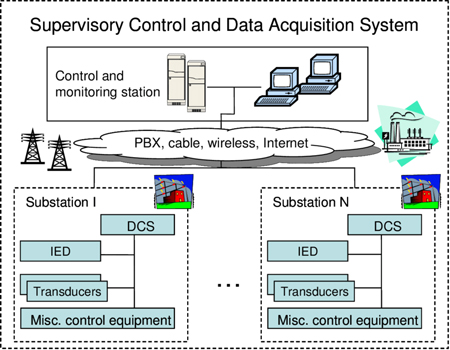
A smart electric grid functions as an operational state authority layer that reconciles SCADA telemetry, endpoint measurements, device status, and network topology into a validated control boundary. If that reconciliation lags behind field conditions by even seconds during a fault event, misoperation risk increases.
Download our FREE Electrical Training Catalog and explore a full range of expert-led electrical training courses.

State estimation does not fail abruptly. It decays under timestamp skew, partial telemetry loss, asynchronous polling cycles, and unmodeled switching events. Each minor deviation widens the gap between calculated topology and physical configuration. That widening is often sub-visual to operators until an automated sequence acts on a topology that is technically valid in the model but incorrect in the field.
During high-load summer peaks, feeder backfeed from distributed energy resources can distort apparent load direction. If reverse power flow is misclassified, automated recloser logic may attempt to restore power in unstable conditions. That single misinterpretation can cascade into transformer overload, lateral voltage collapse, and extended outages across thousands of endpoints.
Operational authority, therefore, depends on disciplined integration with SCADA architecture and validated state estimation models. Utilities that rely on legacy polling intervals without synchronized timestamp discipline often experience a degradation in topology confidence during switching sequences. The result is delayed restoration and manual override intervention.
In large deployments exceeding 2 million endpoints, utilities have reported reductions in restoration time of 18 percent when topology validation cycles are compressed to sub-five-second intervals. That quantified improvement is not driven solely by analytics. It is driven by tighter coupling between telemetry ingestion and switching logic.
A smart electric grid must therefore maintain alignment with How Does SCADA Work and structured SCADA Architecture to preserve command authority across substations and feeders.
The most dangerous failure in a smart electric grid is not a hardware outage. It is false confidence. When model accuracy drops below operational tolerance, automated decisions amplify disturbance rather than contain it.
Consider a feeder experiencing partial vegetation contact. Voltage fluctuation signatures appear in distributed sensors, yet remain below relay trip thresholds. If the anomaly detection confidence is miscalibrated, the system may either ignore precursor instability or generate false positives, eroding operator trust. Both outcomes degrade decision discipline.
Threshold governance becomes central. If anomaly detection precision falls below 95 percent during storm conditions, automated switching should revert to supervised control. That constraint prevents cascading misoperation across adjacent feeders.
The architecture must also align with Smart Grid Monitoring and Smart Grid Analytics to ensure signal interpretation does not drift from physical system behavior.
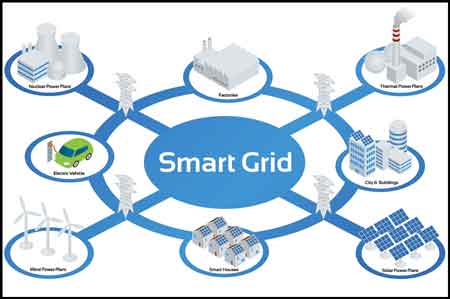
The smart electric grid must operate coherently across distribution grids and the broader transmission and distribution system, where renewable energy sources, energy storage systems, and smart meters continuously reshape load direction and stability margins.
In large-scale power grids, real-time information is not a convenience but a control requirement, especially when energy management decisions must prevent localized instability from escalating into widespread power outages. Smart grid technologies only fulfill their purpose when they reinforce operational state integrity across interconnected infrastructure.
Building a smart electric grid involves trade-offs among latency, bandwidth, and cybersecurity. Increasing telemetry frequency improves state visibility but expands the attack surface and data congestion. Reducing latency improves restoration speed but may strain the communications infrastructure during peak events.
Integration friction often emerges at the boundary between distributed intelligence and centralized control. Edge processing can pre-filter noise and compress data streams, yet excessive edge autonomy risks inconsistent decision criteria across feeders.
Utilities exploring deeper edge integration must align with Smart Grid Edge Computing and maintain a disciplined Grid Cybersecurity Strategy to prevent unauthorized command injection during high velocity switching operations.
Stay informed with our FREE Smart Grid Newsletter — get the latest news, breakthrough technologies, and expert insights, delivered straight to your inbox.
The smart electric grid is therefore not defined by its devices. It is defined by how it enforces control boundary validation under stress.
During wildfire conditions or extreme weather events, topology uncertainty does not expand linearly. It can widen abruptly as communications degrade, DER output fluctuates, and protective settings are temporarily adjusted. If validation cannot keep pace with reconfiguration velocity, restoration logic becomes a liability.
Engineers must treat the smart electric grid as a living control boundary, not a fixed architecture. Authority must be earned continuously through reconciliation of telemetry, switching logic, cybersecurity posture, and threshold discipline.
This architecture intersects with Digital Grid Solutions and long-term Grid Modernization programs, but its purpose is narrower. It protects operational authority at the moment of decision.
Some utilities discover this only after a review of a misoperation. Others design it in advance. The difference is whether the grid was treated as a technology deployment or as an operational doctrine.
Advantages To Instructor-Led Training – Instructor-Led Course, Customized Training, Multiple Locations, Economical, CEU Credits, Course Discounts.
Request For QuotationWhether you would prefer Live Online or In-Person instruction, our electrical training courses can be tailored to meet your company's specific requirements and delivered to your employees in one location or at various locations.