Smart Grid Technologies in Utility Operations
By William Conklin, Associate Editor
By William Conklin, Associate Editor
Request for Quotation Service

Buyers Submit Free RFQs to top suppliers, no obligation.
Suppliers Browse real project RFQs directly from buyers.
Trust Electricity Forum 40 years connection buyers and suppliers.
Smart grid technologies determine how utilities detect faults, automate switching, integrate distributed energy, and contain cyber exposure by expanding real-time visibility, control automation, analytics, and resilience across transmission and distribution networks.
Smart grid technologies are not abstract innovations. They are deployed control assets that compress detection time, shorten restoration intervals, and reduce cyber containment exposure. Technology selection is therefore not cosmetic modernization. It directly alters operational risk.
Utilities implementing these technologies are redesigning visibility boundaries. Where traditional grids relied on substation-level telemetry, modern deployments extend sensing, communication, and automation deep into distribution circuits. The result is improved fault isolation, reduced outage duration, and measurable improvement in reliability indices.
The engineering question is not which technology is newest. It is the combination of technologies that compresses uncertainty without introducing unacceptable integration risk.
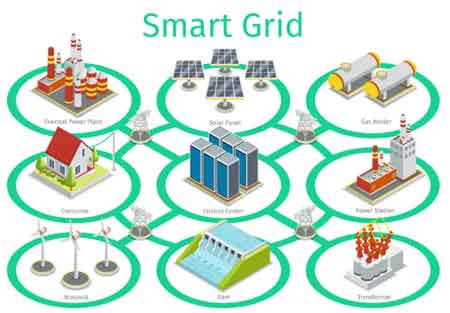
Smart grid technologies function as a layered deployment stack across sensing, communications, control platforms, analytics, and resilience systems. Each layer changes how operators perceive and manage grid conditions.
Field-level visibility begins with improved measurement devices for current, voltage, and power quality. Lateral sensors, fault indicators, and digital relays extend awareness beyond substations. Advances described in Improved Sensor Technology enable the detection of previously invisible transient events.
However, sensor density introduces challenges with data volume. Without disciplined filtering and event prioritization, operators face alert fatigue. Increasing visibility without structured interpretation can increase operational noise rather than reduce uncertainty.
Smart grid deployment depends on secure and resilient communications. Fiber backbones, cellular networks, RF mesh, and private LTE systems support telemetry exchange and control signaling. Grid-wide coordination depends on reliable Grid Connectivity and disciplined communication architecture.
Stay informed with our FREE Smart Grid Newsletter — get the latest news, breakthrough technologies, and expert insights, delivered straight to your inbox.
The tradeoff is latency and vulnerability. High-bandwidth systems enable real-time analytics but expand the attack surface. Operational continuity planning must integrate cybersecurity architecture as described in Grid Cybersecurity Strategy.
Supervisory systems remain central to smart grid operations. Modern implementations expand traditional SCADA into integrated platforms capable of automated switching, state estimation, and distributed control. The evolution of this architecture is examined in SCADA Architecture, and the operational mechanics in How Does SCADA Work.
Integration complexity is a primary deployment constraint. Legacy devices, proprietary protocols, and inconsistent data models can delay modernization by years. Poor integration discipline can produce switching misoperations or topology errors. Automation increases speed, but it also reduces margin for human correction.
A quantified authority signal from large-scale deployments shows that utilities integrating advanced control and sensing across more than one million endpoints have achieved reductions in outage duration exceeding 15 percent when automation is validated against topology models. Below that validation threshold, automation can amplify error propagation.
Data interpretation is where smart grid technologies transition from monitoring to predictive control. Advanced platforms discussed in Data Analytics and Smart Grid Analytics transform raw telemetry into actionable intelligence.
Analytics introduce model risk. State estimation accuracy depends on measurement density and data latency. False positives in anomaly detection can trigger unnecessary switching. In distributed energy environments, inverter behavior and harmonic distortion complicate predictive models.
The sentence that increases decision gravity is simple. Automation without model discipline increases systemic risk.
Storage systems, microgrids, and distributed energy resources represent another critical technology domain. The economic and operational considerations described in Cost of Different Storage Systems for Smart Grids influence how utilities balance resilience with capital expenditure.
Storage improves contingency response and peak management. However, bidirectional power flow alters protection coordination and fault current calculations. Hosting capacity errors can introduce reverse power conditions and nuisance tripping.
Smart grid technologies expand digital dependency. Federal advisories such as those referenced in DHS FBI Alert demonstrate that grid modernization also increases cyber accountability.
Security architecture must evolve in parallel with automation. Network segmentation, authentication controls, and anomaly detection systems are no longer optional layers. They are containment mechanisms.
Smart grid technologies represent the implementation layer of the broader smart grid transformation. While "What Is Smart Grid" defines the conceptual shift toward digital intelligence, this page examines the technologies utilities deploy to achieve it.
Technology selection determines whether modernization improves reliability or introduces new failure modes. Visibility expansion, automation speed, storage integration, and cybersecurity architecture must function as a coordinated system rather than isolated upgrades.
Smart grid technologies, therefore, operate not as standalone tools, but as interdependent control assets shaping the reliability envelope of modern electric networks.

Explore 50+ live, expert-led electrical training courses –