Smart Grid Internet of Things (OT) Architecture
By William Conklin, Associate Editor
By William Conklin, Associate Editor
Request for Quotation Service
Buyers Submit Free RFQs to top suppliers, no obligation.
Suppliers Browse real project RFQs directly from buyers.
Trust Electricity Forum 40 years connection buyers and suppliers.
Smart grid Internet of Things governs distributed endpoint trust, SCADA synchronization, DER telemetry validation, and device-level control integrity to prevent unstable automation, feeder misalignment, and cascading operational risk across transmission and distribution systems.
The Smart Grid Internet of Things is not a monitoring enhancement, and it is not a digital orchestration platform. It is the distributed endpoint confidence layer that governs whether field telemetry can be relied upon inside automated control logic.
The operational question is not how much data is collected. The question is whether endpoint measurements remain synchronized, authenticated, and within tolerance before automation executes.
The Smart Grid Internet of Things becomes a control discipline when endpoint density exceeds the capacity for human verification. Modern utilities operate millions of field devices, including sensors, reclosers, regulators, voltage monitors, and DER interconnection nodes.
At that scale, even a 1% telemetry distortion across 2 million endpoints results in 20,000 potential control inaccuracies. That is not a data problem. It is a control integrity problem.
This distributed trust layer underpins Smart Grid Monitoring, but it precedes it. Monitoring assumes measurement credibility. IoT governance determines whether that credibility exists.
If timestamp alignment, authentication, or signal coherence degrade, automated switching, voltage regulation, and DER coordination become mathematically unstable.
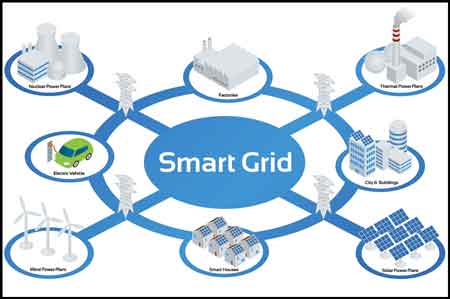
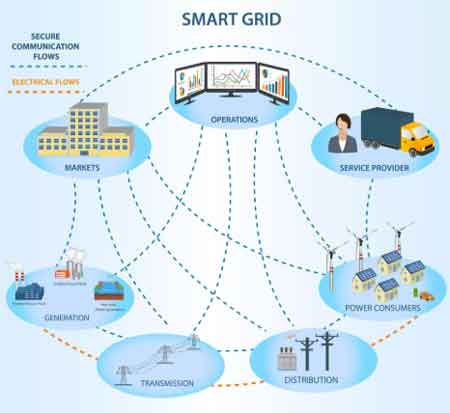
Smart grid IoT operates across advanced metering infrastructure, distributed energy interconnections, and electric vehicle charging nodes where IoT devices enable real time state validation before automation executes.
In a modern power grid saturated with bidirectional flow and decentralized energy management logic, endpoint credibility determines whether DER output, EV demand spikes, and feeder telemetry remain aligned inside protection and switching thresholds.
Download our FREE Electrical Training Catalog and explore a full range of expert-led electrical training courses.

Smart grid IoT does not merely collect signals. It governs whether distributed measurements can be trusted within automated control boundaries.
Distributed endpoints must align with central state estimation models within defined confidence thresholds. If device readings diverge from the modeled feeder state beyond tolerance, automated actions should be inhibited.
A 95 percent correlation threshold during contingency conditions is not a software preference. It is a protection boundary embedded within SCADA Architecture.
Without explicit confidence gating, corrupted telemetry introduces false certainty. False certainty is more dangerous than missing data because it triggers automation based on incorrect assumptions.
This is the structural distinction between endpoint governance and Digital Grid Solutions, which orchestrate higher-level control once trust is established.
Consider a lightly loaded feeder during high solar export. A voltage endpoint reporting stale measurement data triggers unnecessary capacitor switching.
The switching action propagates through regulator tap changes and inverter response curves. What began as one stale endpoint reading becomes a feeder-wide oscillation.
The failure is not in analytics or transport. It is in the endpoint confidence discipline. That discipline operates beneath Smart Grid Communication, which moves data but does not validate its integrity.
Control automation executed without validating measurement freshness.
Every distributed device extends the operational attack surface. Secure boot, identity validation, and certificate rotation are control-integrity requirements that are governed within a broader Grid Cybersecurity Strategy.
Compromised telemetry feeds incorrect load or voltage state into protection logic. If endpoint identity validation fails, automation must default to containment.
Threat escalation dynamics similar to those described in DHS FBI Alert illustrate that operational technology targeting increasingly focuses on distributed endpoints.
The cascading sequence is structural:
Endpoint misalignment reduces state confidence.
Reduced state confidence should inhibit automation.
If inhibition does not occur, unstable switching executes.
Unstable switching increases outage duration and regulatory exposure.
At scale, endpoint discipline determines restoration performance and directly influences how utilities can keep the lights on, a reliability objective further explored in How Utilities Can Keep the Lights On.
Smart grid internet of things defines whether distributed endpoints operate as trusted control inputs or as uncontrolled telemetry streams.
The tradeoff is explicit. Increasing endpoint density improves visibility but multiplies synchronization and authentication complexity.
Speed without validation increases instability risk.
Validation without speed increases response delay.
Utilities must define where that boundary sits.
Smart grid internet of things, therefore, governs distributed endpoint confidence and control integrity at the device scale. It determines whether automation operates inside verified state alignment or inside an assumption.
Stay informed with our FREE Smart Grid Newsletter — get the latest news, breakthrough technologies, and expert insights, delivered straight to your inbox.
Advantages To Instructor-Led Training – Instructor-Led Course, Customized Training, Multiple Locations, Economical, CEU Credits, Course Discounts.
Request For QuotationWhether you would prefer Live Online or In-Person instruction, our electrical training courses can be tailored to meet your company's specific requirements and delivered to your employees in one location or at various locations.