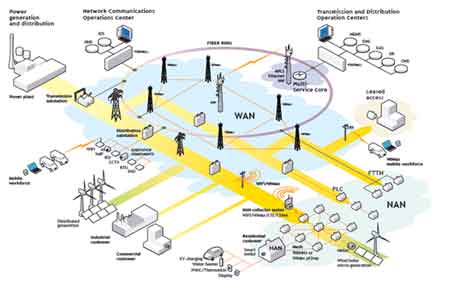
Smart Power Grid System Architecture
By William Conklin, Associate Editor
By William Conklin, Associate Editor
Request for Quotation Service
Buyers Submit Free RFQs to top suppliers, no obligation.
Suppliers Browse real project RFQs directly from buyers.
Trust Electricity Forum 40 years connection buyers and suppliers.
Smart power grid system architecture integrates SCADA control, sensor telemetry, smart substations, and distributed intelligence to manage fault isolation, DER variability, and cyber risk while preserving model confidence thresholds in real-time distribution operations.
A smart power grid system is not a modernization label. It is the operational boundary that determines whether distribution and transmission assets behave predictably under load, DER injection, and contingency stress.
In a saturated feeder with rooftop solar, inverter backfeed, and automated reclosers, state confidence becomes the controlling variable. If telemetry latency exceeds tolerance, switching authority degrades. If model alignment drifts from field conditions, automated logic amplifies disturbance rather than containing it.
The distinction between resilience and instability is rarely evident in architectural diagrams. It emerges at the control room interface, where operators must trust that topology, voltage, and breaker status reflect physical reality within seconds, not minutes.
A smart power grid system operates as a layered hierarchy. Field devices report through secure communications to substation controllers and enterprise platforms. The hierarchy must preserve deterministic behavior. When packet loss, sensor noise, or synchronization drift exceed threshold, the model must degrade gracefully rather than fail silently.
This is where SCADA architecture and smart substation design intersect. Protection schemes and automation logic cannot assume perfect data continuity. A 98.7 percent state estimation accuracy may appear acceptable statistically, but the remaining 1.3 percent becomes critical during peak load transfer.
If model confidence falls below operational tolerance during a feeder reconfiguration, a single misclassified open point can cascade. Automated switching isolates the wrong segment. Load shifts to an already stressed transformer. Voltage dips trigger inverter ride-through instability. What began as a localized fault becomes a multi-feeder outage.
Think you know Smart Grid? Take our quick, interactive quiz and test your knowledge in minutes.
This cascading consequence is not theoretical. Large utilities operating more than two million endpoints have reported reductions in restoration time of 18 to 25 percent after tightening telemetry validation thresholds and enforcing stricter topology reconciliation. The improvement did not come from adding devices. It came from enforcing discipline.
Distributed intelligence introduces a tradeoff. Edge computing reduces latency and improves situational awareness, but it fragments control logic. Centralized orchestration strengthens governance, but increases communication dependency.
A smart power grid system must define where authority resides. When DER penetration exceeds 30 percent of feeder capacity, inverter coordination requires near real-time response. Relying solely on centralized analytics creates a delay. Over-distributing logic increases configuration complexity and cyber exposure.
The architecture, therefore, becomes an engineering negotiation between speed and control.smart grid communication reliability, bandwidth limits, and encryption overhead all influence whether distributed automation is justified.
No model is perfect. Load forecasts, DER output projections, and voltage regulation algorithms operate within bounded uncertainty. A smart power grid system must declare its acceptable error band.
When predictive models exceed their validated range, the system must shift from autonomous mode to operator-supervised control. Failure to enforce this constraint creates a false sense of confidence. Over time, automation bias develops. Operators trust the model beyond its tested conditions.
The issue is not analytics capability. It is governance. Pages such as smart grid analytics and digital grid solutions explore tooling depth, but tooling without threshold discipline increases systemic risk.
One operational edge case illustrates this clearly. During high DER export on a mild spring afternoon, feeder voltage may rise while net load appears low. If telemetry aggregation masks localized reverse flow at a lateral, the model underestimates transformer heating. Protection remains armed for traditional load direction. A single misinterpreted voltage excursion can unnecessarily trip upstream devices.
The smart power grid system must therefore reconcile granular sensing with system-wide authority. That includes validated grid connectivity mapping and enforced grid cybersecurity strategy segmentation so that expanded visibility does not expand the attack surface.
A smart power grid system determines whether a control room action stabilizes or destabilizes a feeder. That sentence carries engineering gravity. Automated switching, adaptive protection, and DER coordination are not modernization features. They are risk multipliers if misaligned.
This architecture also reframes grid modernization. Modernization is not device count. It is a reduction of uncertainty per operational decision.
Utilities that quantify model confidence, enforce telemetry validation thresholds, and discipline integration boundaries achieve measurable reliability gains. Those who pursue device density without governance inherit complexity without control.
A smart power grid system succeeds when it compresses uncertainty faster than disturbances propagate. When it fails, it accelerates instability.

Explore 50+ live, expert-led electrical training courses –