Advanced Distribution Management System Benefits Explained
By Manuel Atanacio, ESTA International
By Manuel Atanacio, ESTA International
Request for Quotation Service
Buyers Submit Free RFQs to top suppliers, no obligation.
Suppliers Browse real project RFQs directly from buyers.
Trust Electricity Forum 40 years connection buyers and suppliers.
Advanced distribution management system benefits include centralized grid control, real-time feeder visibility, automated fault isolation, Volt/VAR optimization, and DER integration, allowing utilities to improve reliability, reduce outages, and maintain stable, safe distribution operations.
Utilities do not lose reliability because equipment suddenly fails. They lose reliability because they lack immediate operational control over evolving grid conditions. When operators cannot see or control real-time feeder behavior, outages propagate, restoration slows, and grid stability becomes dependent on manual intervention.
It becomes the system responsible for maintaining operational authority over the distribution network, allowing utilities to actively control stability, restoration, and performance rather than respond after consequences emerge. This operational authority is what defines an Advanced Distribution Management System, separating it from legacy monitoring platforms that lack execution control.
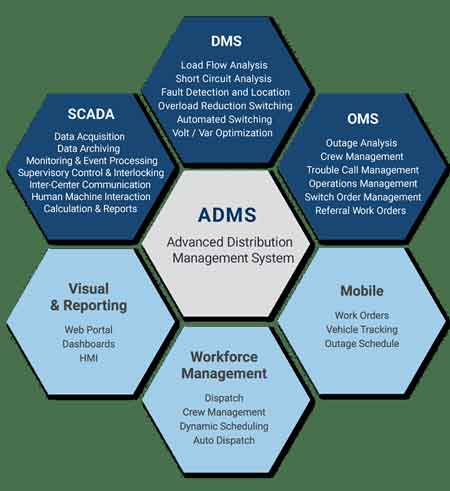
Before advanced distribution control systems, operational responsibility was fragmented across SCADA, outage management, engineering tools, and manual switching procedures. Operators could see parts of the network but lacked unified control authority across the full distribution topology. ADMS consolidates those functions into a single operational platform that continuously maintains awareness of feeder topology, device status, and electrical conditions. This unified awareness depends on accurate, continuously synchronized Grid Modeling, which ensures that operators always understand the network's true electrical configuration.
This centralized control authority allows operators to issue switching commands with full knowledge of downstream impact. When feeder configuration changes, the system immediately reflects those changes in the electrical model. This prevents unsafe switching sequences, reduces restoration delays, and ensures switching actions stabilize rather than destabilize the system. In practice, this capability eliminates many operational blind spots that historically have extended outage duration and increased operational risk.

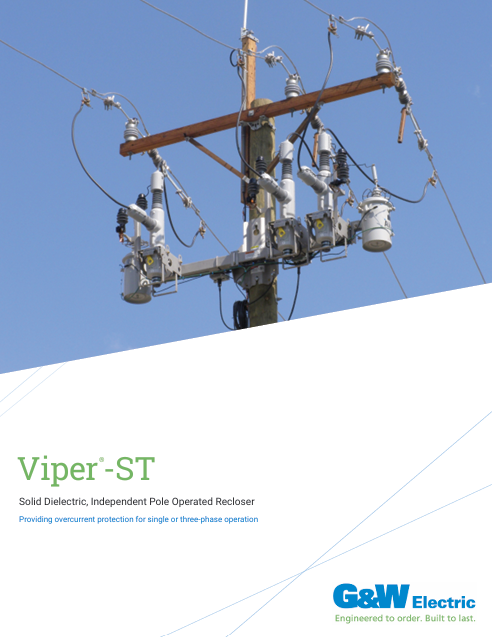
One of the most operationally significant capabilities of ADMS is its ability to detect, isolate, and restore service automatically following faults. Fault location isolation and service restoration functions use real-time telemetry, protective device status, and feeder topology models to identify the most probable fault location and execute switching actions to isolate the affected segment. These restoration workflows are strengthened by integrated Electrical Fault Detection systems that continuously evaluate abnormal feeder behavior before failures propagate.
This process reduces restoration time because operators no longer need to manually analyze outage reports and determine switching plans under time pressure. Instead, the system identifies restoration paths and executes switching sequences in seconds. Customers outside the faulted section regain service quickly, and operators retain complete visibility and control over the restoration process. Utilities that deploy this capability consistently report measurable reductions in outage duration and improved reliability.
Distribution voltage control has always required balancing competing objectives. Voltage must remain within limits across the entire feeder while minimizing losses and avoiding equipment stress. Traditionally, this balancing act relied on fixed regulator settings and operator intervention. ADMS changes voltage control from a static configuration problem into a continuously optimized operational function.
Volt/VAR optimization applications analyze feeder voltage profiles, load conditions, and reactive power flows in real time. The system coordinates capacitor banks, voltage regulators, and DER voltage support to maintain voltage stability across the feeder. This optimization process relies heavily on high-resolution telemetry, including AMI Data, which provides real-time voltage, load, and outage indicators that strengthen ADMS operational awareness and model accuracy.
Operational control is only as effective as the visibility supporting it. ADMS continuously integrates telemetry from SCADA, metering infrastructure, and field devices into a unified operational view. Operators can see actual feeder configuration, power flow, and device status as conditions evolve. These capabilities form the foundation of modern Grid Management Solutions, allowing utilities to transition from passive monitoring to active operational control.
This continuous awareness allows operators to anticipate developing issues rather than reacting to failures after they occur. If load begins to exceed feeder limits or voltage drifts outside acceptable ranges, corrective action can be taken before service disruption occurs. This shift from reactive response to proactive control fundamentally improves grid stability and operational confidence.
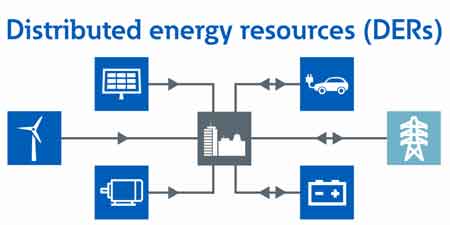
Distributed energy resources introduce operational complexity because they add variable generation and bidirectional power flow to systems originally designed for one-directional power delivery. ADMS integrates DER behavior into the operational model, allowing operators to understand and manage their impact. This coordination occurs alongside the Distributed Energy Resource Management System, which manages individual DER devices while ADMS maintains overall grid authority.
While DER management platforms provide communication and coordination with distributed resources, ADMS remains the operational authority responsible for maintaining feeder stability. The relationship between control platforms is further clarified in ADMS vs DERMS, where ADMS maintains switching authority, topology control, and overall operational responsibility.
The operational efficiency gains from ADMS extend beyond reliability improvement. Many manual operational tasks are replaced by automated, model-driven analysis and control. Switching plans, restoration sequences, and voltage-optimization strategies are generated from real-time electrical models rather than manual interpretation.
Stay informed with our FREE Grid Optimization, DER & Flexibility Newsletter — get the latest news, breakthrough technologies, and expert insights, delivered straight to your inbox.
This reduces operator workload while improving decision quality. Operators supervise system behavior rather than manually calculating operational responses. As distribution systems grow more complex, this shift becomes essential. Manual operational control cannot scale to manage high DER penetration, dynamic load behavior, and increasingly complex feeder configurations.
Distribution systems are no longer passive delivery networks. They are dynamic operational environments requiring continuous control and coordination. Advanced distribution management systems provide the operational authority needed to maintain stability, reliability, and safety under these conditions.
Utilities that rely on fragmented operational tools remain constrained by incomplete visibility and delayed response capability. Those that deploy ADMS operate with full awareness of network conditions and can execute coordinated control actions immediately. The result is not just improved reliability metrics, but fundamentally stronger operational control over the distribution grid itself.
Explore 50+ live, expert-led electrical training courses –