Distribution Line Monitoring for OT Fault Visibility
By Jack Nevida, P.E. Principal Engineer Distribution Integration, SRP
By Jack Nevida, P.E. Principal Engineer Distribution Integration, SRP
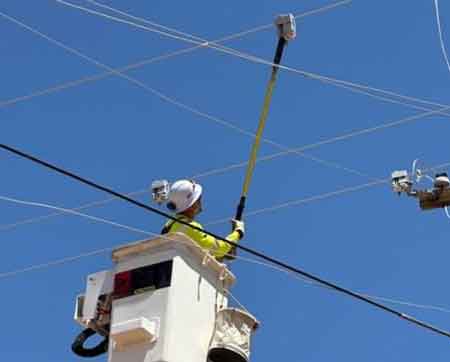
Distribution line monitoring eliminates structural search delay in feeder restoration. When a breaker trips without downstream visibility, patrol distance dictates outage duration. Each mile walked from the substation multiplies customer minutes of interruption and increases exposure on high-risk circuits.
On a mid-line fault, crews traditionally begin at the substation and work outward. A 185-minute interruption affecting 20 customers produces 3,700 customer minutes of interruption. That outcome is not a protection failure. It is a visibility failure.
Distribution line monitoring shifts patrol origin. When line sensors report fault magnitude and direction in near real time, crews deploy directly to the faulted section. In one documented case, restoration time fell to 130 minutes, reducing impact by 1,100 customer minutes.
The operational risk is governance. Sensors without defined ownership for provisioning, firmware control, health monitoring, and ADMS point validation introduce a new failure mode. Telemetry drift can misdirect switching decisions as effectively as no telemetry at all.
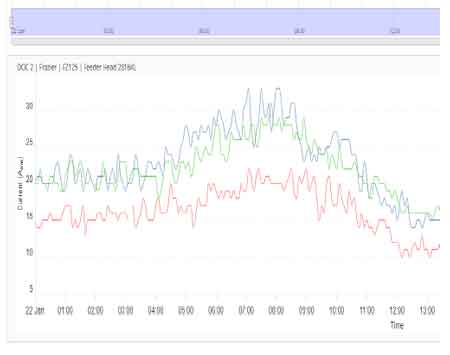
Distribution line monitoring is not simply fault indication. It is a distributed sensing architecture that feeds current, waveform, and status data into the operational technology environment. When integrated through secure gateways into ADMS, sensors provide:
• Fault current magnitude and waveform data
• Directional indication for isolation decisions
• Power flow validation inputs
• Event timestamps synchronized with breaker operations
In one high-risk feeder example, outage time dropped from 185 minutes to 130 minutes, resulting in a reduction of 1,100 customer minutes of interruption for only 20 customers. At scale across thousands of feeders, the compounded reliability effect becomes material to SAIDI and wildfire mitigation exposure.
Stay informed with our FREE Asset Intelligence & Predictive Maintenance Newsletter — get the latest news, breakthrough technologies, and expert insights, delivered straight to your inbox.
Strategic deployment is not uniform. Sensors placed on critical circuits, in fire risk zones, and on feeders with unknown outage causes deliver disproportionate value. Utilities with more than 80 percent underground distribution face additional complexity because patrol distance and excavation time amplify restoration delays.
The decision is not about deploying everywhere. It is where telemetry changes the operational outcome. Feeder sections with historical vegetation exposure, electromechanical relay blind spots, or difficult terrain are high-leverage zones.
Consider a dry, wind-driven event on a high-fire-risk feeder. Without directional field sensing, a breaker lockout triggers full feeder interruption. Crew dispatch begins from the substation. If the fault is mid-line, patrol delay increases the ignition exposure window. A secondary conductor slap or reclose attempt under mislocated fault conditions can escalate from a single interruption to a multi-feeder outage. Distribution line monitoring compresses the uncertainty window and narrows patrol origin, reducing cascading operational exposure.
Sensor value is unlocked only when integrated into the control layer. Integration choices introduce tradeoffs. Cloud-based gateways reduce on-premises resource burden but require secure VPN tunneling and OT network segmentation. High security operations centers introduce additional review cycles but enhance cyber posture.
Utilities that defer ownership decisions for provisioning, firmware updates, and health monitoring create long-term asset drift. Devices outside substations do not align cleanly with traditional relay ownership models. Early governance decisions prevent operational orphaning.
Sensor data becomes actionable when paired with Grid Management Solutions and validated against Grid Modeling. Power flow telemetry supports model calibration, reducing state estimation error in complex DER environments.
Distribution line monitoring introduces challenges with threshold discipline. Overcurrent alarms must distinguish between fault events and high-load conditions caused by distributed energy resources. False positives degrade operator trust. Conservative thresholds delay actionable alarms. The balance between sensitivity and noise becomes a control room design decision.
Waveform validation against protection devices improves confidence. Sensor oscillography that matches relay duration and magnitude strengthens analytical alignment, particularly in circuits transitioning from electromechanical relays to digital protection.
High DER penetration creates bidirectional current flows. A sensor reporting fault current magnitude without directional clarity in backfeed scenarios can mislead the isolation strategy. Directional sensing logic and ADMS coordination are required to prevent isolating the wrong lateral.
Targeted deployment of Line Sensors for Utilities and feeder branch instrumentation through Lateral Monitoring reduces ambiguity. Fault analytics layered with Electrical Fault Detection enhance classification fidelity and reduce unnecessary switching.
Once event data is stable, utilities transition from reactive restoration to condition insight. Historical fault magnitude trends and repetitive transient signatures inform Predictive Maintenance for Utilities. Sensor-driven visibility also strengthens Power System Reliability forecasting by quantifying weak segments.
The strategic decision is not about adding sensors. It is about redefining how distribution circuits are observed. When a breaker trips without downstream telemetry, the control room operates in the dark. When waveform-level insight reaches the OT layer, restoration becomes a directed action rather than a search exercise.
Distribution line monitoring, therefore, functions as an operational visibility multiplier. It compresses uncertainty, reduces patrol dependency, supports the integrity of the ADMS model, and lowers cascading risk in high-consequence feeders. The gravity of the decision lies in recognizing that without distributed sensing, outage management remains structurally reactive.

Advantages To Instructor-Led Training – Instructor-Led Course, Customized Training, Multiple Locations, Economical, CEU Credits, Course Discounts.
Request For QuotationWhether you would prefer Live Online or In-Person instruction, our electrical training courses can be tailored to meet your company's specific requirements and delivered to your employees in one location or at various locations.