Lateral Fault Detection for Distribution Automation Intelligence
By Balaji Santhanam, Director, Hubbell Incorporated
By Balaji Santhanam, Director, Hubbell Incorporated

Lateral fault detection enhances feeder protection by combining oscillography, GPS time stamping, DER visibility, and synchronized event records to isolate branch faults faster, reduce wildfire exposure, and restore service with higher operational certainty.
Lateral fault detection enhances feeder protection by combining oscillography, GPS time stamping, DER visibility, and synchronized event records to isolate branch faults faster, reduce wildfire exposure, and restore service with higher operational certainty.
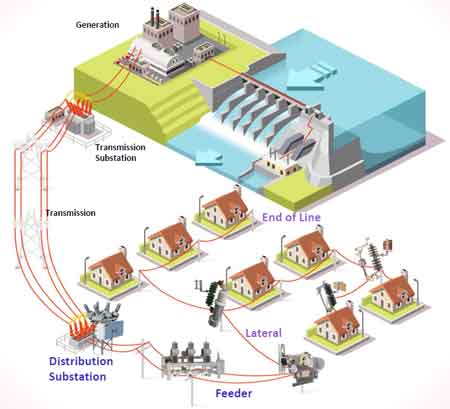
Most distribution automation investments have concentrated at substations and mainline feeders. Yet fault frequency is not distributed evenly across the circuit. Laterals account for the highest number of protective interruptions and represent the largest uninstrumented portion of the medium voltage network.
Laterals define feeder performance but remain structurally under-instrumented. From an OT control perspective, limited visibility at laterals forces operators to infer fault location from upstream device behavior. This introduces switching uncertainty, extended patrol time, and unnecessary feeder lockouts that inflate outage duration, regulatory exposure, and safety risk.
Each feeder branches into numerous laterals serving residential and rural load pockets. These circuits are exposed to vegetation contact, wildlife interaction, and weather-driven conductor movement. Protection historically relies on fuses or non-communicating devices, creating a data void at the exact location where faults most frequently originate.
When a feeder recloser exhausts its sequence due to a lateral fuse operating, the control room sees a feeder-level lockout without branch context. Restoration becomes investigative rather than directed. The difference between inference and confirmation is measured in customer minutes.
Modern lateral devices integrate event recording with waveform capture and accurate GPS time stamping. That combination converts a simple protective device into a synchronized grid sensor. Through Distribution Oscillography, engineers can align lateral waveforms with feeder recloser data and substation relay records.

When lateral event records are fed into AI Fault Detection, patterns emerge that distinguish transient vegetation contact from permanent conductor failure, reducing repeat outage exposure and supporting prioritized vegetation mitigation.
Consider a storm event with high wind and backfeed from rooftop solar. A lateral experiences a temporary fault. Without branch-level visibility, the feeder recloser locks out after multiple operations while crews patrol miles of backbone.
If lateral fault detection provides synchronized event confirmation within seconds, operators can isolate the specific branch and reenergize the feeder, turning a systemic outage into a localized interruption.
Failure to instrument laterals converts localized faults into system-level events, a risk highlighted in Fault Analysis in Power System reviews that show miscoordination consequences when branch events are missing.
Bi-directional power flow introduces new protection ambiguity. Inverter fault contribution alters current magnitude and harmonic content, challenging conventional pickup settings. During red flag conditions, threshold sensitivity and fast-trip capability must balance nuisance operations with ignition risk, underscoring the need for context-specific event insight.
Pattern recognition tools, such as Incipient Fault Detection, can identify emerging degradation trends, but threshold setting remains a human decision. Excessive sensitivity at scale erodes operator confidence and can trigger rollback of protective gains.
This is not a technology problem. It is a coordination problem.
Laterals exist in quantities that exceed feeder devices by multiples. Laterals outnumber feeder devices by multiples, making traditional automation economics unsustainable without integrated communications. Any automation strategy must address deployment economics, remote communications, cybersecurity, and firmware management as a unified architecture.
Cellular LPWAN, hybrid RF mesh with cellular backhaul, and private LTE each introduce tradeoffs in latency, coverage, and operational control. Fleet management platforms must support credential management, firmware updates, and device health monitoring across thousands of endpoints. At the system level, Intelligent Asset Management provides lifecycle coordination between lateral devices, maintenance records, and reliability planning.
The value of lateral fault detection increases when integrated into ADMS, enabling branch-level event confirmation to feed topology modeling and automated restoration decision logic.
An operational edge case arises during switching events when device status telemetry is delayed or misaligned with SCADA timestamps, leading restoration sequences to assume an incorrect topology. Lateral intelligence must therefore include health monitoring and synchronization assurance.
Basic fuse replacement does not scale in a grid experiencing DER growth and wildfire risk. Lateral monitoring expands visibility, but lateral fault detection adds synchronized evidence, waveform fidelity, and actionable timing. Through Lateral Monitoring utilities gain status awareness.
With lateral fault detection, they gain confidence in restoration. Field deployments across large device fleets have demonstrated reductions in fault location time exceeding 40 percent when branch-level intelligence is integrated into control workflows. That improvement compounds during storm events.
Lateral fault detection is not incremental automation. Utilities that ignore lateral fault detection will continue treating feeder reliability as a backbone problem when it is fundamentally a branch problem.
Stay informed with our FREE Asset Intelligence & Predictive Maintenance Newsletter — get the latest news, breakthrough technologies, and expert insights, delivered straight to your inbox.
Advantages To Instructor-Led Training – Instructor-Led Course, Customized Training, Multiple Locations, Economical, CEU Credits, Course Discounts.
Request For QuotationWhether you would prefer Live Online or In-Person instruction, our electrical training courses can be tailored to meet your company's specific requirements and delivered to your employees in one location or at various locations.