Feeder Protection Relay Decisions in Distribution Systems
By William Conklin, Associate Editor
By William Conklin, Associate Editor
Our customized live online or in‑person group training can be delivered to your staff at your location.
Request for Quotation Service
Buyers Submit Free RFQs to top suppliers, no obligation.
Suppliers Browse real project RFQs directly from buyers.
Trust Electricity Forum 40 years connection buyers and suppliers.
Feeder protection relay schemes control how distribution feeders isolate faults, balancing selectivity, ground fault response, and directional behavior to keep outages local while preserving system reliability and service continuity.
When a fault occurs on a distribution feeder, the most important question is not how fast a relay operates, but how much of the system is allowed to go dark. Feeder protection exists to make that decision deliberately. A feeder protection relay, in practice, supports a scheme that isolates only the affected section of a feeder while preserving service everywhere else. That boundary between local isolation and system disruption defines feeder protection as a distinct operating philosophy rather than a device category.
Unlike asset-focused approaches, feeder protection centers on controlling the behavior of a circuit path. A feeder may serve dozens or thousands of downstream loads, branching through overhead lines, underground cables, and multiple switching points. A scheme that treats all feeder faults the same quickly becomes a liability. Effective feeder protection recognizes that where a fault occurs, how current flows, and the feeder's configuration all influence the outcome.
Feeders occupy an awkward middle ground in electrical systems. They are downstream of substations yet upstream of most equipment-level safeguards. They must respond faster than system-wide controls but with more discrimination than simple branch isolation. This is why feeder-level schemes are built around selectivity rather than brute interruption.
In a typical radial feeder, operating logic must distinguish between faults on the feeder itself and disturbances beyond it. Acting too aggressively may clear a fault, but it also removes service to every downstream customer. Acting too slowly risks equipment damage or unsafe conditions. The feeder scheme exists to navigate that tension.

This role is fundamentally different from the intent of power system protection, which governs stability and fault behavior across an entire network. Feeder schemes operate at a narrower scope, but with consequences that are often more visible to end users. When these roles are blurred, faults that should remain local can cascade into wider outages.
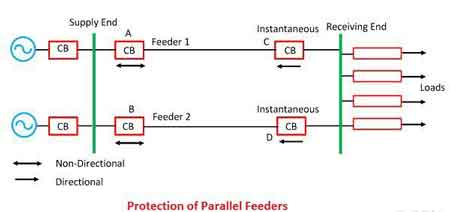
The physical topology of a feeder strongly influences its operating strategy. Radial feeders, where power flows in a single direction from source to load, allow relatively straightforward discrimination between internal and external faults. Schemes in these systems rely on clear upstream–downstream relationships.
Looped and networked feeders introduce complexity. When a feeder can be energized from multiple sources, fault current no longer behaves predictably. Current may flow toward a fault from more than one direction, and the logic must determine whether a disturbance is local or external. In these cases, feeder protection schemes incorporate directional awareness as part of their framework, even though the underlying relay hardware remains secondary to the scheme itself.
This distinction is one reason why a feeder protection relay should not be confused with an overcurrent relay page. Overcurrent relays describe a functional element. Feeder protection describes how multiple elements are applied together to control feeder behavior under abnormal conditions.
Ground faults present a persistent challenge in distribution systems. Unlike high-magnitude phase faults, ground faults may produce relatively low current, especially at the far end of long feeders. A feeder scheme must remain sensitive enough to detect these conditions without reacting to harmless imbalance or transient effects.
This is where a feeder protection relay diverges from generic ground fault protection discussions. The objective is not simply to detect ground current, but to decide whether that condition warrants isolating an entire feeder section. The logic must weigh fault severity, likely location, and system configuration rather than applying a uniform response.
Modern feeders increasingly host distributed energy resources. Solar arrays, backup generators, and storage systems can inject current into a feeder during abnormal conditions. This alters fault behavior in ways older philosophies did not anticipate.
Feeder protection relay schemes must account for the possibility that fault current may not originate solely from the substation. Operating logic must remain dependable even when the current reverses or the magnitude varies unpredictably. This requirement further separates feeder protection from simplified explanations found in general electrical protection overviews.
The success of a feeder protection relay scheme is measured operationally, not academically. Did the correct section isolate? Was restoration straightforward? Were crews able to identify the fault location quickly? Did system behavior align with expectations?
For this reason, feeder protection is often discussed alongside switching devices and feeder segmentation strategies, even though it remains distinct from equipment topics such as metal-clad switchgear or feeder-mounted fault indicators.
Feeder protection should be understood as a decision framework. It governs how a distribution system sacrifices the minimum necessary portion of itself to maintain safety and continuity. It does not explain how relays work, how to test them, or how to calculate settings. Those subjects belong elsewhere.
By treating a feeder protection relay as a scheme rather than a component, engineers and operators preserve clarity in both design and operation. That clarity is what ultimately keeps faults local, outages limited, and distribution systems resilient.
Think you know Electrical Protection? Take our quick, interactive quiz and test your knowledge in minutes.
Once feeder protection philosophy and scheme boundaries are clearly understood, attention naturally shifts to implementation. At that stage, engineers move beyond scheme intent and begin evaluating relay functions, testing approaches, and application-specific behavior in real installations. Those topics require a different level of detail and a different learning mode.
Trying to compress operating philosophy, scheme logic, and device mechanics into a single explanation usually weakens all three. A clearer path is to establish the feeder-level concept first, then develop practical competence separately through focused study and applied environments such as basic protective relay training, where device behavior and testing practices can be explored without blurring the underlying scheme.
Advantages To Instructor-Led Training – Instructor-Led Course, Customized Training, Multiple Locations, Economical, CEU Credits, Course Discounts.
Request For QuotationWhether you would prefer Live Online or In-Person instruction, our electrical training courses can be tailored to meet your company's specific requirements and delivered to your employees in one location or at various locations.