Utility Wildfire Mitigation Plans for Grid Risk Control
By Luis Hernandez, Emergency Management Sr. Consultant, PG&E
By Luis Hernandez, Emergency Management Sr. Consultant, PG&E
Utility wildfire mitigation plans define how utilities translate risk conditions into coordinated operational actions using ICS, incident action planning, resource control, and situational awareness to reduce ignition risk and maintain grid reliability during wildfire events.
Utility wildfire mitigation plans determine how utilities act when wildfire risk conditions exceed normal operating thresholds. These plans are not procedural references. They function as real-time control systems that translate environmental risk into operational decisions that directly affect ignition probability, system stability, and public safety.
The critical challenge is not identifying wildfire risk. It is coordinating decisions across control rooms, field crews, and external agencies fast enough to prevent escalation. Without structured planning, utilities can maintain energized equipment in high-risk conditions while response actions lag behind changing fire behavior.
The Incident Command System provides the operational structure required to manage this problem. It defines command authority, enforces communication discipline, and ensures that all actions follow a unified objective. This prevents conflicting switching actions, delayed de-energization, and misaligned field response during high-risk periods.
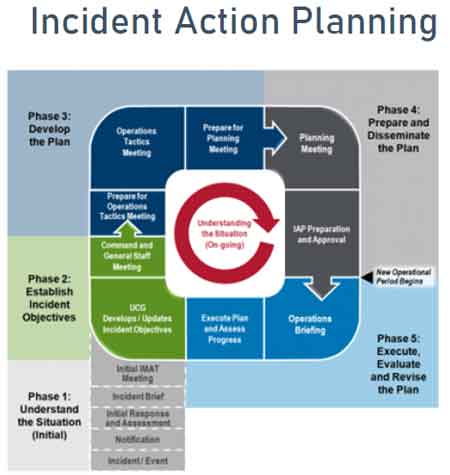
Utility wildfire mitigation plans rely on structured planning cycles that continuously convert situational awareness into action. The Incident Action Planning process defines how utilities establish objectives, assign resources, execute actions, and revise decisions within defined operational periods.
This process operates on time-based cycles ranging from hourly to multi-hour intervals, depending on risk conditions. In large wildfire events, utilities may update plans multiple times per day as weather, load, and fire behavior change. This creates a controlled feedback loop where each operational period is informed by updated intelligence and prior execution outcomes.
Download our FREE Electrical Training Catalog and explore a full range of expert-led electrical training courses.

This planning discipline is a core component of wildfire resilience because it ensures utilities can adapt operations as conditions evolve rather than reacting after failures occur.
The Planning P framework ensures that decisions are not static. It forces continuous reassessment of conditions, preventing outdated assumptions from driving operational actions.
Utility wildfire mitigation plans define operational controls that directly influence ignition risk. These controls are executed through coordinated actions between system operators and field personnel.
These actions include circuit reconfiguration to reduce exposure, load reduction on vulnerable feeders, and temporary de-energization when conditions exceed defined thresholds. Field crews are positioned in advance to reduce response time, while protection settings may be adjusted to reflect elevated risk conditions.
These operational controls must align with wildfire risk reduction strategies so that mitigation actions directly address ignition sources rather than reacting after faults occur.
The effectiveness of these controls depends on timing. Even a delayed de-energization decision by minutes during high-wind conditions can allow energized conductors to initiate ignition events.
Wildfire mitigation plans must be tightly integrated with outage operations. Decisions made to reduce ignition risk directly influence outage behavior, restoration timelines, and system stability.
Utilities coordinate mitigation actions with outage workflows to ensure that preemptive de-energization, switching operations, and restoration sequences are aligned with current wildfire conditions. This coordination becomes critical during large-scale events where multiple feeders and crews must be managed simultaneously.
Integration with an outage management system ensures that these actions are tracked and coordinated across operational teams.
This alignment directly supports grid reliability by ensuring that mitigation actions do not introduce unintended instability or unsafe restoration conditions.
Wildfire mitigation requires utilities to operate within a multi-agency response environment that includes fire services, emergency management organizations, and public agencies. The Incident Command System enables this coordination through unified command structures and standardized communication.
Command functions focus on directing resources and making strategic decisions, while coordination functions align priorities across agencies and resolve conflicts.
This coordination structure contributes to power grid resilience by ensuring that operational decisions reflect both electrical system constraints and public safety requirements during wildfire events.
Utility wildfire mitigation plans require continuous tradeoffs between maintaining service and reducing ignition risk. De-energizing circuits reduces the probability of ignition but introduces immediate outage impacts, while maintaining service increases exposure under elevated-risk conditions.
These tradeoffs directly affect utility reliability, especially when decisions must be made under uncertain and rapidly changing conditions.
Implementation is constrained by incomplete situational awareness, limited crew availability during large-scale events, communication delays across agencies, and uncertainty in weather forecasts and fire behavior.
A critical constraint is forecast uncertainty. Utilities must make decisions based on probabilistic conditions rather than confirmed outcomes.
A key operational risk occurs when utilities rely on incomplete or delayed telemetry to assess wildfire conditions. In these cases, the system may appear stable while environmental conditions have already shifted into a high-risk state.
For example, wind conditions at a remote section of a feeder may exceed safe thresholds before this information is reflected in control room systems. Operators may delay mitigation actions based on outdated data, maintaining energized equipment in conditions that support ignition.
This edge case highlights the dependency of mitigation plans on accurate and timely data.
Stay informed with our FREE Storm, Risk & Grid Resilience Newsletter — get the latest news, breakthrough technologies, and expert insights, delivered straight to your inbox.
If wildfire mitigation plans fail to align planning and execution, utilities can create conditions in which energized equipment operates in high-risk environments while response actions lag.
This failure mode can result in ignition events that escalate into large-scale wildfires, extended outages, and infrastructure damage that takes months to recover.
The most critical aspect of this risk is that it develops while systems appear operationally stable, delaying corrective action until consequences are already unfolding.
Utility wildfire mitigation plans function as the operational execution layer of a broader resilience strategy. Infrastructure improvements and vegetation management reduce baseline risk, but these plans determine how utilities respond when conditions exceed design limits.
They reinforce grid resiliency by ensuring that operational decisions remain coordinated under stress and aligned with real-world system conditions.
Explore 50+ live, expert-led electrical training courses –