Electric Fence Ground Rod Requirements
By Frank Baker, Technical Editor
By Frank Baker, Technical Editor
Our customized live online or in‑person group training can be delivered to your staff at your location.
Request for Quotation Service
Buyers Submit Free RFQs to top suppliers, no obligation.
Suppliers Browse real project RFQs directly from buyers.
Trust Electricity Forum 40 years connection buyers and suppliers.
An electric fence ground rod completes the return path through the soil, allowing fence voltage to deliver an effective shock; poor depth, spacing, or soil contact can cause weak performance even with an energizer under dry or resistive earth conditions.
Electric fences operate as closed systems. The pulse leaves the energizer, travels down the fence conductor, passes through the animal, and must return through the earth to the energizer’s reference terminal. When that return path is resistive or discontinuous, voltage readings can look acceptable while delivered energy collapses under load.
This is where an electric fence ground rod differs from casual expectations. The soil itself becomes part of the electrical path, and dry, rocky, frozen, or chemically resistive terrain can interrupt that path just as effectively as a broken wire. Understanding this behavior requires stepping outside the fence-only view and into broader earthing theory, as outlined in Understanding Electrical Grounding.
The electric fence ground rod is not simply a safety accessory or mechanical anchor. It functions as a current transfer interface between the fence system and the earth. Its role is to provide enough contact with conductive soil to allow the pulse energy to disperse outward and return efficiently.
Unlike utility or building earthing, fence systems are optimized for pulsed energy rather than fault clearing. That distinction matters. Fence installations should always use a dedicated earth reference, separate from building electrodes or utility connections. Mixing the two can introduce interference, stray voltage, and unpredictable current paths, especially during lightning events or switching transients. These differences are explored more broadly in discussions of Grounding and Bonding, but the fence application deserves its own treatment.
Download our FREE Electrical Training Catalog and explore a full range of expert-led electrical training courses.

In practical fence layouts, the charger completing the circuit depends on whether the soil can reliably collect the negative or ground post of the fence charger, which is why standard earth-return designs often struggle in areas with dry conditions and low-conductive soils.
In those environments, hot ground systems are commonly used, so the fence charger completes its pulse without relying solely on soil conductivity. Instead, a hot or ground configuration sends the positive post to the fence, while the return path is reinforced by additional conductors.
This approach is widely regarded as good for areas with dry conditions and low-conductivity soils because it stabilizes shock performance when moisture, terrain, or seasonal conditions limit effective earth contact.
In real installations, shallow electric fence ground rods are the most common failure point. Surface soil dries quickly, freezes seasonally, and often contains high-resistance material. A rod that does not reach stable, moist layers will work at best only intermittently.
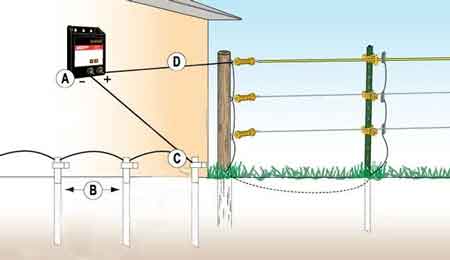
Most effective fence installations rely on electrodes driven deep enough to reach consistent moisture, often six feet or more, depending on local conditions. Placement matters just as much as depth. Rods should be installed where water naturally collects or remains longer, rather than on high, dry terrain that sheds moisture.
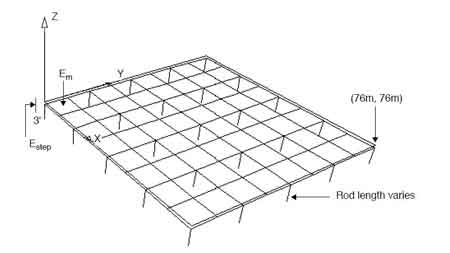
Spacing also plays a role. Multiple rods installed several feet apart create a larger effective return field than a single electrode driven deeper. This principle mirrors earthing system design concepts used in larger installations, such as those described in Grounding Systems, even though the scale is different.
Many fence systems underperform because they rely on a single electrode regardless of soil conditions. In dry or resistive terrain, additional rods dramatically improve performance by expanding the contact area with the earth.
This is not redundancy for safety; it is functional necessity. Each additional electrode reduces overall earth resistance and stabilizes the return path under varying moisture conditions. The same logic underpins engineered earthing networks, such as a Ground Grid, although fence systems use simpler geometry.
The mistake is assuming that stronger energizers compensate for weak earth coupling. In practice, higher output chargers often make return-path deficiencies more obvious rather than less.
Galvanized steel and copper-clad rods are both commonly used for fence earthing, but material choice is secondary to installation quality. A well-installed galvanized rod in moist soil will outperform a poorly placed copper electrode every time.
What does matter is the integrity of the connection between the rod and the energizer. Loose clamps, corroded joints, or undersized conductors introduce resistance exactly where the system can least tolerate it. Proper mechanical bonding between electrode and conductor mirrors the principles used in industrial earthing hardware, including components such as the Electrical Ground Clamp, even though the application is less formal.
Electric fence earth references should never be tied into building electrodes, generator references, or utility systems. Fence pulses can introduce noise, voltage rise, or unintended current paths that interfere with sensitive equipment or create nuisance issues elsewhere.
This separation becomes especially important near structures with their own earthing requirements, such as panels or standby power systems. The distinction between functional return paths and safety earthing is often misunderstood, and the consequences are outlined clearly when comparing applications like fence systems to Grounding a Generator.
Think you know Power Quality? Take our quick, interactive quiz and test your knowledge in minutes.
Fence return-path problems rarely announce themselves clearly. Common symptoms include inconsistent shock strength, animals testing the fence without reaction, or performance that varies dramatically with weather.
Testing involves more than measuring fence voltage. Effective diagnosis considers voltage rise at electrodes under load, soil conditions at different times of year, and the continuity of return connections. These checks overlap with broader diagnostic methods used to verify earth integrity, such as those discussed in How to Check if an Area Is Grounded, even though the tools and thresholds differ.
Fence earthing sits at an intersection between agricultural practice and electrical theory. While it does not follow electrical codes in the same way as premises wiring, it obeys the same physical laws. Concepts like electrode contact area, soil resistivity, and current return behavior apply whether the system protects livestock or power equipment.
Seeing the electric fence ground rod as part of a broader earthing philosophy, rather than an isolated accessory, is often the shift that resolves chronic fence performance issues. That perspective aligns fence systems with the same foundational principles described across the electrical grounding ecosystem, including What Is Electrical Grounding, without forcing inappropriate code frameworks onto the application.
Advantages To Instructor-Led Training – Instructor-Led Course, Customized Training, Multiple Locations, Economical, CEU Credits, Course Discounts.
Request For QuotationWhether you would prefer Live Online or In-Person instruction, our electrical training courses can be tailored to meet your company's specific requirements and delivered to your employees in one location or at various locations.