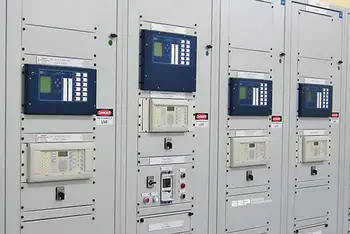
Protective Relay Training - Basic
Our customized live online or in‑person group training can be delivered to your staff at your location.
- Live Online
- 12 hours Instructor-led
- Group Training Available
Regular Price:
$699
Coupon Price:
$599
The Bonneville Power Administration and a cast of utilities, independent power generators, Native American tribes, environmental groups, regulators and consumer groups spent millions of dollars over the past decade haggling over how best to improve the efficiency and reliability of the Northwest's power grid.
The participants all but admitted their effort to create an independent entity capable of managing a unified grid is dead. A group of investor-owned utilities that had supported the project, called Grid West, voted to reject a compromise proposal that BPA had cobbled together to appease critics, most notably publicly owned utilities in Washington.
Instead, the investor-owned utilities will go forward with a scaled down version of Grid West, absent BPA, which controls the largest chunk of transmission assets in the region.
"It's unfortunate," said Dave Kvamme, a PacifiCorp spokesman. "We have 10 years of history working toward a not-for-profit entity that would oversee the region's transmission lines independent of buyers and sellers of electricity."
Grid West is the most recent regional iteration of an effort by federal regulators to increase efficiency and reliability in the electricity industry by eliminating piecemeal management of the power grid. Proponents maintain that a grid managed by a single cooperative entity rather than a host of competing interests would eliminate many bottlenecks, rate disputes and scheduling conflicts that plague the system today.
Regionally, supporters of a unified grid hoped it would clear the way for overdue investments in new transmission equipment that would improve reliability, help make it easier to access renewable power projects in remote areas, and help the BPA sell into power-hungry markets to the south.
But the effort has been controversial from the start. The most vocal opponents have been the publicly owned utilities in Washington, many of which have long-term contracts to buy power from BPA at preferential rates. BPA owns 75 percent of the high voltage transmission grid in Oregon, Washington, Idaho and Montana, so its participation was a linchpin in the organization.
The public utilities, backed by Washington's congressional delegation, worried the plan would increase their costs, and were skeptical that a regionwide organization would deliver any new efficiencies.
They were loath to see control of BPA's transmission grid pass to a private entity, particularly one that would be regulated by the Federal Energy Regulatory Commission. They waged an intense campaign to get BPA to say no to Grid West, and created an alternative proposal to solve transmission problems without creating an entity regulated by the federal commission.
Grid West "would have been a profound change for the region . . . the loss of local and state political control of Bonneville's operation," said Marilyn Showalter, executive director of the Public Power Council, a Portland based organization that represents public utilities in the region.
Investor-owned utilities, meanwhile, have been pressured by the Federal Energy Regulatory Commission to form the regional organizations, in part because the federal agency wants to eliminate utilities' incentives to use control of the grid to make life more difficult for competitors. With limited access to cut-rate BPA power, investor-owned utilities also have a greater appetite for electricity generated in remote areas - by coal-fired plants and wind farms, among other things - but don't want to deal with a complicated tariff structure to move the power to their customers.
BPA, the 800-pound gorilla of generation and transmission in the region, has come under enormous political pressure, and has tried to tack between the two camps. Earlier this year, it proposed a compromise plan that would have moved forward with some of the public utilities proposals, and taken incremental steps toward the implementation of Grid West.
The compromise satisfied neither camp.
On Monday, nine of eleven members of Washington's congressional delegation wrote to BPA Administrator Stephen Wright urging him to avoid going forward with the so called "convergence" approach.
A day later, a majority of the investor-owned utilities voted against Bonneville's compromise. Instead they decided to soldier on without BPA's participation and transmission assets.
PGE and PacifiCorp had both supported Grid West, as did the Oregon Public Utility Commission.
BPA said its compromise proposal would have been the right way to go. In its absence, said spokesman Ed Mosey, "Nothing will change in terms of the operation of the system. We'll operate the way we always have."
Robert Kahn, executive director of the Northwest Independent Power Producers Coalition, said that's the problem. "Something needs to be done," he said. "The status quo is a mess."
Related News
We Need a Total Fossil Fuel Lockdown for a Climate Revolution
Renewables 2020 Global Status Report highlights renewable energy gaps beyond power, urging decarbonization in heating,…
View more
When paying $1 for a coal power plant is still paying too much
San Juan Generating Station eyed for $1 coal-plant sale, as Farmington and Acme propose CCS…
View more
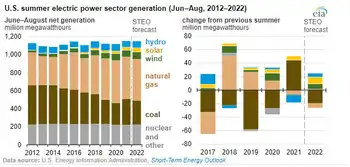
EIA expects solar and wind to be larger sources of U.S. electricity generation this summer
US Summer Electricity Outlook 2022 projects rising renewable energy generation as utility-scale solar and wind…
View more

America’s Electricity is Safe From the Coronavirus—for Now
US Grid Pandemic Response coordinates control rooms, grid operators, and critical infrastructure, leveraging hydroelectric plants,…
View more
Sycamore Energy taking Manitoba Hydro to court, alleging it 'badly mismanaged' Solar Energy Program
Sycamore Energy Manitoba Hydro Lawsuit centers on alleged mismanagement of the solar rebate incentive program,…
View more
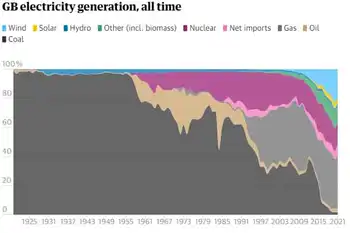
Energy dashboard: how is electricity generated in Great Britain?
Great Britain electricity generation spans renewables and baseload: wind, solar, nuclear, gas, and biomass, supported…
View more
Sign Up for Electricity Forum’s Newsletter
Stay informed with our FREE Newsletter — get the latest news, breakthrough technologies, and expert insights, delivered straight to your inbox.
Electricity Today T&D Magazine Subscribe for FREE

Stay informed with the latest T&D policies and technologies.
- Timely insights from industry experts
- Practical solutions T&D engineers
- Free access to every issue
