



By Similarly, brokerage firms Goldman Sachs and Morgan Stanley yesterday also lowered their Duke stock ratings.


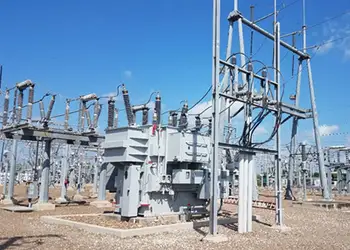
Substation Relay Protection Training

Our customized live online or in‑person group training can be delivered to your staff at your location.
  • Live Online
  • 12 hours Instructor-led
  • Group Training Available
Regular Price:
$699
Coupon Price:
$599
Reserve Your Seat Today
-- Duke Energy Corp. shares fell further yesterday after the second-largest U.S. utility owner placed an unnamed manager on leave amid government probes of sham energy trades.

After falling as much as 22 per cent during the day, the company's shares closed down $1.05 (U.S.), or 4.2 per cent, at $23.70. They fell 11 per cent Friday after Duke said a grand jury and regulators had subpoenaed its trading records.

The trading manager was placed on leave while the company collects information to comply with the subpoenas, spokesman Terry Francisco said. Authorities previously sought records from rival traders such as Dynegy Inc. and CMS Energy Corp. as part of widening probes of the industry since the collapse of Enron Corp.

"Utility stocks have gotten hammered in the last week," said Skip Aylesworth, who helps manage $160-million at FBR American Gas Index Fund Inc., including Duke shares. "This is murder for us. We're usually a safe haven for investors." The Standard & Poor's multi-utilities index, which includes Duke and five other companies, is down 59 per cent this year. Duke was the best-performing in the group, which includes Dynegy, AES Corp. and Williams Cos. The 24-stock electric utilities index is down 29 per cent.

A federal grand jury and the Commodity Futures Trading Commission subpoenaed trading records Friday in a probe of so-called round-trip trades. Such transactions usually involve two companies that buy and sell the same amount of electricity or natural gas at the same price on the same day.

Duke has admitted it included about $1.1-billion of round-trip trades in its financial statements over the years. Merrill Lynch & Co. analyst Steven Fleishman reported the Duke trader had been placed on temporary leave in a report to clients. Mr. Fleishman has a near-term neutral rating on Duke stock.

"We did ask one of our management employees from our trading operation in Houston to step aside," Mr. Francisco said, confirming the report. "This person is on administrative paid leave. We asked him to step aside so as not to impede our investigation."

Mr. Francisco declined to disclose details about the employee placed on leave, except to say that the manager was involved in trading of natural gas and electricity.

On Friday, natural gas and power giant El Paso Corp. said it received a similar subpoena that requests information on trading activities. The Houston firm has already told federal regulators it engaged in no such activities. El Paso's shares dropped 45 cents yesterday to $17.30 on the NYSE.

Energy companies have faced a growing number of probes since the December bankruptcy of Enron and subsequent reports of efforts to manipulate western electricity and gas markets.

Duke is "now being caught up in an environment where any whiff of anything happening at a company is enough to have it taken out and shot," said Anthony Maramarco, a portfolio manager at Jones and Babson Inc., which owns 450,000 shares of Duke.

Charlotte-based Duke's aggressive expansion into non-regulated energy trading "leaves them susceptible to Enronitis," Mr. Aylesworth said.

Duke has said that, at the request of a third party, it did three round-trip natural gas transactions out of more than 30,000 in the West, the company said as part of its response to a probe of 150 companies by the Federal Energy Regulatory Commission.

While many energy companies have had their credit ratings cut, Duke has a single-A-1 rating by Moody's Investors Service and single-A-plus by Standard & Poor's. Rivals such as Dynegy, CMS, Calpine Corp. and Mirant Corp. have been lowered to junk levels by one or more of the agencies.

Yesterday, Salomon Smith Barney analyst Ray Niles cited the subpoenas in a note that accompanied his 2002 and 2003 earnings estimates, which were lowered to $2.55 and $2.70, down from previous estimates of $2.60 and $2.85.

Related News

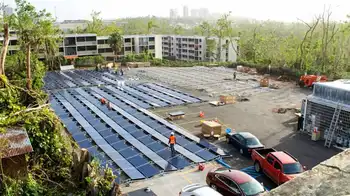
Canadian Solar and Tesla contribute to resilient electricity system for Puerto Rico school

SunCrate Solar Microgrid delivers resilient, plug-and-play renewable power to Puerto Rico schools, combining Canadian Solar PV, Tesla Powerwall battery storage, and Black & Veatch engineering to ensure off-grid continuity during outages and disasters.


Key Points

A compact PV-and-battery system for resilient, diesel-free power and microgrid backup at schools and clinics.

✅ Plug-and-play, modular PV, inverter, and battery architecture

✅ Tesla Powerwall storage; Canadian Solar 325 W panels

✅ Scales via daisy-chain for higher loads and microgrids


Eleven months since their three-building school was first plunged into darkness by Hurricane Maria, 140 students in Puerto Rico’s picturesque Yabucoa district have reliable power. Resilient electricity service was provided Saturday to the SU Manuel Ortiz school through an innovative scalable, plug-and-play solar system pioneered by SunCrate Energy with Black & Veatch support. Known as a “SunCrate,” the unit is an effective mitigation measure to back up the traditional power supply from the grid. The SunCrate can also provide sustainable power in the face of ongoing system outages and future natural disasters without requiring diesel fuel.

The humanitarian effort to return sustainable electricity to the K-8 school, found along the island’s hard-hit southeastern coast, drew donated equipment and expertise from a collection of North American companies. Additional support for the Yabucoa project came from Tesla, Canadian Solar and Lloyd Electric, reflecting broader efforts to build a solar-powered grid in Puerto Rico after Hurricane Maria.

“We are grateful for this initiative, which will equip this school with the technology needed to become a resilient campus and not dependent on the status of the power grid. This means that if we are hit with future harmful weather events, the school will be able to open more quickly and continue providing services to students,” Puerto Rico Secretary of Education Julia Keleher said.

The SunCrate harnesses a scalable rapid-response design developed by Black & Veatch and manufactured by SunCrate Energy. Electricity will be generated by an array of 325-W CS6U-Poly modules from Canadian Solar. California-based Tesla contributed advanced battery energy storage through various Powerwall units capable of storing excess solar power and delivering it outside peak generation periods, with related experience from a virtual power plant in Texas informing deployment.  Lloyd Electric Co. of Wichita Falls, Texas, partnered to support delivery and installation of the SunCrate.

“As families in the region begin to prepare for the school year, this community is still impacted by the longest U.S. power outage in history,” said Dolf Ivener, a Midwestern entrepreneur who owns King of Trails Construction and SunCrate Energy, which is donating the SunCrate. “SunCrate, with its rapid deployment and use of renewable energy, should give this school peace of mind and hopefully returns a touch of long-overdue normalcy to students and their parents. When it comes to consistent power, SunCrate is on duty.”

The SunCrate is a portable renewable energy system conceived by Ivener and designed and tested by Black & Veatch. Its modular design uses solar PV panels, inverters and batteries to store and provide electric power in support of critical services such as police, fire, schools, clinics and other community level facilities.

A SunCrate can generate 23 to 156 kWh per day, and store 10 kWh to 135 kWh depending on configuration. A SunCrate’s power generation and storage capacity can be easily scaled through daisy-chained configurations to accommodate larger buildings and loads. Leveraging resources from Tesla, Canadian Solar, Lloyd Electric and Lord Electric, the unit in Yabucoa will provide an estimated 52 kWh of storable power without requiring use of costlier diesel-powered generators and cutting greenhouse gas emissions. Its capabilities allow the school to strengthen its function as a designated Community Emergency Response Center in the event of future natural disasters.

“Canadian Solar has a long history of using solar power to support humanitarian efforts aiding victims of social injustice and natural disasters, including previous donations to Puerto Rico after Hurricane Maria,” said Dr. Shawn Qu, Chairman and Chief Executive Officer of Canadian Solar. “We are pleased to make the difference for these schoolchildren in Yabucoa who have been without reliable power for too long.”

The SunCrate will also substantially lower the school’s ongoing electricity costs by providing a reliable source of renewable energy on site, as falling costs of solar batteries improve project economics overall.

“Through our experience providing engineering services in Puerto Rico for nearly 50 years, including dozens of specialized projects for local government and industrial clients, we see great potential for SunCrate as a source of resilient power for the Commonwealth’s remote schools and communities at large, underscoring the importance of electricity resilience across critical infrastructure,” said Charles Moseley, a Program Director in Black & Veatch’s water business. “We hope that the deployment of the SunCrate in Yabucoa sets a precedent for facility and municipal level migro-grid efforts on the island and beyond.”

SunCrate also has broad potential applications in conflict/post-conflict environments and in rural electrification efforts in the developing world, serving as a resilient source of electricity within hours of its arrival on site and could enable peer-to-peer energy within communities. Of particular benefit, the system’s flexibility cuts fuel costs to a fraction of a generator’s typical consumption when they are used around the clock with maintenance requirements.


Related News

View more

Sustaining U.S. Nuclear Power And Decarbonization

Existing Nuclear Reactor Lifetime Extension sustains carbon-free electricity, supports deep decarbonization, and advances net zero climate goals by preserving the US nuclear fleet, stabilizing the grid, and complementing advanced reactors.


Key Points

Extending licenses keeps carbon-free nuclear online, stabilizes grid, and accelerates decarbonization toward net zero.

✅ Preserves 24/7 carbon-free baseload to meet climate targets

✅ Avoids emissions and replacement costs from premature retirements

✅ Complements advanced reactors; reduces capital and material needs


Nuclear power is the single largest source of carbon-free energy in the United States and currently provides nearly 20 percent of the nation’s electrical demand. As a result, many analyses have investigated the potential of future nuclear energy contributions in addressing climate change and investing in carbon-free electricity across the sector. However, few assess the value of existing nuclear power reactors.

Research led by Pacific Northwest National Laboratory (PNNL) Earth scientist Son H. Kim, with the Joint Global Change Research Institute (JGCRI), a partnership between PNNL and the University of Maryland, has added insight to the scarce literature and is the first to evaluate nuclear energy for meeting deep decarbonization goals amid rising credit risks for nuclear power identified by Moody's. Kim sought to answer the question: How much do our existing nuclear reactors contribute to the mission of meeting the country’s climate goals, both now and if their operating licenses were extended?

As the world races to discover solutions for reaching net zero as part of the global energy transition now underway, Kim’s report quantifies the economic value of bringing the existing nuclear fleet into the year 2100. It outlines its significant contributions to limiting global warming.

Plants slated to close by 2050 could be among the most important players in a challenge requiring all available carbon-free technology solutions—emerging and existing—alongside renewable electricity in many regions, the report finds. New nuclear technology also has a part to play, and its contributions could be boosted by driving down construction costs.  

“Even modest reductions in capital costs could bring big climate benefits,” said Kim. “Significant effort has been incorporated into the design of advanced reactors to reduce the use of all materials in general, such as concrete and steel because that directly translates into reduced costs and carbon emissions.”

Nuclear power reactors face an uncertain future, and some utilities face investor pressure to release climate reports as well.
The nuclear power fleet in the United States consists of 93 operating reactors across 28 states. Most of these plants were constructed and deployed between 1970-1990. Half of the fleet has outlived its original operating license lifetime of 40 years. While most reactors have had their licenses renewed for an additional 20 years, and some for another 20, the total number of reactors that will receive a lifetime extension to operate a full 80 years from deployment is uncertain.

Other countries also rely on nuclear energy. In France, for example, nuclear energy provides 70 percent of the country’s power supply. They and other countries must also consider extending the lifetime, retiring, or building new, modern reactors while navigating Canadian climate policy implications for electricity grids. However, the U.S. faces the potential retirement of many reactors in a short period—this could have a far stronger impact than the staggered closures other countries may experience.

“Our existing nuclear power plants are aging, and with their current 60-year lifetimes, nearly all of them will be gone by 2050. It’s ironic. We have a net zero goal to reach by 2050, yet our single largest source of carbon-free electricity is at risk of closure, as seen in New Zealand's electricity transition debates,“ said Kim.


Related News

View more

Electric vehicles to transform the aftermarket … eventually

Heavy-Duty Truck Electrification is disrupting the aftermarket as diesel declines: fewer parts, regenerative braking, emissions rules, e-drives, gearboxes, and software engineering needs reshape service demand, while ICE fleets persist for years.


Key Points

Transition of heavy trucks to EV systems, reducing parts and emissions while reshaping aftermarket service and skills.

✅ 33% fewer parts; regenerative braking slashes brake wear

✅ Diesel share declines; EVs and natural gas slowly gain

✅ Aftermarket shifts to e-drives, gearboxes, software and service


Those who sell parts and repair trucks might feel uneasy when reports emerge about a coming generation of electric trucks.

There are reportedly about 33% fewer parts to consider when internal combustion engines and transmissions are replaced by electric motors. Features such as regenerative braking are expected to dramatically reduce brake wear. As for many of the fluids needed to keep components moving? They can remain in their tanks and drums.

Think of them as disruptors. But presenters during the annual Heavy Duty Aftermarket Dialogue are stressing that the changes are not coming overnight. Chris Patterson, a consultant and former Daimler Trucks North America CEO, noted that the Daimler electrification plan underscores the shift as he counts just 50 electrified heavy trucks in North America.

About 88% of today’s trucks run on diesel, with the remaining 12% mostly powered by gasoline, said John Blodgett, MacKay and Company’s vice-president of sales and marketing. Five years out, even amid talk of an EV inflection point, he expects 1% to be electric, 2% to be natural gas, 12% to be gasoline, and 84% on diesel.

But a decade from now, forecasts suggest a split of 76% diesel, 11% gasoline, 7% electric, and 5% natural gas, with a fraction of a percent relying on hydrogen-electric power. Existing internal combustion engines will still be in service, and need to be serviced, but aftermarket suppliers are now preparing for their roles in the mix, especially as Canada’s EV opportunity comes into focus for North American players.

“This is real, for sure,” said Delphi Technologies CEO Rick Dauch.

Aftermarket support is needed
“As programs are launched five to six years from now, what are the parts coming back?” he asked the crowd. “Braking and steering. The fuel injection business will go down, but not for 20-25 years.” The electric vehicles will also require a gear box and motor.

“You still have a business model,” he assured the crowd of aftermarket professionals.

Shifting emissions standards are largely responsible for the transformation that is occurring. In Europe, Volkswagen’s diesel emissions scandal and future emissions rules of Euro 7 will essentially sideline diesel-powered cars, even as electric buses have yet to take over transit systems. Delphi’s light-duty diesel business has dropped 70% in just five years, leading to plant closures in Spain, France and England.

“We’ve got a billion-dollar business in electrification, last year down $200 million because of the downturn in light-duty diesel controllers,” Dauch said. “We think we’re going to double our electrification business in five years.”

That has meant opening five new plants in Eastern European markets like Turkey, Romania and Poland alone.

Deciding when the market will emerge is no small task, however. One new plant in China offered manufacturing capacity in July 2019, but it has yet to make any electric vehicle parts, highlighting mainstream EV challenges tied to policy shifts, because the Chinese government changed the incentive plans for electric vehicles.

‘All in’ on electric vehicles
Dana has also gone “all in” on electrification, said chairman and CEO Jim Kamsickas, referring to Dana’s work on e-drives with Kenworth and Peterbilt. Its gasket business is focusing on the needs of battery cooling systems and enclosures.

But he also puts the demand for new electric vehicle systems in perspective. “The mechanical piece is still going to be there.”

The demand for the new components and systems, however, has both companies challenged to find enough capable software engineers. Delphi has 1,600 of them now, and it needs more.

“Just being a motor supplier, just being an inverter supplier, just being a gearbox supplier itself, yes you’ll get value out of that. But in the longhaul you’re going to need to have engineers,” Kamsickas said of the work to develop systems.

Dauch noted that Delphi will leave the capital-intensive work of producing batteries to other companies in markets like China and Korea. “We’re going to make the systems that are in between – inverters, chargers, battery management systems,” he said.

Difficult change
But people working for European companies that have been built around diesel components are facing difficult days. Dauch refers to one German village with a population of 1,200, about 800 of whom build diesel engine parts. That business is working furiously to shift to producing gasoline parts.

Electrification will face hurdles of its own, of course. Major cities around the world are looking to ban diesel-powered vehicles by 2050, but they still lack the infrastructure needed to charge all the cars and truck fleet charging at scale, he added.

Kamsickas welcomes the disruptive forces.

“This is great,” he said. “It’s making us all think a little differently. It’s just that business models have had to pivot – for you, for us, for everybody.”

They need to be balanced against other business demands, including evolving cross-border EV collaboration dynamics, too.

Said Kamsickas: “Working through the disruption of electrification, it’s how do you financially manage that? Oh, by the way, the last time I checked there are [company] shareholders and stakeholders you need to take care of.”

“It’s going to be tough,” Dauch agreed, referring to the changes for suppliers. “The next three to four years are really going to be game changes. “There’ll be some survivors and some losers, that’s for sure.”


Related News

View more

BNEF Report: Wind and Solar Will Provide 50% of Electricity in 2050

BNEF 2019 New Energy Outlook projects surging renewable energy demand, aggressive decarbonization, wind and solar cost declines, battery storage growth, coal phase-out, and power market reform to meet Paris Agreement targets through 2050.


Key Points

Bloomberg's NEO 2019 forecasts power demand, renewables growth, and decarbonization pathways through 2050.

✅ Predicts wind/solar to ~50% of global electricity by 2050

✅ Foresees coal decline; Asia transitions slower than Europe

✅ Calls for power market reform and battery integration


In a report that examines the ways in which renewable energy demand is expected to increase, Bloomberg New Energy Finance (BNEF) finds that “aggressive decarbonization” will be required beyond 2030 to meet the temperature goals of the Paris Agreement on climate change.

Focusing on electricity, BNEF’s 2019 New Energy Outlook (NEO) predicts a 62% increase in global power demand, leading to global generating capacity tripling between now and 2050, when wind and solar are expected to make up almost 50% of world electricity, as wind and solar gains indicate, due to decreasing costs.

The report concludes that coal will collapse everywhere except Asia, and, by 2032, there will be more wind and solar electricity than coal-fired electricity. It forecasts that coal’s role in the global power mix will decrease from 37% today, as renewables surpass 30% globally, to 12% by 2050 with the virtual elimination of oil as a power-generating source.

Highlighting regional differences, the report finds that:

Western European economies are already on a strong decarbonization path due to carbon pricing and strong policy support, with offshore wind costs dropping bolstering progress;

by 2040, renewables will comprise 90% of the electricity mix in Europe, with wind and solar accounting for 80%;

the US, with low-priced natural gas, and China, with its coal-fired plants, will transition more slowly even as 30% from wind and solar becomes feasible; and

China’s power sector emissions will peak in 2026 and then fall by more than half over the next 20 years, as solar PV growth accelerates, with wind and solar increasing from 8% to 48% of total electricity generation by 2050.

Power markets must be reformed to ensure wind, solar and batteries are properly remunerated for their contributions to the grid.

The 2019 report finds that wind and solar now represent the cheapest option for adding new power-generating capacity in much of the world, amid record-setting momentum, which is expected to attract USD 13.3 trillion in new investment. While solar, wind, batteries and other renewables are expected to attract USD 10 trillion in investment by 2050, the report warns that curbing emissions will require other technologies as well.

Speaking about the report, Matthias Kimmel, NEO 2019 lead analyst, said solar photovoltaic modules, wind turbines and lithium-ion batteries are set to continue on aggressive cost reduction curves of 28%, 14% and 18%, respectively, for every doubling in global installed capacity. He explained that by 2030, energy generated or stored and dispatched by these technologies will undercut electricity generated by existing coal and gas plants.

To achieve this level of transition and decarbonization, the report stresses, power markets must be reformed to ensure wind, solar and batteries are “properly remunerated for their contributions to the grid.”

Additionally, the 2019 NEO includes a number of updates such as:

  • new scenarios on global warming of 2°C above preindustrial levels, electrified heat and road transport, and an updated coal phase-out scenario;
  • new sections on coal and gas power technology, the future grid, energy access, and costs related to decarbonization technology such as carbon capture and storage (CCS), biogas, hydrogen fuel cells, nuclear and solar thermal;
  • sub-national results for China;
  • the addition of commercial electric vehicles;
  • an expanded air-conditioning analysis; and
  • modeling of Brazil, Mexico, Chile, Turkey and Southeast Asia in greater detail.

Every year, the NEO compares the costs of competing energy technologies, informing projections like US renewables at one-fourth in the near term. The 2019 report brought together 65 market and technology experts from 12 countries to provide their views on how the market might evolve.


Related News

View more

Proposed underground power line could bring Iowa wind turbine electricity to Chicago

SOO Green Underground Transmission Line proposes an HVDC corridor buried along Canadian Pacific railroad rights-of-way to deliver Iowa wind energy to Chicago, enhance grid interconnection, and reduce landowner disruption from new overhead lines.


Key Points

A proposed HVDC project burying lines along a railroad to move Iowa wind power to Chicago and link two grids.

✅ HVDC link from Mason City, IA, to Plano, IL

✅ Buried in Canadian Pacific railroad right-of-way

✅ Connects MISO and PJM grids for renewable exchange


The company behind a proposed underground transmission line that would carry electricity generated mostly by wind turbines in Iowa to the Chicago area said Monday that the $2.5 billion project could be operational in 2024 if regulators approve it, reflecting federal transmission funding trends seen recently.

Direct Connect Development Co. said it has lined up three major investors to back the project. It plans to bury the transmission line in land that runs along existing Canadian Pacific railroad tracks, hopefully reducing the disruption to landowners. It's not unusual for pipelines or fiber optic lines to be buried along railroad tracks in the land the railroad controls.

CEO Trey Ward said he "believes that the SOO Green project will set the standard regarding how transmission lines are developed and constructed in the U.S."

A similar proposal from a different company for an overhead transmission line was withdrawn in 2016 after landowners raised concerns, even as projects like the Great Northern Transmission Line advanced in the region. That $2 billion Rock Island Clean Line was supposed to run from northwest Iowa into Illinois.

The new proposed line, which was first announced in 2017, would run from Mason City, Iowa, to Plano, Ill., a trend echoed by Canadian hydropower to New York projects. The investors announced Monday were Copenhagen Infrastructure Partners, Jingoli Power and Siemens Financial Services.

The underground line would also connect two different regional power operating grids, as seen with U.S.-Canada cross-border transmission approvals in recent years, which would allow the transfer of renewable energy back and forth between customers and producers in the two regions.

More than 36 percent of Iowa's electricity comes from wind turbines across the state.

Jingoli Power CEO Karl Miller said the line would improve the reliability of regional power operators and benefit utilities and corporate customers in Chicago, even amid debates such as Hydro-Quebec line opposition in the Northeast.


Related News

View more

27 giant parts from China to be transported to wind farm in Saskatchewan

Port of Vancouver Wind Turbine Blades arrive from China for a Saskatchewan wind farm, showcasing record oversized cargo logistics, tandem crane handling, renewable energy capacity, and North America's longest blades from Goldwind.


Key Points

Record-length blades for a Canadian wind farm, boosting renewable energy and requiring heavy-lift logistics at the port.

✅ 27 blades unloaded via tandem cranes with cage supports

✅ 50 turbines headed to Assiniboia over 21 weeks

✅ Largest 250 ft blades to arrive; reduced CO2 vs coal


A set of 220-foot-long wind turbine blades arrived at the Port of Vancouver from China over the weekend as part a shipment bound for a wind farm in Canada, alongside BC generating stations coming online in the region.

They’re the largest blades ever handled by the port, and this summer, even larger blades will arrive as companies expand production such as GE’s blade factory in France to meet demand — the largest North America has ever seen.

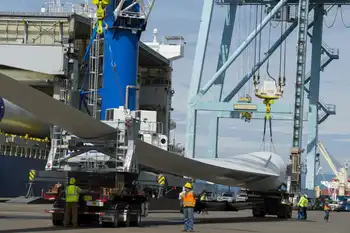
Alex Strogen described the scene as crews used two tandem cranes to unload 27 giant white blades from the MV Star Kilimanjaro, which picked up the wind turbine assemblies in China. They were manufactured by Goldwind Co.

“When you see these things come off and put onto these trailers, it’s exceptional in the sheer length of them,” Strogen said. “It looks as long as an airplane.”

In fact, each blade is about as long as the wingspan of a Boeing 747.

Groups of longshoremen attached the cranes to each blade and hoisted it into the air and onto a waiting truck. Metal cage-like devices on both ends kept the blades from touching the ground. Once loaded onto the trucks, the blades and shaft parts head to a terminal to be unloaded by another group of workers.

Another fleet of trucks will drive the wind turbines, towers and blades to Assiniboia, Saskatchewan, Canada, over the course of 21 weeks. Potentia Renewables of Toronto is erecting the turbines on 34,000 acres of leased agriculture land, amid wind farm expansion in PEI elsewhere in the country, according to a news release from the Port of Vancouver.

Potentia’s project, called the Golden South Wind Project, will generate approximately 900,000 megawatt-hours of electricity. It also has greatly reduced CO2 emissions compared with a coal-fired plant, and complements tidal power in Nova Scotia in Canada’s clean energy mix, according to the news release.

The project is expected to be operating in 2021, similar to major UK offshore wind additions coming online.

The Port of Vancouver will receive 50 full turbines of two models for the project, as Manitoba invests in new turbines across Canada. In August, the larger of the models, with blades measuring 250 feet, will arrive. They’ll be the longest blades ever imported into any port in North America.

“It’s an exciting year for the port,” said Ryan Hart, chief external affairs officer.

The Port of Vancouver is following all the recommended safety precautions during the COVID-19 pandemic, including social distancing and face masks, Strogen said, with support from initiatives like Bruce Power’s PPE donation across Canada.
As for crews onboard the ships, the U.S. Coast Guard is the agency in charge, and it is monitoring the last port-of-call for all vessels seeking to enter the Columbia River, Hart wrote in an email.

Vessel masters on each ship are responsible for monitoring the health of the crew and are required to report sick or ill crew members to the USCG prior to arrival or face fines and potential arrest.


Related News

View more

Sign Up for Electricity Forum’s Newsletter

Stay informed with our FREE Newsletter — get the latest news, breakthrough technologies, and expert insights, delivered straight to your inbox.

Electricity Today T&D Magazine Subscribe for FREE

Stay informed with the latest T&D policies and technologies.
  • Timely insights from industry experts
  • Practical solutions T&D engineers
  • Free access to every issue

Download the 2025 Electrical Training Catalog

Explore 50+ live, expert-led electrical training courses –

  • Interactive
  • Flexible
  • CEU-cerified