Electricity Storage Seen Taming Volatile Prices

By Reuters


CSA Z463 Electrical Maintenance -

Our customized live online or in‑person group training can be delivered to your staff at your location.
  • Live Online
  • 6 hours Instructor-led
  • Group Training Available
Regular Price:
$249
Coupon Price:
$199
Reserve Your Seat Today
The U.S. energy industry, long frustrated by the inability to store electricity, is looking to experimental batteries and compressed air systems that could smooth prices and just possibly add more than $10 billion a year to the economy.

Sharp price swings and congestion on the power grid are hallmarks of the deregulated power market partly because electricity, unlike other energy commodities, cannot be stored.

But new approaches to storing energy could smooth out price spikes, defer costly power line expansions and challenge the belief that electricity has no shelf life.

Energy storage could bolster the U.S. economy by $175 billion over the next 15 years, mostly through optimizing current power systems, according to Richard Baxter, consultant at Pearl Street Inc. and director of advocacy group Energy Storage Council.

"They don't make money, but they save money," Baxter said. "It's definitely an alternative to upgrading or building a new power line."

Despite deregulation efforts over the past decade, U.S. power markets have developed slowly, hampered by a shortage of lines needed to ship electrons to where they are most needed.

Transmission limitations, coupled with sudden power plant outages and strong weather-driven demand, can send wholesale prices soaring in a matter of minutes, creating the kind of marketplace volatility that scares off many companies.

Access to stored power would let companies "peak shave," reducing their power generation requirements during high-priced, high-usage hours by tapping into megawatts put aside during low-demand, low-price hours.

"Storage is an ideal tool for making the markets work," said Imre Gyuk, program manager at the U.S. Department of Energy. "Storage allows you to get away from the hand-to-mouth system we have now."

AIR AND WATER

About 3 percent of U.S. power comes from pumped-storage hydroelectric plants, a system that has existed for decades.

Pumped-storage systems pump water up to a reservoir during low energy demand hours -- typically overnight -- and release the water to run down through turbine generators during peak demand hours, putting energy on the grid when prices are highest.

The price differential between high and low demand hours covers the cost of pumping the water to the upper reservoir.

While strict new environmental rules make it unlikely any more of these big-scale projects will be built, compressed air is being touted as an alternative to hydro in a system that shares many of pumped storage's basic concepts.

Compressed air energy storage (CAES) uses off-peak power to ram air under great pressure into underground salt caverns or aquifers, releasing it during peak hours to drive gas turbines.

But to turn a profit, such projects need to be big.

Only two CAES facilities are currently in operation, a 110 MW unit in McIntosh, Alabama, and a 290 MW unit in Huntorf, Germany. CAES Development Co. LLC has plans to open a 2,700 MW unit in Norton, Ohio, estimated to cost $1 billion.

LOCAL APPEAL

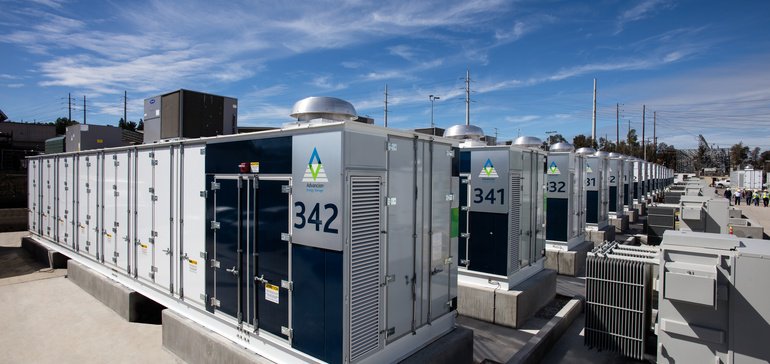
Battery technology, using fuel cells or the more developed sodium-sulfur (NAS) cells, is better suited to utilities seeking to maximize peak shaving or to skirt line congestion.

The California Energy Commission said it would issue a request for proposals for five electricity storage projects in the next month in an effort to bolster the power system to avoid a repeat of the state's 2000-01 energy crisis.

American Electric Power Co. Inc., the largest U.S. power generator, launched a pilot NAS system in Ohio last year. The system has a nominal capacity of 100 kilowatts for peak shaving, but can be boosted to five times that level for brief periods.

NAS technology, first developed by Ford Motor Co. in the 1960s, has been widely used in Japan, where 30 MW of capacity have been installed.

"I think that economical energy storage will have an unbelievable impact on our power system. It will change everything," said David Nichols, manager of American Electric Power's Dolan Technology Center.

Related News
Energy-hungry Europe to brighten profit at US solar equipment makers

European Solar Inverter Demand surges as photovoltaics and residential solar expand during the clean energy transition, driven by high natural gas prices; Germany leads, boosting Enphase and SolarEdge sales for rooftop systems and grid-tied installations.


Key Points

Rising European need for solar inverters, fueled by residential PV growth, high energy costs, and clean energy policies.

✅ Germany leads EU rooftop PV installations

✅ Enphase and SolarEdge see revenue growth

✅ High gas prices and policies spur adoption


Solar equipment makers are expected to post higher quarterly profit, benefiting from strong demand in Europe for critical components that convert energy from the sun into electricity, amid record renewable momentum worldwide.

The continent is emerging as a major market for solar firms as it looks to reduce its dependence on the Russian energy supply and accelerate its clean energy transition, with solar already reshaping power prices in Northern Europe across the region, brightening up businesses of companies such as Enphase Energy (ENPH.O) and SolarEdge Technologies (SEDG.O), which make solar inverters.

Wall Street expects Enphase and SolarEdge to post a combined adjusted net income of $323.8 million for the April-June quarter, a 56.7% jump from a year earlier, even as demand growth slows in the United States.

The energy crisis in Europe is not as acute as last year when Western sanctions on Russia severely crimped supplies, but prices of natural gas and electricity continue to be much higher than in the United States, Raymond James analyst Pavel Molchanov said.

As a result, demand for residential solar keeps growing at a strong pace in the region, with Germany being one of the top markets and solar adoption in Poland also accelerating in recent years across the region.

About 159,000 residential solar systems became operational in the first quarter in Germany amid a solar power boost that reflects policy and demand, a 146% rise from a year earlier, according to BSW solar power association.

Adoption of solar is also helping European homeowners have greater control over their energy costs as fossil fuel prices tend to be more volatile, Morningstar analyst Brett Castelli said.

SolarEdge, which has a bigger exposure to Europe than Enphase, said its first-quarter revenue from the continent more than doubled compared with last year.

In comparison, growth in the United States has been tepid due to lukewarm demand in states like Texas and Arizona where cheaper electricity prices make the economics of residential solar less attractive, even though solar is now cheaper than gas in parts of the U.S. market.

Higher interest rates following the U.S. Federal Reserve's recent actions to tame inflation are also weighing on demand, even as power outage risks rise across the United States.

Analysts also expect weakness in California where a new metering reform reduces the money credited to rooftop solar owners for sending excess power into the grid, underscoring how policy shifts can reshape the sector. The sunshine state accounts for nearly a third of the U.S. residential solar market.

Enphase will report its results on Thursday after the bell, while SolarEdge will release its second-quarter numbers on Aug. 1.


Related News

View more

Magnitude 5 quake strikes near Iran nuclear plant

Iran Bushehr Earthquake rattles southern province near the Bushehr nuclear power plant, USGS reports M5.1 at 38 km depth; seismic activity along major fault lines raises safety, damage, and monitoring concerns.


Key Points

A magnitude 5.1 quake near Bushehr nuclear plant at 38 km depth, with no damage reported, per USGS.

✅ USGS lists magnitude 5.1 at 38 km depth

✅ Near Bushehr nuclear power plant; built for stronger quakes

✅ Iran lies on major fault lines; quake risk is frequent


A magnitude 5 earthquake struck southern Iran early Friday near the Islamic Republic's only nuclear power plant. There were no immediate reports of damage or injuries as Iran continues combined-cycle conversions across its power sector.

The quake hit Iran's Bushehr province at 5:23 a.m., according to the U.S. Geological Survey. It put the magnitude at 5.1 and the depth of the earthquake at 38 kilometres (24 miles), in a province tied to efforts to transmit electricity to Europe in coming years.

Iranian state media did not immediately report on the quake. However, the Bushehr nuclear power plant was designed to withstand much stronger earthquakes, a notable consideration as Iraq plans nuclear power plants to address shortages.

A magnitude 5 earthquake can cause considerable damage, including power disruptions that have seen blackouts spark protests in some Iranian cities.

Iran sits on major fault lines and is prone to near-daily earthquakes, yet it remains a key player in regional power, with Iran-Iraq energy cooperation ongoing. In 2003, a 6.6-magnitude quake flattened the historic city of Bam, killing 26,000 people, and today Iran supplies 40% of Iraq's electricity through cross-border power deals. Bam is near the Bushehr nuclear plant, which wasn’t damaged at that time, while more recently Iran finalized deals to rehabilitate Iraq's power grid to improve resilience.


Related News

View more

Financial update from N.L energy corp. reflects pandemic's impact

Nalcor Energy Pandemic Loss underscores Muskrat Falls delays, hydroelectric risks, oil price shocks, and COVID-19 impacts, affecting ratepayers, provincial debt, timelines, and software commissioning for the Churchill River project and Atlantic Canada subsea transmission.


Key Points

A $171M Q1 2020 downturn linked to COVID-19, oil price collapse, and Muskrat Falls delays impacting schedules and costs.

✅ Q1 2020 profit swing: +$92M to -$171M amid oil price crash

✅ Muskrat Falls timeline slips; cost may reach $13.1B

✅ Software, workforce, COVID-19 constraints slow commissioning


Newfoundland and Labrador's Crown energy corporation reported a pandemic-related profit loss from the first quarter of 2020 on Tuesday, along with further complications to the beleaguered Muskrat Falls hydroelectric project.

Nalcor Energy recorded a profit loss of $171 million in the first quarter of 2020, down from a $92 million profit in the same period last year, due in part to falling oil prices during the COVID-19 pandemic.

The company released its financial statements for 2019 and the first quarter of 2020 on Tuesday, and officials discussed the numbers in a livestreamed presentation that detailed the impact of the global health crisis on the company's operations.

The loss in the first quarter was caused by lower profits from electricity sales and a drop in oil prices due to the pandemic and other global events, company officials said.

The novel coronavirus also added to the troubles plaguing the Muskrat Falls hydroelectric dam on Labrador's Churchill River, amid Quebec-N.L. energy tensions that long predate the pandemic.

Work at the remote site stopped in March over concerns about spreading the virus. Operations have been resuming slowly, with a reduced workforce tackling the remaining jobs.

Officials with Nalcor said it will likely be another year before the megaproject is complete.

CEO Stan Marshall estimates the months of delays could bring the total cost to $13.1 billion including financing, up from the previous estimate of $12.7 billion -- though the total impact of the coronavirus on the project's price tag has yet to be determined.

"If we're going to shut down again, all of that's wrong," Marshall said. "But otherwise, we can just carry on and we'll have a good idea of the productivity level. I'm hoping that by September we'll have a more definitive number here."

The 824 megawatt hydroelectric dam will eventually send power to Newfoundland, and later Nova Scotia, through subsea cables, even as Nova Scotia boosts wind and solar in its energy mix.

It has seen costs essentially double since it was approved in 2012, and faced significant delays even before pandemic-forced shutdowns in North America and around the world this spring.

Cost and schedule overruns were the subject of a sweeping inquiry that held hearings last year, while broader generation choices like biomass use have drawn scrutiny as well.

The commissioner's report faulted previous governments for failing to protect residents by proceeding with the project no matter what, and for placing trust in Nalcor executives who "frequently" concealed information about schedule, cost and related risks.

Some of the latest delays have come from challenges with the development of software required to run the transmission link between Labrador and Newfoundland, where winter reliability issues have been flagged in reports.

The software is still being worked out, Marshall said Tuesday, and the four units at the dam will come online gradually over the next year.

"It's not an all or nothing thing," Marshall said of the final work stages.
Nalcor's financial snapshot follows a bleak fiscal update from the province this month. The Liberal government reported a net debt of $14.2 billion and a deficit of more than $1.1 billion, even as a recent Churchill Falls deal promised new revenues for the province, citing challenges from pandemic-related closures and oil production shutdowns.

Finance Minister Tom Osborne said at the time that help from Ottawa will be necessary to get the province's finances back on track.

Muskrat Falls represents about one-third of the province's debt, and is set to produce more power than the province of about half a million people requires. Anticipated rate increases due to the ballooning costs and questions about Muskrat Falls benefits have posed a significant political challenge for the provincial government.

Ottawa has agreed to work with Newfoundland and Labrador on a rewrite of the project's financial structure, scrapping the format agreed upon in past federal-provincial loan agreements in order to ease the burden on ratepayers, while some argue independent planning would better safeguard ratepayers.

Marshall, a former Fortis CEO who was brought in to lead Nalcor in 2016, has called the project a "boondoggle" and committed to seeing it completed within four years. Though that plan has been disrupted by the pandemic, Marshall said the end is in sight.

"I'm looking forward to a year from now. And I hope to be gone," Marshall said.


Related News

View more

PG&E Wildfire Assistance Program Accepting Applications for Aid

PG&E Wildfire Assistance Program offers court-approved aid and emergency grants for Northern California wildfires and Camp Fire victims, covering unmet needs, housing, and essentials; apply online by November 15, 2019 under Chapter 11-funded eligibility.


Key Points

A $105M, court-approved aid fund offering unmet-needs payments and emergency support for 2017-2018 wildfire victims.

✅ $5,000 Basic Unmet Needs per household, self-certified

✅ Supplemental aid for extreme circumstances after basic grants

✅ Apply online; deadline November 15, 2019; identity required


Beginning today, August 15, 2019, those displaced by the 2017 Northern California wildfires and 2018 Camp fire can apply for aid through an independently administered Wildfire Assistance Program funded by Pacific Gas and Electric Company (PG&E). PG&E’s $105 million fund, approved by the judge in PG&E’s Chapter 11 cases and related bankruptcy plan, is intended to help those who are either uninsured or need assistance with alternative living expenses or other urgent needs. The court-approved independent administrator is set to file the eligibility criteria as required by the court and will open the application process.

“Our goal is to get the money to those who most need it as quickly as possible. We will prioritize wildfire victims who have urgent needs, including those who are currently without adequate shelter,” said Cathy Yanni, plan administrator. Yanni is partnering with local agencies and community organizations to administer the fund, and PG&E also supports local communities through property tax contributions to counties.

“We appreciate the diligent work of the fund administrator in quickly establishing a way to distribute these funds and ensuring the program supports those with the most immediate needs. PG&E is focused on helping those impacted by the devastating wildfires in recent years and strengthening our energy system to reduce wildfire risks and prevent utility-caused catastrophic fires. We feel strongly that helping these communities now is the right thing to do,” said Bill Johnson, CEO and President of PG&E Corporation.

Applicants can request a “Basic Unmet Needs” payment of $5,000 per household for victims who establish basic eligibility requirements and self-certify that they have at least $5,000 of unmet needs that have not been compensated by the Federal Emergency Management Agency (FEMA). Payments are to support needs such as water, food, prescriptions, medical supplies and equipment, infant formula and diapers, personal hygiene items, and transportation fuels beyond what FEMA covered in the days immediately following the declared disasters, aligning with broader health and safety actions the company has taken.

Those who receive basic payments may also qualify for a “Supplemental Unmet Needs” payment. These funds will be available only after “Basic Unmet Needs” payments have been issued. Supplemental payments will be available to individuals and families who currently face extreme or extraordinary circumstances as compared to others who were impacted by the 2017 and 2018 wildfires, including areas affected by power line-related fires across California.

To qualify for the payments, applicants’ primary residence must have been within the boundary of the 2017 Northern California wildfires or the 2018 Camp fire in Butte County. Applicants also must establish proof of identity and certify that they are not requesting payments for an expense already paid for by FEMA.

Applicants can find more information and apply for assistance at https://www.norcalwildfireassistanceprogram.com/. The deadline to file for aid is November 15, 2019.

The $105 million being provided by PG&E was made available from the company’s cash reserves. PG&E will not seek cost recovery from its customers, and its rates are set to stabilize in 2025 according to recent guidance.


Related News

View more

Lawmakers question FERC licensing process for dams in West Virginia

FERC Hydropower Licensing Dispute centers on FERC authority, Clean Water Act compliance, state water quality certifications, Federal Power Act timelines, and Army Corps dams on West Virginia's Monongahela River licenses.


Key Points

An inquiry into FERC's licensing process and state water quality authority for hydropower at Monongahela River dams.

✅ Questions on omitted state water quality conditions

✅ Debate over starting Clean Water Act certification timelines

✅ Potential impacts on states' rights and licensing schedules


As federal lawmakers, including Democrats pressing FERC, plan to consider a bill that would expand Federal Energy Regulatory Commission (FERC) licensing authority, questions emerged on Tuesday about the process used by FERC to issue two hydropower licenses for existing dams in West Virginia.

In a letter to FERC Chairman Neil Chatterjee, Democratic leaders of the House Energy and Commerce Committee, as electricity pricing changes were being debated, raised questions about hydropower licenses issued for two dams operated by the U.S. Army Corps of Engineers on the Monongahela River in West Virginia.

U.S. Reps. Frank Pallone Jr. (D-NJ), the ranking member of the Subcommittee on Energy, Bobby Rush (D-IL), the ranking member of the Subcommittee on Environment, and John Sarbanes (D-MD), amid Maryland clean energy enforcement concerns, questioned why FERC did not incorporate all conditions outlined in a West Virginia Department of Environmental Protection water quality certificate into plans for the projects.

“By denying the state its allotted time to review this application and submit requirements on these licenses, FERC is undermining the state’s authority under the Clean Water Act and Federal Power Act to impose conditions that will ensure water quality standards are met,” the letter stated.

The House of Representatives was slated to consider the Hydropower Policy Modernization Act of 2017, H.R. 3043, later in the week. The measure would expand FERC authority over licensing processes, a theme mirrored in Maine's transmission line debate over interstate energy projects. Opponents of the bill argue that the changes would make it more difficult for states to protect their clean water interests.

West Virginia has announced plans to challenge FERC hydropower licenses for the dams on the Monongahela River, echoing Northern Pass opposition seen in New Hampshire.


Related News

View more

Vehicle-to-grid could be ‘capacity on wheels’ for electricity networks

Vehicle-to-Grid (V2G) enables EV batteries to provide grid balancing, flexibility, and demand response, integrating renewables with bidirectional charging, reducing peaker plant reliance, and unlocking distributed energy storage from millions of connected electric vehicles.


Key Points

Vehicle-to-Grid (V2G) lets EVs export power via bidirectional charging to balance grids and support renewables.

✅ Turns parked EVs into distributed energy storage assets

✅ Delivers balancing services and demand response to the grid

✅ Cuts peaker plant use and supports renewable integration


“There are already many Gigawatt-hours of batteries on wheels”, which could be used to provide balance and flexibility to electrical grids, if the “ultimate potential” of vehicle-to-grid (V2G) technology could be harnessed.

That’s according to a panel of experts and stakeholders convened by our sister site Current±, which covers the business models and technologies inherent to the low carbon transition to decentralised and clean energy. Focusing mainly on the UK grid but opening up the conversation to other territories and the technologies themselves, representatives including distribution network operator (DNO) Northern Powergrid’s policy and markets director and Nissan Europe’s director of energy services debated the challenges, benefits and that aforementioned ultimate potential.

Decarbonisation of energy systems and of transport go hand-in-hand amid grid challenges from rising EV uptake, with vehicle fuel currently responsible for more emissions than electricity used for energy elsewhere, as Ian Cameron, head of innovation at DNO UK Power Networks says in the Q&A article.

“Furthermore, V2G technology will further help decarbonisation by replacing polluting power plants that back up the electrical grid,” Marc Trahand from EV software company Nuvve Corporation added, pointing to California grid stability initiatives as a leading example.

While the panel states that there will still be a place for standalone utility-scale energy storage systems, various speakers highlighted that there are over 20GWh of so-called ‘batteries on wheels’ in the US, capable of powering buildings as needed, and up to 10 million EVs forecast for Britain’s roads by 2030.

“…it therefore doesn’t make sense to keep building expensive standalone battery farms when you have all this capacity on wheels that just needs to be plugged into bidirectional chargers,” Trahand said.


Related News

View more

Sign Up for Electricity Forum’s Newsletter

Stay informed with our FREE Newsletter — get the latest news, breakthrough technologies, and expert insights, delivered straight to your inbox.

Electricity Today T&D Magazine Subscribe for FREE

Stay informed with the latest T&D policies and technologies.
  • Timely insights from industry experts
  • Practical solutions T&D engineers
  • Free access to every issue

Live Online & In-person Group Training

Advantages To Instructor-Led Training – Instructor-Led Course, Customized Training, Multiple Locations, Economical, CEU Credits, Course Discounts.

Request For Quotation

Whether you would prefer Live Online or In-Person instruction, our electrical training courses can be tailored to meet your company's specific requirements and delivered to your employees in one location or at various locations.