By For additional information about Texas Electric Choice, call the toll-free answer center at 1-866-PWR-4-TEX (1-866-797-4839).


NFPA 70b Training - Electrical Maintenance

Our customized live online or in‑person group training can be delivered to your staff at your location.

  • Live Online
  • 12 hours Instructor-led
  • Group Training Available
Regular Price:
$699
Coupon Price:
$599
Reserve Your Seat Today
Beginning January 1, 2002, Texas' electric industry opened to customer choice, giving consumers the power to choose the company that provides their electricity. Electric Choice offers benefits for both residential and non-residential customers.

Only electric customers of Texas' investor-owned utilities, including American Electric Power (including Central Power & Light, Southwestern Electric Power Company and West Texas Utilities), Entergy, Texas New Mexico Power, Reliant Energy, TXU Electric, TXU SESCO, and Southwestern Public Service Company will be impacted by the Texas Electric Choice program.

The new law allows municipally-owned utilities and electric cooperatives to decide whether they want to offer their customers choice. Customers of municipally-owned utilities or electric cooperatives should contact their local utility or city government for more information.

The Public Utility Commission of Texas (PUC) is the state agency responsible for regulating public utilities in Texas. It will continue to regulate the delivery of electricity to a home or business, ensuring safety and reliability every step of the way. The PUC will also have limited regulation over Retail Electric Providers (REPs) to ensure that electric customers are protected.

A web site (http://www.powertochoose.org/) has been developed as a resource to learn about and participate in the Texas Electric Choice program. The site is continually updated to help consumers evaluate their options in competitive electric market.

Related News

Grid coordination opens road for electric vehicle flexibility

Smart EV Charging orchestrates vehicle-to-grid (V2G), demand response, and fast charging to balance the power grid, integrating renewables, electrolyzers for hydrogen, and megawatt chargers for fleets with advanced control and co-optimization.


Key Points

Smart EV charging coordinates EV load to stabilize the grid, cut peaks, and integrate renewable energy efficiently.

✅ Reduces peak demand via coordinated, flexible load control

✅ Enables V2G services with renewables and battery storage

✅ Supports megawatt fast charging for heavy-duty fleets


As electric vehicle (EV) sales continue to rev up in the United States, the power grid is in parallel contending with the greatest transformation in its 100-year history: the large-scale integration of renewable energy and power electronic devices. The expected expansion of EVs will shift those challenges into high gear, causing cities to face gigawatt-growth in electricity demand, as analyses of EV grid impacts indicate, and higher amounts of variable energy.

Coordinating large numbers of EVs with the power system presents a highly complex challenge. EVs introduce variable electrical loads that are highly dependent on customer behavior. Electrified transportation involves co-optimization with other energy systems, like natural gas and bulk battery storage, including mobile energy storage flexibility for new operational options. It could involve fleets of automated ride-hailing EVs and lead to hybrid-energy truck stops that provide hydrogen and fast-charging to heavy-duty vehicles.

Those changes will all test the limits of grid integration, but the National Renewable Energy Laboratory (NREL) sees opportunity at the intersection of energy systems and transportation. With powerful resources for simulating and evaluating complex systems, several NREL projects are determining the coordination required for fast charging, balancing electrical supply and demand, and efficient use of all energy assets.


Smart and Not-So-Smart Control
To appreciate the value of coordinated EV charging, it is helpful to imagine the opposite scenario.

"Our first question is how much benefit or burden the super simple, uncoordinated approach to electric vehicle charging offers the grid," said Andrew Meintz, the researcher leading NREL's Electric Vehicle Grid Integration team, as well as the RECHARGE project for smart EV charging. "Then we compare that to the 'whiz-bang,' everything-is-connected approach. We want to know the difference in value."

In the "super simple" approach, Meintz explained that battery-powered electric vehicles grow in market share, exemplified by mass-market EVs, without any evolution in vehicle charging coordination. Picture every employee at your workplace driving home at 5 p.m. and charging their vehicle. That is the grid's equivalent of going 0 to 100 mph, and if it does not wreck the system, it is at least very expensive. According to NREL's Electrification Futures Study, a comprehensive analysis of the impacts of widespread electrification across all U.S. economic sectors, in 2050 EVs could contribute to a 33% increase in energy use during peak electrical demand, underscoring state grid challenges that make these intervals costly when energy reserves are procured. In duck curve parlance, EVs will further strain the duck's neck.

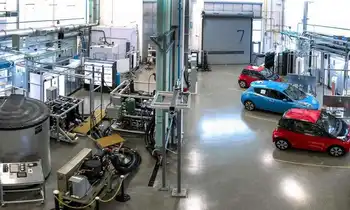
The Optimization and Control Lab's Electric Vehicle Grid Integration bays allow researchers to determine how advanced high power chargers can be added safely and effectively to the grid, with the potential to explore how to combine buildings and EV charging. Credit: Dennis Schroeder, NREL
Meintz's "whiz-bang" approach instead imagines EV control strategies that are deliberate and serve to smooth, rather than intensify, the upcoming demand for electricity. It means managing both when and where vehicles charge to create flexible load on the grid.

At NREL, smart strategies to dispatch vehicles for optimal charging are being developed for both the grid edge, where consumers and energy users connect to the grid, as in RECHARGEPDF, and the entire distribution system, as in the GEMINI-XFC projectPDF. Both projects, funded by the U.S. Department of Energy's (DOE's) Vehicle Technologies Office, lean on advanced capabilities at NREL's Energy Systems Integration Facility to simulate future energy systems.

At the grid edge, EVs can be co-optimized with distributed energy resources—small-scale generation or storage technologies—the subject of a partnership with Eaton that brought industry perspectives to bear on coordinated management of EV fleets.

At the larger-system level, the GEMINI-XFC project has extended EV optimization scenarios to the city scale—the San Francisco Bay Area, to be specific.

"GEMINI-XFC involves the highest-ever-fidelity modeling of transportation and the grid," said NREL Research Manager of Grid-Connected Energy Systems Bryan Palmintier.

"We're combining future transportation scenarios with a large metro area co-simulationPDF—millions of simulated customers and a realistic distribution system model—to find the best approaches to vehicles helping the grid."

GEMINI-XFC and RECHARGE can foresee future electrification scenarios and then insert controls that reduce grid congestion or offset peak demand, for example. Charging EVs involves a sort of shell game, where loads are continually moved among charging stations to accommodate grid demand.

But for heavy-duty vehicles, the load is harder to hide. Electrified truck fleets will hit the road soon, creating power needs for electric truck fleets that translate to megawatts of localized demand. No amount of rerouting can avoid the requirements of charging heavy-duty vehicles or other instances of extreme fast-charging (XFC). To address this challenge, NREL is working with industry and other national laboratories to study and demonstrate the technological buildout necessary to achieve 1+ MW charging stationsPDF that are capable of fast charging at very high energy levels for medium- and heavy-duty vehicles.

To reach such a scale, NREL is also considering new power conversion hardware based on advanced materials like wide-bandgap semiconductors, as well as new controllers and algorithms that are uniquely suited for fleets of charge-hungry vehicles. The challenge to integrate 1+ MW charging is also pushing NREL research to higher power: Upcoming capabilities will look at many-megawatt systems that tie in the support of other energy sectors.


Renewable In-Roads for Hydrogen

At NREL, the drive toward larger charging demands is being met with larger research capabilities. The announcement of ARIES opens the door to energy systems integration research at a scale 10-times greater than current capabilities: 20 MW, up from 2 MW. Critically, it presents an opportunity to understand how mobility with high energy demands can be co-optimized with other utility-scale assets to benefit grid stability.

"If you've got a grid humming along with a steady load, then a truck requires 500 kW or more of power, it could create a large disruption for the grid," said Keith Wipke, the laboratory program manager for fuel cells and hydrogen technologies at NREL.

Such a high power demand could be partially served by battery storage systems. Or it could be hidden entirely with hydrogen production. Wipke's program, with support from the DOE's Hydrogen and Fuel Cell Technologies Office, has been performing studies into how electrolyzers—devices that use electricity to break water into hydrogen and oxygen—could offset the grid impacts of XFC. These efforts are also closely aligned with DOE's H2@Scale vision for affordable and effective hydrogen use across multiple sectors, including heavy-duty transportation, power generation, and metals manufacturing, among others.

"We're simulating electrolyzers that can match the charging load of heavy-duty battery electric vehicles. When fast charging begins, the electrolyzers are ramped down. When fast charging ends, the electrolyzers are ramped back up," Wipke said. "If done smoothly, the utility doesn't even know it's happening."

NREL Researchers Rishabh Jain, Kazunori Nagasawa, and Jen Kurtz are working on how grid integration of electrolyzers—devices that use electricity to break water into hydrogen and oxygen—could offset the grid impacts of extreme fast-charging. Credit: National Renewable Energy Laboratory
As electrolyzers harness the cheap electrons from off-demand periods, a significant amount of hydrogen can be produced on site. That creates a natural energy pathway from discount electricity into a fuel. It is no wonder, then, that several well-known transportation and fuel companies have recently initiated a multimillion-dollar partnership with NREL to advance heavy-duty hydrogen vehicle technologies.

"The logistics of expanding electric charging infrastructure from 50 kW for a single demonstration battery electric truck to 5,000 kW for a fleet of 100 could present challenges," Wipke said. "Hydrogen scales very nicely; you're basically bringing hydrogen to a fueling station or producing it on site, but either way the hydrogen fueling events are decoupled in time from hydrogen production, providing benefits to the grid."

The long driving range and fast refuel times—including a DOE target of achieving 10-minutes refuel for a truck—have already made hydrogen the standout solution for applications in warehouse forklifts. Further, NREL is finding that distributed electrolyzers can simultaneously produce hydrogen and improve voltage conditions, which can add much-needed stability to a grid that is accommodating more energy from variable resources.

Those examples that co-optimize mobility with the grid, using diverse technologies, are encouraging NREL and its partners to pursue a new scale of systems integration. Several forward-thinking projects are reimagining urban mobility as a mix of energy solutions that integrate the relative strengths of transportation technologies, which complement each other to fill important gaps in grid reliability.


The Future of Urban Mobility
What will electrified transportation look like at high penetrations? A few NREL projects offer some perspective. Among the most experimental, NREL is helping the city of Denver develop a smart community, integrated with electrified mobility and featuring automated charging and vehicle dispatch.

On another path to advanced mobility, Los Angeles has embarked on a plan to modernize its electricity system infrastructure, reflecting California EV grid stability goals—aiming for a 100% renewable energy supply by 2045, along with aggressive electrification targets for buildings and vehicles. Through the Los Angeles 100% Renewable Energy Study, the city is currently working with NREL to assess the full-scale impacts of the transition in a detailed analysis that integrates diverse capabilities across the laboratory.

The transition would include the Port of Long Beach, the busiest container port in the United States.

At the port, NREL is applying the same sort of scenario forecasting and controls evaluation as other projects, in order to find the optimal mix of technologies that can be integrated for both grid stability and a reliable quality of service: a mix of hydrogen fuel-cell and battery EVs, battery storage systems, on-site renewable generation, and extreme coordination among everything.

"Hydrogen at ports makes sense for the same reason as trucks: Marine applications have big power and energy demands," Wipke said. "But it's really the synergies between diverse technologies—the existing infrastructure for EVs and the flexibility of bulk battery systems—that will truly make the transition to high renewable energy possible."

Like the Port of Long Beach, transportation hubs across the nation are adapting to a complex environment of new mobility solutions. Airports and public transit stations involve the movement of passengers, goods, and services at a volume exceeding anywhere else. With the transition to digitally connected electric mobility changing how airports plan for the future, NREL projects such as Athena are using the power of high-performance computing to demonstrate how these hubs can maximize the value of passenger and freight mobility per unit of energy, time, and/or cost.

The growth in complexity for transportation hubs has just begun, however. Looking ahead, fleets of ride-sharing EVs, automated vehicles, and automated ride-sharing EV fleets could present the largest effort to manage mobility yet.


A Self-Driving Power Grid
To understand the full impact of future mobility-service providers, NREL developed the HIVE (Highly Integrated Vehicle Ecosystem) simulation framework. HIVE combines factors related to serving mobility needs and grid operations—such as a customer's willingness to carpool or delay travel, and potentially time-variable costs of recharging—and simulates the outcome in an integrated environment.

"Our question is, how do you optimize the management of a fleet whose primary purpose is to provide rides and improve that fleet's dispatch and charging?" said Eric Wood, an NREL vehicle systems engineer.

HIVE was developed as part of NREL's Autonomous Energy Systems research to optimize the control of automated vehicle fleets. That is, optimized routing and dispatch of automated electric vehicles.

The project imagines how price signals could influence dispatch algorithms. Consider one customer booking a commute through a ride-hailing app. Out of the fleet of vehicles nearby—variously charged and continually changing locations—which one should pick up the customer?

Now consider the movements of thousands of passengers in a city and thousands of vehicles providing transportation services. Among the number of agents, the moment-to-moment change in energy supply and demand, and the broad diversity in vendor technologies, "we're playing with a lot of parameters," Wood said.

But cutting through all the complexity, and in the midst of massive simulations, the end goal for vehicle-to-grid integration is consistent:

"The motivation for our work is that there are forecasts for significant load on the grid from the electrification of transportation," Wood said. "We want to ensure that this load is safely and effectively integrated, while meeting the expectations and needs of passengers."

The Port of Long Beach uses a mix of hydrogen fuel-cell and battery EVs, battery storage systems, on-site renewable generation, and extreme coordination among everything. Credit: National Renewable Energy Laboratory
True Replacement without Caveats

Electric vehicles are not necessarily helpful to the grid, but they can be. As EVs become established in the transportation sector, NREL is studying how to even out any bumps that electrified mobility could cause on the grid and advance any benefits to commuters or industry.

"It all comes down to load flexibility," Meintz said. "We're trying to decide how to optimally dispatch vehicle charging to meet quality-of-service considerations, while also minimizing charging costs."


Related News

View more

Chinese govt rejects the allegations against CPEC Power Producers

CPEC Power Producers drive China-Pakistan energy cooperation under the Belt and Road Initiative, delivering clean, reliable electricity, investment transparency, and grid stability while countering allegations, cutting circular debt, and easing load-shedding nationwide.


Key Points

CPEC Power Producers are BRI-backed energy projects supplying clean, reliable power and stabilizing Pakistan's grid.

✅ Supply one-third of load during COVID-19 peak, ensuring reliability

✅ Reduce circular debt and mitigate nationwide load-shedding

✅ Operate under BRI with transparent, long-term investment


Chinese government has rejected the allegations against the CPEC Power Producers (CPPs) amid broader coal reduction goals in the power sector.

Chinese government has made it clear that a mammoth cooperation with Pakistan in the energy sector is continuing, aligned with its broader electricity outlook through 2060 and beyond.

A letter written by Chinese ambassador to minister of Energy Omar Ayub Khan has said that major headway has been seen in recent days in the perspective of CPEC projects, alongside China's nuclear energy development at home. But he wants to invite the attention of government of Pakistan to the recent allegations leveled against the CPEC Power Producers (CPPs).

The Chinese ambassador further said Energy is a major area of cooperation under the CPEC and the CPPs have provided large amount of clean, reliable and affordable electricity to the Pakistani consumers and have guaranteed one-third of the power load during the COVID-19 pandemic, even as China grappled with periodic power cuts domestically. However many misinformed analysis and media distortion about the CPPs have been made public to create confusion about the CPEC, amid global solar sector uncertainty influencing narratives. Therefore, the Port Qasim Electric Power Company, Huaneng Shandong Ruyi Energy Limited and the China Power Hub Generation Company Limited as leading CPPs have drafted their own reports in this regard to present the real facts about the investors and operators. The conclusion is the CPPs have contributed to overcoming of loadshedding and the reduction of the power circular debt.

Reports of the two companies have also been attached with the letter wherein it has been laid out that CPEC as a pilot project under the Belt and Road Initiative, which also includes regional nuclear energy cooperation efforts, is an important platform for China and Pakistan to build a stronger economic and development partnership.

Chinese companies have expressed strong reservations over report of different committees besides voicing protest over it. They have made it clear they are ready to present the real situation before the competent authorities and committee, and in parallel with electricity infrastructure initiatives abroad, because all the work is being carried out by Chinese companies in power sector in fair and transparent manner.


Related News

View more

What Will Drive Utility Revenue When Electricity Is Free?

AI-Powered Utility Customer Experience enables transparency, real-time pricing, smart thermostats, demand response, and billing optimization, helping utilities integrate distributed energy resources, battery storage, and microgrids while boosting customer satisfaction and reducing costs.


Key Points

An approach where utilities use AI and real-time data to personalize service, optimize billing, and cut energy costs.

✅ Real-time pricing aligns retail and wholesale market signals

✅ Device control via smart thermostats and home energy management

✅ Analytics reveal appliance-level usage and personalized savings


The latest electric utility customer satisfaction survey results from the American Customer Satisfaction Index (ACSI) Energy Utilities report reveal that nearly every investor-owned utility saw customer satisfaction go down from 2018 to 2019. Residential customers are sending a clear message in the report: They want more transparency and control over energy usage, billing and ways to reduce costs.

With both customer satisfaction and utility revenues on the decline, utilities are facing daunting challenges to their traditional business models amid flat electricity demand across many markets today. That said, it is the utilities that see these changing times as an opportunity to evolve that will become the energy leaders of tomorrow, where the customer relationship is no longer defined by sales volume but instead by a utility company's ability to optimize service and deliver meaningful customer solutions.

We have seen how the proliferation of centralized and distributed renewables on the grid has already dramatically changed the cost profile of traditional generation and variability of wholesale energy prices. This signals the real cost drivers in the future will come from optimizing energy service with things like batteries, microgrids and peer-to-peer trading networks. In the foreseeable future, flat electricity rates may be the norm, or electricity might even become entirely free as services become the primary source of utility revenue.

The key to this future is technological innovation that allows utilities to better understand a customer’s unique needs and priorities and then deliver personalized, well-timed solutions that make customers feel valued and appreciated as their utility helps them save and alleviates their greatest pain points.

I predict utilities that adopt new technologies focused on customer experience, aligned with key utility trends shaping the sector, and deliver continual service improvements and optimization will earn the most satisfied, most loyal customers.

To illustrate this, look at how fixed pricing today is applied for most residential customers. Unless you live in one of the states with deregulated utilities where most customers are free to choose a service provider in a competitive marketplace, as consumers in power markets increasingly reshape offerings, fixed-rate tariffs or time-of-use tariffs might be the only rate structures you have ever known, though new utility rate designs are being tested nationwide today. These tariffs are often market distortions, bearing little relation to the real-time price that the utility pays on the wholesale market.

It can be easy enough to compare the rate you pay as a consumer and the market rate that utilities pay. The California ISO has a public dashboard -- as do other grid operators -- that shows the real-time marginal cost of energy. On a recent Friday, for example, a buyer in San Francisco could go to the real-time market and procure electricity at a rate of around 9.5 cents per kilowatt-hour (kWh), yet a residential customer can pay the utility PG&E between 22 cents and 49 cents per kWh amid major changes to electric bills being debated, depending on usage.

The problem is that utility customers do not usually see this data or know how to interpret it in a way that helps add value to their service or drive down the cost.

This is a scenario ripe for innovation. Artificial intelligence (AI) technologies are beginning to be applied to give customers the transparency and control over the energy they desire, and a new type of utility is emerging using real-time pricing signals from wholesale markets to give households hassle-free energy savings. Evolve Energy in Texas is developing a utility service model, even as Texas utilities revisit smart home network strategies, that delivers electricity to consumers at real-time market prices and connects to smart thermostats and other connected devices in the home for simple monitoring and control -- all managed via an intuitive consumer app.

My company, Bidgely, partners with utilities and energy retailers all over the world to apply artificial intelligence and machine learning algorithms to customer data in order to bring transparency to their electricity bills, showing exactly where the customers’ money is going down to the appliance and offering personalized, actionable advice on how to save.

Another example is from energy management company Keewi. Its wireless outlet adaptors are revealing real-time energy usage information to Texas A&M dorm residents as well as providing students the ability to conserve energy through controlling items in their rooms from their smartphones.

These are but a few examples of innovations among many in play that answer the consumer demand for increased transparency and control over energy usage.

Electric service providers will be closely watching how consumers respond to AI-driven innovation, including providers in traditionally regulated markets that are exploring equitable regulation approaches now, to stay aligned with policy and customer expectations. While regulated utilities have no reason to fear that their customers might sign up with a competitor, they understand that the revenues from electricity sales are going down and the deployment of distributed energy resources is going up. Both trends were reflected in a March report from Bloomberg New Energy Finance (via ThinkProgress) that claimed unsubsidized storage projects co-located with solar or wind are starting to compete with coal and gas for dispatchable power. Change is coming to regulated markets, and some of that change can be attributed to customer dissatisfaction with utility service.

Like so many industries before, the utility-customer relationship is on track to become less about measuring unit sales and more about driving revenue through services and delivering the best customer value. Loyal customers are most likely to listen and follow through on the utility’s advice and to trust the utility for a wide range of energy-related products and services. Utilities that make customer experience the highest priority today will emerge tomorrow as the leaders of a new energy service era.


Related News

View more

Pickering nuclear station is closing as planned, despite calls for refurbishment

Ontario Pickering Nuclear Closure will shift supply to natural gas, raising emissions as the electricity grid manages nuclear refurbishment, IESO planning, clean power imports, and new wind, solar, and storage to support electrification.


Key Points

Ontario will close Pickering and rely on natural gas, increasing emissions while other nuclear units are refurbished.

✅ 14% of Ontario electricity supplied by Pickering now

✅ Natural gas use rises; grid emissions projected up 375%

✅ IESO warns gas phaseout by 2030 risks blackouts, costs


The Ontario government will not reconsider plans to close the Pickering nuclear station and instead stop-gap the consequent electricity shortfall with natural gas-generated power in a move that will, as an analysis of Ontario's grid shows, hike the province’s greenhouse gas emissions substantially in the coming years.

In a report released this week, a nuclear advocacy group urged Ontario to refurbish the aging facility east of Toronto, which is set to be shuttered in phases in 2024 and 2025, prompting debate over a clean energy plan after Pickering as the closure nears. The closure of Pickering, which provides 14 per cent of the province’s annual electricity supply, comes at the same time as Ontario’s other two nuclear stations are undergoing refurbishment and operating at reduced capacity.

Canadians for Nuclear Energy, which is largely funded by power workers' unions, argued closing the 50-year-old facility will result in job losses, emissions increases, heightened reliance on imported natural gas and an electricity supply gap across Ontario.

But Palmer Lockridge, spokesperson for the provincial energy minister, said further extending Pickering’s lifespan isn’t on the table.

“As previously announced in 2020, our government is supporting Ontario Power Generation’s plan to safely extend the life of the Pickering Nuclear Generating Station through the end of 2025,” said Lockridge in an emailed response to questions.

“Going forward, we are ensuring a reliable, affordable and clean electricity system for decades to come. That’s why we put a plan in place that ensures we are prepared for the emerging energy needs following the closure of Pickering, and as a result of our government’s success in growing and electrifying the province’s economy.”

The Progressive Conservative government under Premier Doug Ford has invested heavily in electrification, sinking billions into electric vehicle and battery manufacturing and industries like steel-making to retool plants to run on electricity rather than coal, and exploring new large-scale nuclear plants to bolster baseload supply.

Natural gas now provides about seven per cent of the province’s energy, a piece of the pie that will rise significantly as nuclear energy dwindles. Emissions from Ontario’s electricity grid, which is currently one of the world’s cleanest with 94 per cent zero-emission power generation, are projected to rise a whopping 375 per cent as the province turns increasingly to natural gas generation. Those increases will effectively undo a third of the hard-won emissions reductions the province achieved by phasing out coal-fired power generation.

The Independent Electricity System Operator (IESO), which manages Ontario’s grid, studied whether the province could phase out natural gas generation by 2030 and concluded that “would result in blackouts and hinder electrification” and increase average residential electricity costs by $100 per month.

The Ontario Clean Air Alliance, however, obtained draft documents from the electricity operator that showed it had studied, but not released publicly, other scenarios that involved phasing out natural gas without energy shortfalls, price hikes or increases in emissions.

The Ontario government will not reconsider plans to close the Pickering nuclear station and instead stop-gap the consequent electricity shortfall facing Ontario with natural gas-generated power in a move that will hike the province’s greenhouse gas emissions.

One model suggested increasing carbon taxes and imports of clean energy from other provinces could keep blackouts, costs and emissions at bay, while another involved increasing energy efficiency, wind generation and storage.

“By banning gas-fired electricity exports to the U.S., importing all the Quebec water power we can with the existing transmission lines and investing in energy efficiency and wind and solar and storage — do all those things and you can phase out gas-fired power and lower our bills,” said Jack Gibbons, chair of the Ontario Clean Air Alliance.

The IESO has argued in response that the study of those scenarios was not complete and did not include many of the challenges associated with phasing out natural gas plants.

Ontario Energy Minister Todd Smith asked the IESO to develop “an achievable pathway to zero-emissions in the electricity sector and evaluate a moratorium on new-build natural gas generation stations,” said his spokesperson. That report, an early look at halting gas power, is expected in November.


Related News

View more

Feds to study using electricity to 'reduce or eliminate' fossil fuels

Electrification Potential Study for Canada evaluates NRCan's decarbonization roadmap, assessing electrification of end uses and replacements for fossil fuels across transportation, buildings, and industry, including propane, diesel, natural gas, and coal, to guide energy policy.


Key Points

An NRCan study assessing electrification to replace fossil fuels across sectors and guide deep decarbonization R&D.

✅ Evaluates non-electric alternatives alongside electrification paths

✅ Covers propane, diesel, natural gas, and coal end uses

✅ Guides NRCan R&D priorities for deep decarbonization


The federal government wants to spend up to $300,000 on a study aimed at understanding whether existing electrical technologies can “reduce or eliminate” fossil fuels used for virtually every purpose other than generating electricity.

The proposal has caused consternation within the Saskatchewan government, whose premier has criticized a 2035 net-zero grid target as shifting the goalposts, and which has spent months attacking federal policies it believes will harm the Western Canadian energy sector without meaningfully addressing climate change.

Procurement documents indicate the “Electrification Potential Study for Canada” will provide “strategic guidance on the need to pursue both electric and non-electric energy research and development to enable deep decarbonisation scenarios.”

“It is critical that (Natural Resources Canada) as a whole have a cross-sectoral, consistent, and comprehensive understanding of the viability of electric technologies as a replacement for fossil fuels,” the documents state.

The study proponent will be asked to examine possible replacements for a range of fuels, including propane, transportation fuel, fuel oil, diesel, natural gas and coal, even as Alberta maps a path to clean electricity for its grid. Only international travel fuel and electricity generation are outside the scope of the study.

“To be clear, the consultant should not answer these questions directly, but should conduct the analysis with them in mind. The goal … is to collate data which can be used by (Natural Resources Canada) to conduct analysis related to these questions,” the documents state.

Natural Resources Canada issued the request for proposals one week before Prime Minister Justin Trudeau officially launched a 40-day election campaign in which climate and energy policy, including debates over Alberta's power market like a Calgary retailer's challenge, is expected to play a defining role.

It also comes as the federal government works to complete the controversial Trans Mountain Pipeline Expansion project through British Columbia, amid tariff threats boosting support for Canadian energy projects, which it bought last year for $4.5 billion and is currently bogged down in the court system.

A Natural Resources Canada spokeswoman said the ministry would not be able to respond to questions until sometime on Thursday.

While the documents make clear that the study aims to answer unresolved questions about what the International Energy Agency calls an increasingly-electric future, with clean grid and storage trends emerging, without a specific timeline, the provincial government is far from thrilled.

Energy and Resources Minister Bronwyn Eyre said the document reflects the federal government’s “hostility” to the energy sector, even as Alberta's electricity sector faces profound change, because government ministries like Natural Resources Canada don’t do anything without political direction.

Asked whether a responsible government should consider every option before taking a decision, Eyre said a government that was not interested in eliminating fossil fuels entirely would not have used such “strong” language in a public document, noting that provinces like Ontario are grappling with hydro system problems as well.

“I think it’s a real wake-up call to what (Ottawa’s) endgame really is here,” she said, adding that the document does not ask the proponent to conduct an economic impact analysis or consider potential job losses in the energy sector.

The study is organized by Natural Resources Canada’s office of energy research and development, which is tasked with accelerating energy technology “in order to produce and use energy in … more clean and efficient ways,” the documents state.

Bidding on the proposal closes Oct. 14, one week before the federal election. The successful proponent must deliver a final report in April 2020, according to the documents.


Related News

View more

ERCOT Issues RFP to Procure Capacity to Alleviate Winter Concerns

ERCOT Winter Capacity RFP seeks up to 3,000 MW through generation and demand response to bolster Texas grid reliability during peak load, leveraging Reliability Must-Run, incentive factors, and EEA risk mitigation for the 2023-24 season.


Key Points

An ERCOT initiative to procure 3,000 MW of generation and demand response to reduce EEA risk and improve reliability.

✅ Targets 3,000 MW from generation and demand response

✅ Uses RMR-style contracts with flexible incentive factors

✅ Aims to lower EEA probability below 10% this winter


The Electric Reliability Council of Texas (ERCOT) issued a request for proposals to stakeholders to procure up to 3,000 MW of generation or demand response capacity to meet load and reserve requirements during the winter 2023-24 peak load season (Dec. 1, 2023, through Feb. 29, 2024), amid ongoing Texas power grid challenges across the region.

ERCOT cited “several factors, including significant peak load growth since last winter, recent and proposed retirements of dispatchable Generation Resources, and recent extreme winter weather events, including Winter Storm Elliott in December 2022, Winter Storm Uri in February 2021, and the 2018 and 2011 winter storms, each of which resulted in abnormally high demand during winter weather.” It now seeks additional capacity under its “authority to prevent an anticipated Emergency Condition,” reflecting nationwide blackout risks identified by grid experts.

In its notice regarding the RFP, ERCOT identified a number of mothballed and recently decommissioned generation resources that may be eligible to offer capacity under the RFP. It further stated that offers must comport with the format of its “Reliability Must-Run” agreement but could include a proposed “Incentive Factor” that reflects the revenues the unit owners determine would be necessary to bring the unit back to operation. It added that the Incentive Factor is not necessarily limited to 10%. Providers of eligible demand response can submit offers based on similar principles that are not necessarily constrained by cost. The notice identifies potential acceptable sources of demand response, describes certain parameters for the kinds of demand response that are permitted to respond to the RFP, and outlines the time periods during which ERCOT must be able to deploy the demand response resources to improve electricity reliability across the system.

To meet the Dec. 1, 2023, service start date, ERCOT developed an aggressive timeline to solicit and evaluate proposals through the RFP. Responses to the RFP are due Nov. 6, 2023. ERCOT’s schedule provides that it will notify market participants that obtain awards on Nov. 23, 2023. Expect contracts to be executed by Nov. 30, 2023.

Unlike Regional Transmission Organizations in the Northeastern United States, ERCOT does not have a capacity market. Instead, ERCOT relies on a high price cap of $5,000 per MWh for its energy market (decreased from the $9,000 per MWh cap in effect during Winter Storm Uri) and an Operating Reserve Demand Curve adder that pays additional funds to generators supplying power and ancillary services, an area recently scrutinized for improper payments when supply conditions are tight. In the wake of Winter Storm Uri, some calls were made to have ERCOT adopt a capacity market for reliability reasons, and a number of legal battles continue to play out in the wake of Winter Storm Uri. (See recent McGuireWoods legal alert “Winter Storm Uri Power Dispute Reaches the Supreme Court of Texas.”) Though a capacity market was not adopted, the Texas Legislature approved a $7.2 billion loan program, widely described as an electricity market bailout for generators, to build up to 10,000 MW of dispatchable generation. The legislature also approved a version of the Public Utility Commission of Texas’ proposal to establish a “Performance Credit Mechanism,” but with a cost cap of $1 billion.

The loss of life and economic impacts of Winter Storm Uri in 2021, along with the energy crunches and calls for conservation this past summer, are driving changes to ERCOT’s “energy-only” market, including electricity market reforms under consideration. Texas policymakers are providing multiple financial incentives to promote investment in dispatchable on-demand generation, and voters will consider funding to modernize generation measures this year to make the Texas grid more reliable and able to deal with power demand from a growing economy and increased demand for electricity driven by weather. In the meantime, ERCOT’s plan to procure 3,000 MW through this RFP process is a stopgap measure intended to bolster reliability for the upcoming winter season and lower the probability of load shed in the event of severe winter weather.


Related News

View more

Sign Up for Electricity Forum’s Newsletter

Stay informed with our FREE Newsletter — get the latest news, breakthrough technologies, and expert insights, delivered straight to your inbox.

Electricity Today T&D Magazine Subscribe for FREE

Stay informed with the latest T&D policies and technologies.
  • Timely insights from industry experts
  • Practical solutions T&D engineers
  • Free access to every issue

Download the 2025 Electrical Training Catalog

Explore 50+ live, expert-led electrical training courses –

  • Interactive
  • Flexible
  • CEU-cerified