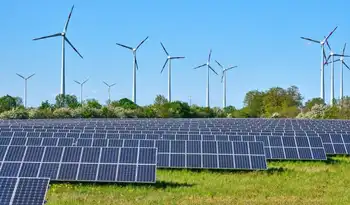
Xcel Energy powers up PlainviewÂ’s Kiser Substation

By Xcel Energy


NFPA 70b Training - Electrical Maintenance

Our customized live online or in‑person group training can be delivered to your staff at your location.

  • Live Online
  • 12 hours Instructor-led
  • Group Training Available
Regular Price:
$599
Coupon Price:
$499
Reserve Your Seat Today
PLAINVIEW, Texas – The Kiser Substation, Xcel Energy’s newest addition to its Plainview-area power delivery network, began operation in early December 2014, providing a strong boost to electrical facilities powering the Plainview economy.

Kiser is the product of a 2010 high-voltage transmission study that identified $106.7 million in improvements for several South Plains counties as part of Xcel EnergyÂ’s Power for the Plains transmission enhancement initiative.

The substation is located at the southwest corner of the intersection of Farm-to-Market Road 400 and 24th Street in Plainview, and was built for a cost of $6.3 million. It is capable of stepping down power voltage from 115-kilovolts to feed 69-kilovolt lines on the area network.

Two new 115-kilovolt transmission lines feed into Kiser – one line from Kress Substation and another from the Cox Substation east of Plainview. Two other area substations, North Plainview and Kress Rural, have been upgraded to 115-kilovolt service. Working together, the new lines and new and upgraded substations provide additional sources of power for Plainview, and also give Xcel Energy options for rerouting power in the case of an outage on other lines in the network.

“We build our system to last for decades, and we believe in Plainview’s ability to attract industry and create jobs,” said David Hudson, president of Southwestern Public Service Company, an Xcel Energy company. “These new facilities give our economic developers the tools they need to retain and attract business, and they add value to the local tax rolls as well.”

Related News

Manitoba Hydro scales back rate increase next year

Manitoba Hydro 3.5 Percent Rate Increase proposes a smaller electricity rate hike under Public Utilities Board oversight to bolster financial reserves, address debt and Bipole III costs, amid shifting export sales and water flow conditions.


Key Points

It is Manitoba Hydro's proposed 3.5% electricity rate hike for 2019-20 to shore up finances under PUB oversight.

✅ PUB review sought without lengthy hearing

✅ Revenue boost forecast at 59 million dollars

✅ Natural gas rates flat; class shifts adjust bills


Manitoba Hydro is scaling back its rate hike request for next year, instead of the annual 7.9 per cent hikes the Crown corporation previously said it would need until 2023-24 to address debt. 

Hydro is asking the Public Utilities Board for a 3.5 per cent rate increase next year, which would take effect on April 1.

In last week's application, Hydro said its new board is reviewing the corporation's financial picture. Once that is complete, the utility expects to submit a new multi-year rate plan in late 2019 that addresses the organization's long-term future.

"It's too speculative at this point to discuss any possible future rate increases," spokesperson Bruce Owen said in an email.

The proposed increase next year is similar to other jurisdictions and nearly in line with the Public Utilities Board's decision to allow an average 3.6 per cent jump in electricity rates in 2018-19, which began this summer.

"The requested 3.5 per cent rate increase … generates a modest level of net income under average water flow conditions that will assist in gradually building the revenue base and reduce the risk of the corporation incurring a loss" in 2019-20, the rate application said.

If approved, consumers would face their second rate increase from Hydro in under a year.

Crown Services Minister Colleen Mayer said she's sympathetic to customers bracing for another rate increase amid NL rate hike concerns that far exceeds the rate of inflation.

"I hear that, very clearly," she said. "The NDP left us with an insurmountable problem — we're trying to fix that."

Hydro goes to court over special rate class for First Nations residents in Manitoba

National Energy Board OK's Manitoba-Minnesota Transmission Project

Next year's rate increase is projected to bring in $59 million of revenue, boosting the Crown corporation's financial reserves by $31 million.

Without it, the utility would deal with a net loss, it said.

This time, Hydro officials are asking PUB to forgo a rate hearing, suggesting neither itself nor the board has the resources for a lengthy six- to nine-month process to review an application where not much has changed financially and would generate a "minimum level of net income," Hydro said in a letter to the board.

The short-term rate relief, the letter recommends, should be "awarded in a timely and cost-effective manner, recognizing that the corporation's long-term financial forecasts will be finalized and available for review" in late 2019.

Hydro's net income next year will be lower than projected, the rate application said, due to a reduction in export sales and increases in depreciation and financing costs from Bipole III.

"Even though they had a total implosion of their previous board, on this very issue, they haven't learned lessons and they continue to be cheerleaders for these rapid rate increases," Kinew said, referring to the exodus of every board member but one earlier this year.

Manitoba Hydro's burgeoning debt surpasses $19 billion

On natural gas, Manitoba Hydro is asking PUB for no rate increase for the next two years.

There will, however, be some changes in rates in different customer classes, Owen said, resulting in modest rate reductions for mainly residential customers and increases for customers who use a lot of natural gas.

The corporation also wants to stop collecting fees to support the furnace replacement program. The initiative will continue with existing fees.


Related News

View more

China boosts wind energy, photovoltaic and concentrated solar power

China Renewable Energy Law drives growth in wind power, solar thermal, and photovoltaic capacity, supporting grid integration and five-year plans, even as China leads CO2 emissions, with policy incentives, compliance inspections, and national resource assessments.


Key Points

A legal framework that speeds wind, solar thermal, and PV growth in China via mandates, incentives, and grid rules.

✅ 2018 renewables: 1.87T kWh, 26.7% of national power

✅ Over 100 State Council policies enabling deployment

✅ Law inspections and regional oversight across six provinces


China leads renewable energies, installing more wind power, solar thermal and photovoltaic than any other country, as seen in the China solar PV growth reported in 2016, but also leads CO2 emissions, and much remains to be done.

The effective application of Chinas renewable energy law has boosted the use of renewable energy in the country and facilitated the rapid development of the sector, as solar parity across Chinese cities indicates, a report said.

The report on compliance with renewable energy law was presented today at the current bimonthly session of the Standing Committee of the National Peoples Assembly (APN).

Electricity generated by renewable energy amounted to about 1.87 trillion kilowatts per hour in 2018, representing 26.7 percent of Chinas total energy production in the year, aligning with trends where wind and solar doubling globally over five years, the report said.

Ding Zhongli, vice president of the NPC Standing Committee, presented the report to the legislators at the second plenary meeting of the session.

An inspection of the law enforcement was carried out from August to November, as U.S. renewables hit 28% record showed momentum elsewhere. A total of 21 members of the NPC Standing Committee and the NPC Environmental Protection and Resource Conservation Committee, as well as national legislators, traveled to six regions at the provincial level on inspection visits. Twelve legislative bodies at the provincial level inspected the law enforcement efforts in their jurisdictions.

The relevant State Council agencies have implemented more than 100 regulations and policies to foster a good policy environment for the development of renewable energy, as seen in markets where U.S. renewable electricity surpassed coal in 2022. Local regulations have also been formulated based on local conditions, according to the report.

In accordance with the law, a thorough investigation of the national conditions of renewable energy resources was undertaken.

In 2008 and 2014 atlas of solar energy resources and wind energy evaluation of China were issued. The relevant agencies of the State Council have also implemented five-year plans for the development of renewable energy, which have provided guidance to the sector, while countries like Ireland's one-third green power target remain in focus within four years.

The main provisions of the law have been met, the law has been effectively applied and the purpose of the legislation has been met, and this momentum is echoed abroad, with U.S. renewables near one-fourth according to projections, Ding said.


Related News

View more

Idaho Power Settlement Could Close Coal Plant, Raise Rates

Idaho Power Valmy Settlement outlines early closure of the North Valmy coal-fired plant in Nevada, accelerated depreciation recovery, a 1.17% base-rate increase, and impacts for customers, NV Energy co-ownership, and Idaho Public Utilities Commission review.


Key Points

A proposed agreement to close North Valmy early, recover costs via a 1.17% rate hike, and seek PUC approval.

✅ Unit 1 closes 2019; Unit 2 closes 2025 in Nevada.

✅ 1.17% base-rate hike; about $1.20 per 1,000 kWh monthly bill.

✅ Idaho PUC comment deadline May 25; NV Energy co-owner.


State regulators have set a May 25 deadline for public comment on a proposed settlement related to the early closure of a coal-fired plant co-owned by Idaho Power, even as some utilities plan to keep a U.S. coal plant running indefinitely in other jurisdictions.

The settlement calls for shuttering Unit 1 of the North Valmy Power Plant in Nevada in 2019, with Unit 2 closing in 2025, amid regional coal unit retirements debates. The units had been slated for closure in 2031 and 2035, respectively.

If approved by the Idaho Public Utilities Commission, the settlement would increase base rates by approximately $13.3 million, or 1.17 percent, in order to allow the company to recover its investment in the plant on an accelerated basis.

That equates to an additional $1.20 on the monthly bill of the typical residential customer using 1,000 kilowatt-hours of energy per month.

Idaho Power, which co-owns the plant with NV Energy, maintains that closing Valmy early rather than continuing to operate it until it is fully depreciated in 2035, will ultimately save customers $103 million in today's dollars.

The company said a significant decrease in market prices for electricity has made it uneconomic to operate the plant except during extremely cold or hot weather, when the demand for energy peaks, a trend underscored by transactions involving the San Juan Generating Station deal elsewhere. The company also said plant balances have increased by approximately $70 million since its last general rate case in 2011, due to routine maintenance and repairs, as well as investments required to meet environmental regulations.

The proposed settlement reflects a number of changes to Idaho Power's original proposal regarding Valmy, and comes in the wake of discussions with interested parties in February and April, against the backdrop of a broader energy debate over plant closures and reliability.

In its initial application, filed in October, Idaho Power proposed closing both units in 2025. The original proposal would have increased base rates by $28.5 million, or about 2.5 percent, in order to allow the company to recover its costs associated with the plant's accelerated depreciation, decommissioning and anticipated investments, with cautionary examples such as the Kemper power plant costs illustrating potential risks.

Concurrently, Idaho Power asked for commission approval to adjust depreciation rates for its other plants and equipment based on the result of a study it conducts every five years, as outlined in Case IPC-E-16-23. The adjustment would have led to a $6.7 million increase to base rates.

The two requests filed in October would have increased customer costs by a total of $35.2 million or 3.1 percent, leading to a $3.08 increase on the bills of the typical residential customer who uses 1,000 kilowatt-hours per month.

The proposed settlement submitted to the Commission on May 4 calls for $13,285,285 to be recovered from all customer classes through base rates until 2028, all related to the Valmy shutdown. That is an increase of 1.17 percent and would result in a $1.20 increase on the bills of the typical residential customer who uses 1,000 kilowatt-hours per month.


Related News

View more

EPA Policy to limit telework emerges during pandemic

EPA Telework Policy restricts remote work, balancing work-from-home guidance during the COVID-19 pandemic with flexible schedules, union contracts, OMB guidance, and federal workforce rules, impacting managers, SES staff, and non-bargaining employees nationwide.


Key Points

A directive limiting many EPA staff to two telework days weekly, with pandemic exceptions and flexible schedules.

✅ Limits telework to two days per week for many employees

✅ Allows flexible schedules, including maxiflex, during emergencies

✅ Aligns with OMB, OPM, CDC guidance; honors union agreements


EPA has moved forward on a new policy that would restrict telework even as agency leadership has encouraged staff to work from home during the coronavirus outbreak.

The new EPA order obtained by E&E News would require employees to report to the office at least three days every week.

"Full-time employees are expected to report to the official worksite and duty station a minimum of three (3) days per week," says the order, dated as approved on Feb. 27. It went into effect March 15 — that night, EPA Administrator Andrew Wheeler authorized telework for the entire agency due to the pandemic.

The order focuses on EPA employees' work schedules and gives them new flexibilities that could come in handy during a public health emergency like the COVID-19 virus, when parts of the power sector consider on-site staffing to ensure continuity.

It also stipulates a deep reduction in EPA employees' capability to work remotely, leaving them with two days of telework per week. An agency order on telework, issued in January 2016, said staff could telework full time.

"The EPA supports the use of telework," said that order. "Regular telework may range from one day per pay period up to full time."

An EPA spokeswoman said the new order doesn't change the agency's guidance to staff to work from home during the pandemic.

"The health and safety of our employees is our top priority, and that is why we have requested that all employees telework, even as residential electricity use increases with more people at home, until at least April 3. There is no provision in the work schedules policy, telework policy or collective bargaining agreement that limits this request," said the spokeswoman.

"While EPA did implement the national work schedule policy effective 3/15/2020, it was implemented in order to provide increased work schedule flexibilities for non-bargaining unit employees who were not previously afforded flexible schedules, including maxiflex," she added.

"The implementation of the policy does not currently impact telework opportunities for EPA employees, and EPA has strongly encouraged all staff to telework," she said.

Still, the new order has caused consternation among EPA employees.

One EPA manager described it as another move by the Trump administration to restrict telework across the government.

"Amidst the COVID-19 crisis, this policy seems particularly ill-timed and unwise. It doesn't even give the administration the chance to evaluate the situation once the COVID-19 pandemic passes," said the manager.

"I think this is a dramatic change in the flexibilities available to the EPA employees without any data to support such a drastic move," the manager said. "It has huge ramifications for employees, many of whom commute over an hour each way to the office, increasing air pollution in the process."

Another EPA staffer said, "I honestly think such an order, given current circumstances, would elicit little more than a scoff and a smirk."

The person added, "How tone-deaf and heavy-handed can one administration be?"

Inside EPA first reported on the new order. E&E News obtained the memo independently.

The recently issued policy applies only to non-bargaining-unit employees, including "full-time and part-time" agency staff as well as "supervisors and managers in the competitive, excepted, Senior Level, Scientific and Professional, and Senior Executive Service positions."

In addition, the order covers "Public Health Service Officers, Schedule C, Administratively Determined employees and non-EPA employees serving on Intergovernmental Personnel Act assignments to EPA."

Nevertheless, EPA employees covered under union contracts must adhere to those contracts if the policy runs counter to them.

"If provisions of this order conflict with the provisions of a collective bargaining agreement, the provisions of the agreement must be applied," the order says.

EPA has taken a more restrictive approach with the agency's largest union, American Federation of Government Employees Council 238, which represents about 7,500 EPA employees. EPA imposed a contract on the council's bargaining unit employees last July that limited them to one day of telework per week, among other changes that triggered union protests.

EPA and AFGE have since relaunched contract negotiations, and how to handle telework is one of the issues under discussion. Both sides committed to complete those bargaining talks by April 15 and work with the Federal Service Impasses Panel if needed (Greenwire, Feb. 27).


Both sides of the telework debate
EPA's new order has been under consideration for some time.

E&E News obtained a draft version last year. The agency had circulated it for comment in July, noting the proposal "limits the number of days an employee may telework per week," among other changes (Greenwire, Sept. 12, 2019).

EPA, like other federal agencies under the Trump administration, has sought to reduce employees' telework. That effort, though, has run into the headwinds of a global pandemic, with a U.S. grid warning highlighting broader risks, leading agency leaders to reverse course and now encourage staff to work remotely in order to stop the spread of the COVID-19 virus.

Wheeler in an email last week told staff that he authorized telework for employees across the country. Federal worker unions had sought the opportunity for remote work on behalf of EPA employees, and the agency had already relaxed telework policies at various offices the prior week where the coronavirus had begun to take hold.

The EPA spokeswoman said the agency moved toward telework after guidance from other agencies.

"Consistent with [Office of Management and Budget], [Centers for Disease Control and Prevention] and [Office of Personnel Management] guidance, along with state and local directives, we have taken swift action in regions and at headquarters to implement telework for all employees. We continue to tell all employees to telework," said the spokeswoman.

Wheeler said in a later video message that his expectation was most EPA employees were working from home.

"I understand that this is a difficult and scary time for all of us," said the EPA administrator.

The coronavirus has become a real challenge for EPA, and utilities like BC Hydro Site C updates illustrate broader operational adjustments.

Agency staff have been exposed to the virus while some have tested positive, and nuclear plant workers have raised similar concerns, according to internal emails. That has led to employees self-quarantining while their colleagues worry they may next fall ill (Greenwire, March 20).

One employee said that since EPA's operations have been maintained with staff working from home, even as household electricity bills rise for many, it's harder for the Trump administration to justify restricting remote work.

"With the current climate, I think employees have shown we can keep the agency going with nearly 95% teleworking full time. It makes their argument hard to justify in light of things," said the EPA employee.

The Trump administration overall has pushed for more remote work by the federal workforce in the battle with the COVID-19 virus. The Office of Management and Budget issued guidance to agencies last week "to minimize face-to-face interactions" and "maximize telework across the nation."

Lawmakers have also pushed to expand telework for federal workers due to the virus.

Democratic senators sent a letter last week urging President Trump to issue an executive order directing agencies to use telework.

In addition, Sens. James Lankford (R-Okla.), Chris Van Hollen (D-Md.) and Kyrsten Sinema (D-Ariz.) introduced legislation that would allow federal employees to telework full time during the pandemic.

Some worry EPA's new order could further sour morale at the agency after the pandemic passes, as other utilities consider measures like unpaid days off to trim costs. Employees may leave if they can't work from home more.

"People will quit EPA over something like this. Maybe that's the goal," said the EPA manager.


Related News

View more

Three New Solar Electricity Facilities in Alberta Contracted At Lower Cost than Natural Gas

Alberta Solar Energy Contracts secure low-cost photovoltaic PPAs for government operations, delivering renewable electricity at 4.8 cents/kWh, beating natural gas LCOE, enhancing summer grid efficiency across Hays, Tilley, and Jenner with Canadian Solar.


Key Points

Low-cost PV power agreements meeting 55% of Alberta government electricity demand via new Canadian Solar facilities.

✅ Price: 4.8 cents/kWh CAD, under gas-fired generation LCOE.

✅ Sites: Hays, Tilley, Jenner; 50% equity with Conklin Métis Local #193.

✅ Supplies 55% of provincial government electricity demand.


Three new solar electricity facilities to be built in south eastern Alberta (Canada) amid Alberta's solar growth have been selected through a competitive process to supply the Government of Alberta with 55 per cent of their annual electricity needs. The facilities will be built near Hays, Tilley, and Jenner, by Canadian Solar with Conklin Métis Local #193 as 50-percent equity owners.

The Government of Alberta's operations have been powered 100 per cent with wind power since 2007. Upon the expiration of some of these contracts, they have been renewed to switch from wind to solar energy. The average contract pricing will be $0.048 per kilowatt hour (3.6 cents/kWh USD), which is less than the average historical wholesale power pool price paid to natural gas-fired electricity in the province in years 2008 - 2018.

"The conversation about solar energy has long been fixated on its price competitiveness with fossil fuels," said John Gorman, CanSIA President & CEO. "Today's announcement demonstrates that low cost solar energy has arrived as a mainstream option in Alberta, even as demand for solar lags in Canada according to federal assessments. The conversation should next focus on how to optimize an all-of-the-above strategy for developing the province's renewable and non-renewable resources."

"This price discovery is monumental for the solar industry in Canada" said Patrick Bateman, CanSIA Director of Policy & Market Development. "At less than five cents per kilowatt hour, this solar electricity has a cost that is less than that of natural gas. Achieving Alberta's legislated 30 per cent by 2030 renewable electricity target just became a whole lot cheaper!".


Quick Facts:

  • The contract price of 4.8 cents/kWh CAD to be paid by Alberta Infrastructure for this solar electricity represents a lower Levelized Cost of Electricity (LCOE) than the average annual wholesale price paid by the power pool to combined-cycle and single-cycle natural gas-fired electricity generation which was 7.1 cents/kWh and 11.2 cents/kWh respectively from 2008 - 2018.
  • Alberta receives more hours of sunshine than Miami, Florida in the summer months. Alberta's electricity supply is most strained in summer, highlighting challenges for solar expansion when high temperatures increase the resistance of the distribution and transmission systems, and reduce the efficiency of cooling thermal power plants. For this reason, solar facilities sited near to electricity demand improves overall grid efficiency. Supply shortages are atypical in Alberta in winter when solar energy is least available. When they do occur, imports are increased and large loads are decreased.
  • In 2018, Alberta's solar electricity generation exceeded 50 MW. While representing much less than 1% of the province's electricity supply today, the Canadian Solar Industries Association (CanSIA) forecasts that solar energy could supply as much as 3 per cent of the province's electricity by 2030, supporting renewable energy job growth across Alberta. A recent supply chain study of the solar electricity sector in Alberta by Solas Energy Consulting Inc. found a potential of $4.1 billion in market value and a labour force rising to 10,000 in 2030.


To learn more about solar energy and the best way for consumers to go solar, please visit the Canadian Solar Industries Association at www.CanSIA.ca.


Related News

View more

Avista Commissions Largest Solar Array in Washington

Adams Nielson Solar Array, a 28 MW DC utility-scale project in Lind, WA, spans 200 acres with 81,700 panels, powering about 4,000 homes, supporting Avista’s Solar Select program and renewable energy, sustainability, and carbon reduction.


Key Points

Adams Nielson Solar Array is a 28 MW DC facility in Lind, WA, powering ~4,000 homes via Avista’s Solar Select.

✅ 81,700 panels across 200 acres in Eastern Washington

✅ Offsets emissions equal to removing 7,300 cars annually

✅ Collaboration by Avista, Strata Solar, WUTC, WSU Energy


Official commissioning of the Adams Nielson solar array located in Lind, WA occurred today. The 28 Megawatt DC array is comprised of 81,700 panels that span 200 acres and generates enough electricity to supply the equivalent of approximately 4,000 homes annually, similar to a new co-op solar project serving South Metro members.

“Avista’s interest in the development of Solar Select, a voluntary commercial solar program reflecting broader corporate adoption such as a corporate solar power plant commissioned by Arvato, is consistent with the Company’s ongoing commitment to provide customers with renewable energy choices at reasonable cost,” said Dennis Vermillion, president, Avista Corporation. “In recent years, an increasing number of Avista customers have expressed their expectations and challenges in acquiring renewable energy. Avista is pleased to lead this effort and develop renewable energy products that meet our customers’ needs today and into the future.” This interest is being generated by a mix of local and national customers across a variety of industries, including Huckleberry’s, Gonzaga University, Community Colleges of Spokane, Hotstart, Central Pre-Mix Concrete, a CRH Co., independently owned McDonald's franchise locations, Spokane City, Main Market and Community Building and VA Medical Center.

Jim Simon, director of sustainability at Gonzaga University said, “The Solar Select program helps Gonzaga University move even closer to achieving its goal of climate neutrality by 2050 by continuing to prioritize renewables in our energy portfolio, as other communities add projects like a municipal solar project to boost local supply. We are grateful for Avista’s leadership in this project and look forward to other opportunities to reduce our greenhouse gas emissions.”

Spokane Mayor David Condon said, “The City of Spokane is pleased to partner with Avista through the Solar Select Program, as we continue to seek out opportunities that are both environmentally and financially responsible. The City already is a net producer of energy, generating more clean, green energy than our use of electricity, natural gas, and fuel, a milestone also seen with North Carolina's first wind farm now fully operational. We are excited to add even more clean energy to power City Hall.”

The Solar Select program created a cost-effective structure to bring solar energy to large business customers in Eastern Washington, allowing them to advance their desired sustainability goals and benefiting from industry service innovations led by companies like Omnidian expanding their global reach. The array is projected to deliver the environmental benefit equivalent of more than 7,300 cars removed from the road each year. This renewable energy program was made possible through a collaboration of Avista, Strata Solar, the Washington Utilities and Transportation Commission, and the WSU Energy Program. 


Related News

View more

Sign Up for Electricity Forum’s Newsletter

Stay informed with our FREE Newsletter — get the latest news, breakthrough technologies, and expert insights, delivered straight to your inbox.

Electricity Today T&D Magazine Subscribe for FREE

Stay informed with the latest T&D policies and technologies.
  • Timely insights from industry experts
  • Practical solutions T&D engineers
  • Free access to every issue

Live Online & In-person Group Training

Advantages To Instructor-Led Training – Instructor-Led Course, Customized Training, Multiple Locations, Economical, CEU Credits, Course Discounts.

Request For Quotation

Whether you would prefer Live Online or In-Person instruction, our electrical training courses can be tailored to meet your company's specific requirements and delivered to your employees in one location or at various locations.