What Is Grid in Power System Architecture
By William Conklin, Associate Editor
By William Conklin, Associate Editor
Request for Quotation Service
Buyers Submit Free RFQs to top suppliers, no obligation.
Suppliers Browse real project RFQs directly from buyers.
Trust Electricity Forum 40 years connection buyers and suppliers.
In operational terms, what is grid in power system defines the stability envelope that prevents cascading failure across generation, transmission, substations, and distribution.
The electric grid is not simply wires and towers. It is a coordinated operational control system that governs how energy is produced, transferred, transformed, protected, and restored under stress. When it functions properly, instability never becomes visible to customers. When it fails, consequences cascade through voltage collapse, protection miscoordination, or uncontrolled islanding.
From an OT perspective, the grid is a continuously monitored and adjusted system of physical assets and digital control layers. Digital supervision enhances visibility, but stability physics and protection coordination remain the primary containment mechanisms. Generation must match load within narrow frequency tolerances. Transmission corridors must remain within thermal and stability limits. Substations must transform voltage and enforce protection boundaries. Distribution circuits must isolate faults without compromising upstream reliability.
The traditional grid is a centrally controlled, hierarchical network designed for one-way power flow and deterministic protection. A smart grid overlays this architecture with bidirectional communication, distributed sensors, adaptive protection, and real-time analytics. The physics of generation, transmission, and frequency stability remain unchanged. The control intelligence expands.
The engineering question is not what the grid is in theory. The question is how the control structure performs under disturbance.
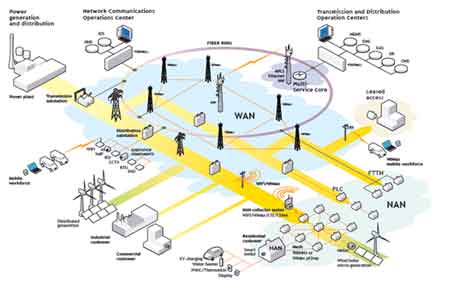
In operational terms, a grid in a power system is a synchronized control network linking generation plants, transmission lines, substations, distribution feeders, protection relays, and supervisory control layers into a single stability envelope. Every switching decision, relay setting, and load forecast influences that envelope.

At the transmission level, stability margins govern how much disturbance the system can absorb. A single three phase fault that clears in 100 milliseconds may be acceptable. A delayed clearing event can trigger oscillations, overload parallel paths, and initiate cascading trips. That sequence illustrates why protection coordination is not theoretical. It defines containment.
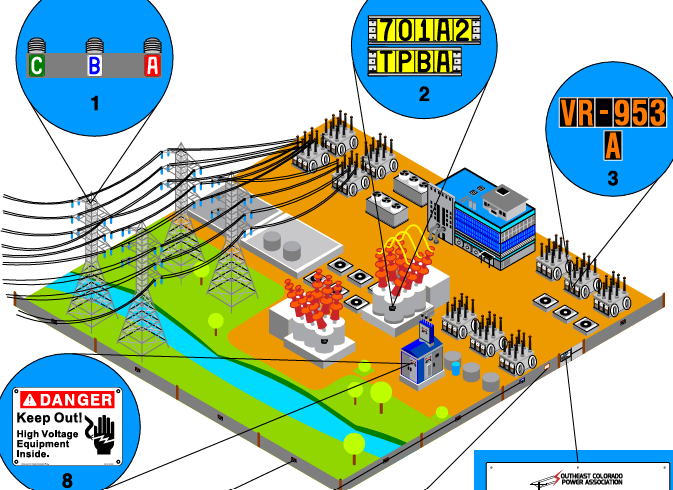
At the substation layer, topology awareness becomes decisive. Misinterpreting breaker status or bus configuration can produce switching errors that energize unintended sections. Articles such as Smart Substation and Substation SCADA detail how digital relays and intelligent electronic devices formalize this control boundary.
Distribution adds complexity through volume. A single utility may manage millions of endpoints across feeders with mixed overhead and underground assets. Without validated telemetry and integration as described in How Does SCADA Work, operators rely on inference rather than confirmation.
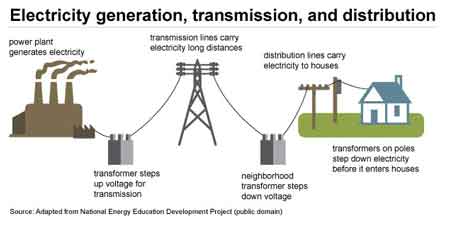
The grid is structurally divided into generation, high-voltage transmission, substations, and medium- and low-voltage distribution. Each layer has distinct failure modes.
Generation failures primarily affect frequency stability. Transmission failures threaten system separation. Substation failures compromise voltage control and protection selectivity. Distribution failures affect customers directly but can propagate upstream if isolation is delayed.
A cascading operational consequence illustrates the interaction. A transmission line overload during peak demand triggers a relay trip. Power reroutes to adjacent corridors, raising thermal loading. A second trip occurs. Frequency begins to decline. Underfrequency load shedding activates. Customers experience rolling outages. What began as a localized overload becomes a regional reliability event.
That scenario is why grid operators monitor real-time power flow, reactive support, and contingency margins continuously.
Modern grids rely on layered digital supervision. SCADA systems, energy management systems, and distribution management platforms create situational awareness. The evolution from analog telemetry to digital networks is examined in SCADA Architecture and SCADA Integration.
However, digital visibility introduces tradeoffs. Increased connectivity expands cyber exposure. A compromised control channel can disrupt breaker operations or falsify telemetry. Strategic resilience measures are outlined in Grid Cybersecurity Strategy.
Deployment constraints also emerge at scale. Integrating distributed energy resources changes load flow direction, protection settings, and voltage regulation. Miscalculated hosting capacity can produce reverse power conditions and nuisance trips. These grid modernization pressures are addressed in Grid Modernization.
A quantified authority signal from large-scale deployments shows why control accuracy matters. In utilities managing over one million endpoints, validated topology models have achieved greater than 98 percent switching accuracy when telemetry is continuously reconciled. Below that threshold, restoration time and misoperation risk increase measurably.
No grid model is perfect. State estimation relies on telemetry density and data latency. Sparse measurement points create uncertainty bands around voltage magnitude and phase angle. During high DER penetration, harmonic distortion and inverter behavior can distort measurement fidelity, complicating fault location algorithms.
An operational edge case illustrates this. During a feeder backfeed event from rooftop solar clusters, protection relays may detect directional ambiguity. If settings are not adjusted, relays can trip unnecessarily, isolating healthy sections. That misoperation does not originate from hardware failure. It originates from a model assumption error.
Threshold discipline, therefore, becomes critical. Protection margins, thermal ratings, and voltage limits are set conservatively to absorb uncertainty. Relaxing those thresholds for efficiency gains increases exposure.
Stay informed with our FREE Smart Grid Newsletter — get the latest news, breakthrough technologies, and expert insights, delivered straight to your inbox.
If operators misunderstand grid topology under stress, restoration becomes guesswork.
Understanding what is grid in power system forms the foundation for understanding the What Is Smart Grid transformation. The traditional grid is a control architecture centered on stability and protection. The smart grid extends that architecture with sensors, analytics, automation, and distributed intelligence.
The traditional electric grid is a physics-governed architecture for stability, centered on centralized generation, hierarchical transmission, radial distribution, and deterministic protection logic. All modernization efforts operate on top of this structure. They do not replace it.
Explore 50+ live, expert-led electrical training courses –