Cybersecurity for Utilities Protects Operational Control
By Grant Gilchrist, P.Eng. Systems Engineer, Grid Modernization Tesco Automation
By Grant Gilchrist, P.Eng. Systems Engineer, Grid Modernization Tesco Automation

Cybersecurity for utilities protects SCADA, DERMS, substations, and grid communications from unauthorized control, data manipulation, and operational disruption, preserving command integrity, device authentication, and reliable electric system operation.
Electric utilities do not fail because information is lost. They fail when control is compromised. The difference is operational, not theoretical. A corrupted database can be restored. A malicious switching command, executed at the wrong moment, can isolate substations, destabilize feeders, or interrupt service to thousands of customers. Cybersecurity exists to preserve operational authority across grid control infrastructure, ensuring that only authenticated systems and authorized personnel can observe, communicate with, and control electrical assets.
Every modern utility relies on continuous machine-to-machine communication coordinated through advanced control platforms such as Advanced Distribution Management Systems (ADMS), which integrate telemetry, switching authority, and system visibility into a unified operational control layer. Control centers exchange commands with substations. Protective relays transmit system conditions. Distributed resources report generation output and receive dispatch instructions.
These interactions occur over complex networks that extend far beyond physical substations into telecommunications infrastructure, enterprise systems, and field-deployed devices. Cybersecurity protects the integrity of these operational relationships. Without it, the grid cannot distinguish legitimate control from malicious interference.
Electric utilities operate one of society’s most critical infrastructure systems, where cybersecurity protects operational technology (OT) systems from cyber threats that could disrupt grid control or compromise switching authority. The modern threat landscape continues to expand as digital communications, distributed energy resources, and remote device connectivity introduce new cyber risks.
Effective cybersecurity for utilities is therefore not a one-time implementation but an ongoing risk management discipline that includes authentication, monitoring, and incident response capability to preserve operational reliability.
Download our FREE Electrical Training Catalog and explore a full range of expert-led electrical training courses.

Supervisory Control and Data Acquisition systems serve as the operational command layer of utility infrastructure, forming the foundation of modern grid management solutions that coordinate real-time monitoring, switching, and reliability response across transmission and distribution networks. Operators depend on SCADA platforms to observe grid conditions, initiate switching operations, and respond to faults or abnormal system behavior. Every operational decision originates from telemetry delivered through these systems.
Cybersecurity ensures that telemetry data remains trustworthy and that control commands cannot be forged or altered during transmission. Device authentication confirms that data originates from legitimate field equipment. Message integrity validation ensures that values have not been modified in transit. Role-based authorization restricts control access to personnel with defined operational responsibilities.
Without these protections, SCADA systems would accept commands based solely on connectivity rather than verified identity. That distinction separates secure grid operation from uncontrolled network exposure.
Utility communications networks were historically designed for availability rather than adversarial resilience. Today, they must satisfy both requirements simultaneously. Substations communicate using IP networks, radio systems, fiber infrastructure, and cellular connections. These channels allow efficient grid monitoring and control, but they also create pathways that must be secured against interception, impersonation, and manipulation.
Protocols such as DNP3 Secure Authentication and Transport Layer Security establish cryptographic identity verification between communicating devices, protecting the operational data streams that support platforms such as AMI data infrastructure, which continuously delivers system visibility from field devices to control centers. Public key infrastructure allows utilities to assign unique digital identities to substations, relays, and field controllers. These identities allow systems to verify the origin of commands before execution.
This authentication process prevents unauthorized systems from issuing control commands, even if they gain network access. Connectivity alone is no longer sufficient to establish trust. Identity verification defines operational legitimacy.
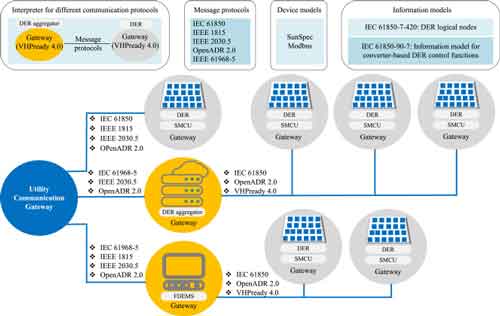
Distributed energy resources have transformed the electrical network from a centralized system into a distributed operational environment. Solar generation, battery storage, and inverter-based resources now participate directly in grid stability and dispatch operations through coordinated control platforms such as the Distributed Energy Resource Management System (DERMS), which orchestrates DER response to maintain grid reliability. These systems communicate continuously with DER management platforms, creating thousands of new operational endpoints.
Each endpoint represents both operational capability and potential exposure. Cybersecurity ensures that distributed devices cannot be impersonated or manipulated to disrupt grid behavior. Certificate-based authentication, encrypted communications, and centralized authorization prevent unauthorized access to distributed control pathways, forming the foundation of modern DER cybersecurity protections required to safely integrate distributed resources into utility operations.
These protections allow utilities to integrate distributed generation safely while maintaining control authority over system stability and dispatch operations.
Operational trust depends on identity verification. Every device, system, and user interacting with the grid control infrastructure must be authenticated before access is granted. Authentication confirms identity. Authorization defines permitted actions.
Public key infrastructure allows utilities to manage authentication across thousands of distributed devices without relying on shared credentials. Digital certificates uniquely identify each operational asset, allowing secure communication relationships to be established automatically across complex control architectures that also support advanced applications such as grid modeling and system simulation, which depend on trusted data inputs to accurately represent real-world grid behavior.
Think you know Grid Cybersecurity & Protection? Take our quick, interactive quiz and test your knowledge in minutes.
Role-based access control ensures that operational authority is restricted according to defined responsibilities. Operators can issue switching commands. Engineers can analyze telemetry. Maintenance personnel can access configuration tools. Cybersecurity ensures that these roles cannot be impersonated or exceeded.
Cybersecurity assumes that exposure cannot be eliminated entirely. Instead, it limits exposure and prevents unauthorized access from reaching critical control systems. Utilities implement a layered security architecture to isolate operational systems from external networks and enterprise infrastructure, protecting both operational control layers and intelligent infrastructure platforms such as intelligent asset management systems, which rely on trusted telemetry to monitor asset condition and reliability risk.
Network segmentation divides infrastructure into defined security zones. Firewalls restrict communication pathways between zones. Secure gateways enforce authentication requirements before allowing access to critical systems. Intrusion detection systems monitor network activity for abnormal behavior.
This layered approach ensures that even if one component is compromised, operational control systems remain protected by multiple layers of authentication and authorization.
Grid reliability depends on trusted control relationships. Operators must trust telemetry data to make operational decisions. Field devices must trust incoming commands before executing control actions. Cybersecurity ensures that this trust relationship cannot be compromised, preserving the operational integrity required to maintain power system reliability across increasingly complex and distributed electrical infrastructure.
Authentication prevents impersonation. Encryption protects communications from interception. Authorization restricts operational control to approved systems and personnel. Monitoring systems detect abnormal behavior before operational impact occurs.
These protections preserve command authority across grid infrastructure, ensuring that operational decisions remain under utility control rather than external influence.
Cybersecurity is no longer an external protective function. It is embedded directly within operational infrastructure. SCADA systems, substations, DER platforms, and communications networks all depend on cryptographic identity verification and secure communications protocols to function safely.
Without cybersecurity, grid visibility cannot be trusted. Without trusted visibility, operational control becomes uncertain. Without operational control, reliability cannot be guaranteed.
Cybersecurity protects the operational integrity of modern electric infrastructure by ensuring that every command, every data exchange, and every control action originates from verified, authorized, and trusted sources.
Explore 50+ live, expert-led electrical training courses –