What is a Watt-hour?
By Harold WIlliams, Associate Editor
By Harold WIlliams, Associate Editor
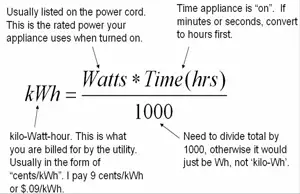
A watt-hour (Wh) is a unit of electrical energy equal to one watt of power used for one hour. It measures the total energy consumed or stored in electrical systems and is commonly used for appliance energy use, battery capacity, and electricity billing.
A watt-hour is calculated by multiplying power in watts by time in hours. This relationship allows energy use to be measured consistently across appliances, batteries, and electrical systems.
A watt-hour does not describe how fast electricity is being used. It describes the total energy consumed over time. This distinction is why watt-hours appear on battery labels, power banks, and utility bills, while watts appear on equipment ratings that describe instantaneous power.
Understanding watt-hours is essential because electrical systems store, deliver, and charge for energy rather than power. Whether comparing battery capacity, estimating device runtime, or interpreting an electric bill, watt-hours connect electrical performance to real-world energy use.
To better understand the foundation of electrical energy, see our guide on What is Electricity?
Although the terms sound similar, watts and watt-hours describe different electrical quantities.
A watt (W) measures power, which represents the rate at which electrical energy is used at a specific moment.
A watt-hour (Wh) measures energy, representing the total electrical energy used over a period of time.
The relationship is simple: power describes the rate, while energy describes the total.
A useful analogy is driving. Speed tells you how fast you are moving, while distance tells you how far you have traveled. In the same way, watts describe the rate of energy use, while watt-hours describe the total energy consumed.
Stay informed with our FREE Electricity Questions Newsletter — get the latest news, breakthrough technologies, and expert insights, delivered straight to your inbox.
This distinction becomes important when comparing batteries and energy storage systems. Amp-hours indicate current capacity, but watt-hours reveal true energy capacity because they account for voltage. For that reason, watt-hour ratings provide a more accurate basis for comparing battery performance and align directly with the energy units used for electricity billing.
Calculating watt-hours is straightforward. You multiply the device's power rating by the time it operates.
The basic formula is:
Energy (Wh) = Power (W) × Time (h)
If a device uses 50 watts and runs for two hours, it consumes 100 watt-hours of energy. This relationship applies regardless of the device or application type. For a deeper look at electrical power itself, see What is a Watt?
Looking at everyday examples helps clarify how watt-hours accumulate.
A 60-watt light bulb uses 60 watt-hours in one hour.
A 100-watt bulb consumes 100 watt-hours of energy when operated for one hour.
A 6-watt decorative bulb takes about 10 minutes to use 1 watt-hour.
These examples show that devices with very different power ratings can consume the same amount of energy when operated for different durations.
Not all devices draw power at a constant rate. Some ramp up gradually, cycle on and off, or vary their power demand during operation. Even when power use changes, total energy consumption can still be measured accurately using watt-hours.
Figure 2-6 illustrates two hypothetical devices that both consume exactly one watt-hour of energy, but in different ways. One device draws power at a constant level, while the other increases its power draw over time.
Device A draws a steady 60 watts and uses one watt-hour of energy in exactly one minute.
Device B starts at zero watts and increases linearly to 100 watts, yet still consumes exactly one watt-hour of energy.
For Device B, the total energy use is calculated by integrating the power-versus-time curve. Because the curve forms a triangle, the energy is found using the formula:
Area = ½ × base × height
Base = 0.02 hours
Height = 100 watts
Energy = ½ × 100 × 0.02 = 1 watt-hour
This demonstrates an important principle. Even when power varies, total energy use depends on the full operating period, not just peak power. It is also essential to convert minutes or seconds into hours when calculating watt-hours to avoid incorrect results.
Fig. 2-6. Two hypothetical devices that consume 1 watt-hour of energy.
Energy consumption becomes more complex when viewed at the household level. Homes rarely draw power at a steady rate. Usage rises and falls throughout the day depending on lighting, cooking, heating, cooling, and appliance use.
Figure 2-7 shows a typical household power profile over a 24-hour period. The curve changes constantly as different devices turn on and off. Calculating total energy by hand would require measuring the entire area under the curve, which is impractical.
Instead, electric utilities rely on electric meters that continuously track cumulative energy consumption. These meters record usage in kilowatt-hours. Each billing cycle, the utility subtracts the previous meter reading from the current one and bills the customer for the total energy used. Understanding how appliances contribute to this total is a key step in learning how to save electricity. Saving energy at home starts with understanding how devices consume power; see How to Save Electricity

Fig. 2-7. Graph showing the amount of power consumed (watt-hour) by a hypothetical household, as a function of the time of day.
A Watt-hour and a kilowatt-hour measure the same quantity: total energy used. The difference is simply scale.
One kilowatt-hour (kWh) equals 1,000 watt-hours (Wh).
Because household energy use is typically measured in thousands of watt-hours, kilowatt-hours are more convenient for billing and reporting.
For example, a refrigerator drawing 150 watts and operating continuously for 24 hours consumes:
150 W × 24 h = 3,600 Wh = 3.6 kWh
This is why electricity bills are expressed in kilowatt-hours rather than watt-hours.
A watt-hour provides a clear and consistent way to measure electrical energy consumption. Whether power usage is steady or constantly changing, watt-hours accurately reflect the total energy used over time. From individual devices to entire households, they form the foundation for understanding energy use, battery capacity, and electricity costs.
By learning how watt-hours and kilowatt-hours work, you gain the ability to interpret energy data, compare devices meaningfully, and make informed decisions about efficiency and cost savings.
For a broader understanding of how energy ties into everyday systems, visit What is Energy?
Advantages To Instructor-Led Training – Instructor-Led Course, Customized Training, Multiple Locations, Economical, CEU Credits, Course Discounts.
Request For QuotationWhether you would prefer Live Online or In-Person instruction, our electrical training courses can be tailored to meet your company's specific requirements and delivered to your employees in one location or at various locations.