Grounding an Electrical Panel Correctly
By Frank Baker, Technical Editor
By Frank Baker, Technical Editor
Our customized live online or in‑person group training can be delivered to your staff at your location.
Request for Quotation Service

Buyers Submit Free RFQs to top suppliers, no obligation.
Suppliers Browse real project RFQs directly from buyers.
Trust Electricity Forum 40 years connection buyers and suppliers.
Grounding an electrical panel establishes a safe earth reference so fault current follows controlled paths, breakers operate correctly, and touch voltage is limited, protecting equipment and people through proper bonding and grounding conductors.
Grounding an electrical panel is rarely the most visible part of an electrical system, yet it quietly governs how that system behaves when something goes wrong. It establishes a stable reference to Earth, limits unexpected voltage rises, and provides fault energy with a controlled path instead of letting it wander through people, equipment, or building steel. When grounding (sometimes referred to as "earthing") is done thoughtfully, the panel becomes a predictable anchor for the entire electrical installation rather than a weak link waiting to be exposed under stress.
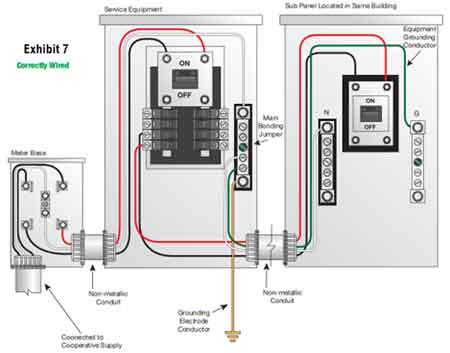
At the service entrance, grounding connects the electrical system to earth through a deliberate network of conductors and electrodes. This connection does not carry current during normal operation, nor does it directly interrupt faults. Instead, it defines the electrical reference point that enables protective devices to correctly sense abnormal conditions and operate consistently. This broader system perspective is central to any accurate understanding of electrical grounding, especially when evaluating why some panels perform reliably while others behave erratically during disturbances.
Grounding works alongside bonding, and the two are often confused, even by experienced tradespeople. Grounding establishes the system’s relationship to earth; bonding ensures that all exposed conductive parts remain at the same electrical potential. When these roles blur, problems follow. Metal enclosures, raceways, and equipment frames must be electrically continuous so that no dangerous voltage differences develop during faults.
Download our FREE Electrical Training Catalog and explore a full range of expert-led electrical training courses.

Without that continuity, the earthing system loses effectiveness even if every required conductor is technically present. The interaction between these elements is examined more fully in the discussion of grounding and bonding.
Electrical codes define minimum grounding requirements for panels, but real-world performance depends on how earthing, bonding, conductors, and earth connections function together as an integrated system.
The earthing connection at the panel is carried outward by the grounding electrode conductor, which links the earthing bus to the earth interface. Its routing, termination quality, and physical protection influence how effectively the system responds under abnormal conditions. Sharp bends, loose lugs, or corrosion may pass an inspection yet quietly increase impedance where it matters most. Over time, these small compromises can alter fault current paths and place additional stress on insulation and connected equipment. Understanding the function of the grounding electrode conductor helps explain why earthing quality cannot be judged solely by conductor size.
At the earth interface, grounding electrodes complete the system’s connection to soil. Ground rods, building steel, or other approved electrodes stabilize system voltage rather than “absorbing” electricity in a literal sense. Their effectiveness depends on placement, spacing, and soil conditions, which is why multiple electrodes often perform better than a single point of contact. When viewed as part of a complete grounding system, electrodes become functional elements that influence how the entire installation behaves during faults and surges.
One of the most common earthing errors involves misunderstanding the relationship between neutral and ground. At the main service disconnect, these conductors are intentionally bonded to establish a single reference point for the system. In downstream panels, they must remain isolated so normal return currents stay on the neutral conductor. When this separation is violated, grounding conductors may carry current they were never designed to handle, creating unpredictable voltage gradients and long-term safety concerns. This distinction is clarified in discussions of electrical neutral vs ground.
Grounding issues often remain hidden until unusual conditions arise. Lightning events, insulation failures, or accidental conductor contact can suddenly expose weaknesses that went unnoticed for years. Panels that appear compliant on paper may respond unpredictably if earthing paths are compromised or poorly integrated. These failures tend to surface as nuisance tripping, unexplained equipment damage, or elevated touch voltages rather than dramatic incidents. Many of these patterns trace back to misunderstandings addressed in the broader context of electrical grounding code.
From a field perspective, effective panel grounding is judged by continuity and behavior, not just documentation. Electricians and inspectors who understand earthing look for secure terminations, protected routing, and evidence that earthing paths will remain intact over time. Grounding treated as a living part of the system, subject to environmental exposure and mechanical stress, tends to remain reliable long after installation. This practical viewpoint aligns with the principles discussed in understanding electrical grounding.
Ultimately, electrical panel grounding is about predictability. It ensures that when abnormal conditions occur, the system responds in controlled, expected ways rather than improvising along unintended paths. Codes establish the framework, but judgment and system awareness determine whether earthing truly serves its purpose. When done correctly, earthing remains invisible in daily operation, and that quiet reliability is exactly the goal.
Think you know Power Quality? Take our quick, interactive quiz and test your knowledge in minutes.
Explore 50+ live, expert-led electrical training courses –