Substation Relay Protection Training

Our customized live online or in‑person group training can be delivered to your staff at your location.

  • Live Online
  • 12 hours Instructor-led
  • Group Training Available
Regular Price:
$699
Coupon Price:
$599
Reserve Your Seat Today

Related News

Is Hydrogen The Future For Power Companies?

Hydrogen Energy Transition accelerates green hydrogen, electrolyzers, renewables, and fuel cells, as the EU and US scale decarbonization, NextEra tests hydrogen-to-power, and DOE funds pilots to replace natural gas and cut CO2.


Key Points

A shift to deploy green hydrogen tech to decarbonize power, industry, and transport across EU and US energy systems.

✅ EU targets 40 GW electrolyzers plus 40 GW imports by 2030

✅ DOE funds pilots; NextEra trials hydrogen-to-power at Okeechobee

✅ Aims to replace natural gas, enable fuel cells, cut CO2


Last month, the European Union set out a comprehensive hydrogen strategy as part of its goal to achieve carbon neutrality for all its industries by 2050. The EU has an ambitious target to build out at least 40 gigawatts of electrolyzers within its borders by 2030 and also support the development of another 40 gigawatts of green hydrogen in nearby countries that can export to the region by the same date. The announcement came as little surprise, given that Europe is regarded as being far ahead of the United States in the shift to renewable energy, even as it looks to catch up on fuel cells with Asian leaders today.

But the hydrogen bug has finally arrived stateside: The U.S. Department of Energy has unveiled the H2@Scale initiative whereby a handful of companies including Cummins Inc. (NYSE: CMI), Caterpillar Inc.(NYSE: CAT), 3M Company (NYSE: MMM), Plug Power Inc.(NASDAQ: PLUG) and EV startup Nikola Corp.(NASDAQ: NKLA), even as the industry faces threats to the EV boom that investors are watching, will receive $64 million in government funding for hydrogen research projects.

Hot on the heels of the DoE initiative: American electric utility and renewable energy giant, NextEra Energy Inc.(NYSE: NEE), has unveiled an equally ambitious plan to start replacing its natural gas-powered plants with hydrogen.

During its latest earnings call, NextEra’s CFO Rebecca Kujawa said the company is “…particularly excited about the long-term potential of hydrogen” and discussed plans to start a pilot hydrogen project at one of its generating stations at Okeechobee Clean Energy Center owned by its subsidiary, Florida Power & Light (FPL). NextEra reported Q2 revenue of $4.2B (-15.5% Y/Y), which fell short of Wall Street’s consensus by $1.12B while GAAP EPS of $2.59 (+1.1% Y/Y) beat estimates by $0.09. The company attributed the big revenue slump to the effects of Covid-19.

Renewable energy and hydrogen stocks have lately become hot property as EV adoption hits an inflection point worldwide, with NEE up 16% in the year-to-date; PLUG +144%, Bloom Energy Corp. (NYSE: BE) +62.8% while Ballard Power Systems (NASDAQ: BLDP) has gained 98.2% over the timeframe.

NextEra’s usual modus operandi involves conducting small experiments with new technologies to establish their cost-effectiveness, a pragmatic approach informed by how electricity changed in 2021 across the grid, before going big if the trials are successful.

CFO Kujawa told analysts:
“Based on our ongoing analysis of the long-term potential of low-cost renewables, we remain confident as ever that wind, solar, and battery storage will be hugely disruptive to the country’s existing generation fleet, while reducing cost for customers and helping to achieve future CO2 emissions reductions. However, to achieve an emissions-free future, we believe that other technologies will be necessary, and we are particularly excited about the long-term potential of hydrogen.”

NextEra plans to test the electricity-to-hydrogen-to-electricity model at its natural gas-powered Okeechobee Clean Energy Center that came online in 2019. Okeechobee is already regarded as one of the cleanest thermal energy facilities anywhere on the globe. However, replacing natural gas with zero emissions hydrogen would be a significant step in helping the company achieve its goal to become 100% emissions-free by 2050.

Kujawa said the company plans to continue evaluating other potential hydrogen opportunities to accelerate the decarbonization of transportation fuel, amid the debate over the future of vehicles between electricity and hydrogen, and industrial feedstock and also support future demand for low-cost renewables.

Another critical milestone: NextEra finished the quarter with a renewables backlog of approximately 14,400 megawatts, its largest in its 20-year development history. To put that backlog into context, NextEra revealed that it is larger than the operating wind and solar portfolios of all but two companies in the world.

Hydrogen Bubble?
That said, not everybody is buying the hydrogen hype.

Barron’s Bill Apton says Wall Street has discovered hydrogen this year and that hydrogen stocks are a bubble, even as hybrid vehicles gain momentum in the U.S. market according to recent reports. Apton says the huge runup by Plug Power, Ballard Energy, and Bloom Energy has left them trading at more than 50x future cash flow, making it hard for them to grow into their steep valuations. He notes that smaller hydrogen companies are up against big players and deep-pocketed manufacturers, including government-backed rivals in China and the likes of Cummins.

According to Apton, it could take a decade or more before environmentally-friendly hydrogen can become competitive with natural gas on a cost-basis, while new ideas like flow battery cars also vie for attention, making hydrogen stocks better long-term picks than the cult stocks they have become.


Related News

View more

Tesla Electric is preparing to expand in the UK

Tesla Electric UK Expansion signals retail energy entry, leveraging Powerwall VPPs for grid services, dynamic pricing, and energy trading, building on Texas success and Octopus Energy ties to buy and sell electricity automatically.


Key Points

Tesla's plan to launch Tesla Electric in the UK, using Powerwall VPPs to retail energy, trade power, and hedge peaks.

✅ Retail energy model built on Powerwall VPP aggregation

✅ Automated buy-sell arbitrage with dynamic pricing

✅ Leverages prior UK approval and Octopus Energy ties


According to a new job posting, Tesla Electric, Tesla’s new electric utility division, is preparing to expand in the United Kingdom as regions such as California grid planners look to electric vehicles for stability to manage demand.

Late last year, after gaining experience through its virtual power plants (VPPs), including response during California blackouts that pressured the grid, Tesla took things a step further with the launch of “Tesla Electric.”

Instead of reacting to specific “events” and providing services to your local electric utilities through demand response programs, as Tesla Powerwall owners have done in VPPs in California, Tesla Electric is actively and automatically buying and selling electricity for Tesla Powerwall owners – providing a buffer against peak prices.

The company is essentially becoming an energy retailer, aligning with a major future for its energy business envisioned by leadership.

Tesla Electric is currently only available to Powerwall owners in Texas, but the company has plans to expand its products through this new division.

We recently reported on Tesla Electric customers in Texas making as much as $150 a day selling electricity back to the grid through the program.

Now Tesla is looking to expand Tesla Electric to the UK, where grid capacity for rising EV demand remains a key consideration.

The company has listed a new job posting for a role called “Head of Operations, Tesla Electric – Retail Energy.”

This has been in the works for a while now. Tesla used to have a partnership with Octopus Energy in the UK for special electricity rates for its owners, during a period when UK EV inquiries surged amid a fuel supply crisis, but it seemed to be a stepping stone before it would itself become an energy provider in the market.

In 2020, Tesla was officially approved as an electricity retailer in the UK. Now it looks like Tesla is going to use this approval with the launch of Tesla Electric.


Related News

View more

TTC Introduces Battery Electric Buses

TTC Battery-Electric Buses lead Toronto transit toward zero-emission mobility, improving air quality and climate goals with sustainable operations, advanced charging infrastructure, lower maintenance, energy efficiency, and reliable public transportation across the Toronto Transit Commission network.


Key Points

TTC battery-electric buses are zero-emission vehicles improving quality, lowering costs, and providing efficient service.

✅ Zero tailpipe emissions improve urban air quality

✅ Lower maintenance and energy costs increase savings

✅ Charging infrastructure enables reliable operations


The Toronto Transit Commission (TTC) has embarked on an exciting new chapter in its commitment to sustainability with the introduction of battery-electric buses to its fleet. This strategic move not only highlights the TTC's dedication to reducing its environmental impact but also positions Toronto as a leader in the evolution of public transportation. As cities worldwide strive for greener solutions, the TTC’s initiative stands as a significant milestone toward a more sustainable urban future.

Embracing Green Technology

The decision to integrate battery-electric buses into Toronto's transit system aligns with a growing trend among urban centers to adopt cleaner, more efficient technologies, including Metro Vancouver electric buses now in service. With climate change posing urgent challenges, transit authorities are rethinking their operations to foster cleaner air and reduce greenhouse gas emissions. The TTC’s new fleet of battery-electric buses represents a proactive approach to addressing these concerns, aiming to create a cleaner, healthier environment for all Torontonians.

Battery-electric buses operate without producing tailpipe emissions, and deployments like Edmonton's first electric bus illustrate this shift, offering a stark contrast to traditional diesel-powered vehicles. This transition is crucial for improving air quality in urban areas, where transportation is a leading source of air pollution. By choosing electric options, the TTC not only enhances the city’s air quality but also contributes to the global effort to combat climate change.

Economic and Operational Advantages

Beyond environmental benefits, battery-electric buses present significant economic advantages. Although the initial investment for electric buses may be higher than that for conventional diesel buses, and broader adoption challenges persist, the long-term savings are substantial. Electric buses have lower operating costs due to reduced fuel expenses and less frequent maintenance requirements. The electric propulsion system generally involves fewer moving parts than traditional engines, resulting in lower overall maintenance costs and improved service reliability.

Moreover, the increased efficiency of electric buses translates into reduced energy consumption. Electric buses convert a larger proportion of energy from the grid into motion, minimizing waste and optimizing operational effectiveness. This not only benefits the TTC financially but also enhances the overall experience for riders by providing a more reliable and punctual service.

Infrastructure Development

To support the introduction of battery-electric buses, the TTC is also investing in necessary infrastructure upgrades, including the installation of charging stations throughout the city. These charging facilities are essential for ensuring that the electric fleet can operate smoothly and efficiently. By strategically placing charging stations at transit hubs and along bus routes, the TTC aims to create a seamless transition for both operators and riders.

This infrastructure development is critical not just for the operational capacity of the electric buses but also for fostering public confidence in this new technology, and consistent safety measures such as the TTC's winter safety policy on lithium-ion devices reinforce that trust. As the TTC rolls out these vehicles, clear communication regarding their operational logistics, including charging times and routes, will be essential to inform and engage the community.

Engaging the Community

The TTC is committed to engaging with Toronto’s diverse communities throughout the rollout of its battery-electric bus program. Community outreach initiatives will help educate residents about the benefits of electric transit, addressing any concerns and building public support, and will also discuss emerging alternatives like Mississauga fuel cell buses in the region. Informational campaigns, workshops, and public forums will provide opportunities for dialogue, allowing residents to voice their opinions and learn more about the technology.

This engagement is vital for ensuring that the transition is not just a top-down initiative but a collaborative effort that reflects the needs and interests of the community. By fostering a sense of ownership among residents, the TTC can cultivate support for its sustainable transit goals.

A Vision for the Future

The TTC’s introduction of battery-electric buses marks a transformative moment in Toronto’s public transit landscape. This initiative exemplifies the commission's broader vision of creating a more sustainable, efficient, and user-friendly transportation network. As the city continues to grow, the need for innovative solutions to urban mobility challenges becomes increasingly critical.

By embracing electric technology, the TTC is setting an example for other transit agencies across Canada and beyond, and piloting driverless EV shuttles locally underscores that leadership. This initiative is not just about introducing new vehicles; it is about reimagining public transportation in a way that prioritizes environmental responsibility and community engagement. As Toronto moves forward, the integration of battery-electric buses will play a crucial role in shaping a cleaner, greener future for urban transit, ultimately benefitting residents and the planet alike.


Related News

View more

Economic Crossroads: Bank Earnings, EV Tariffs, and Algoma Steel

Canada Economic Crossroads highlights bank earnings trends, interest rates, loan delinquencies, EV tariffs on Chinese imports, domestic manufacturing, Algoma Steel decarbonization, sustainability, and housing market risks shaping growth, investment, consumer prices, and climate policy.


Key Points

An overview of how bank earnings, EV tariffs, and Algoma Steel's transition shape Canada's economy.

✅ Higher rates lift margins but raise delinquencies and housing risks

✅ EV tariffs aid domestic makers but pressure consumer prices

✅ Algoma invests to decarbonize, boosting efficiency and compliance


In a complex economic landscape, recent developments have brought attention to several pivotal issues affecting Canada's business sector. The Globe and Mail’s latest report delves into three major topics: the latest bank earnings, the implications of new tariffs on Chinese electric vehicles (EVs), and Algoma Steel’s strategic maneuvers. These factors collectively paint a picture of the challenges and opportunities facing Canada's economy.

Bank Earnings Reflect Economic Uncertainty

The recent financial reports from major Canadian banks have revealed a mixed picture of the nation’s economic health. As the Globe and Mail reports, earnings results show robust performances in some areas while highlighting growing concerns in others. Banks have generally posted strong quarterly results, buoyed by higher interest rates which have improved their net interest margins. This uptick is largely attributed to the central bank's monetary policies aimed at combating inflation and stabilizing the economy.

However, the positive earnings are tempered by underlying economic uncertainties. Rising loan delinquencies and a slowing housing market are areas of concern. Increased interest rates, while beneficial for banks’ margins, have also led to higher borrowing costs for consumers and businesses. This dynamic has the potential to impact overall economic growth and consumer confidence.

Tariffs on Chinese EVs: A Strategic Shift

Another significant development is the imposition of new tariffs on Chinese electric vehicles. This move is part of a broader strategy to protect domestic automotive industries and address trade imbalances, aligning with public support for tariffs in key sectors. The tariffs are expected to increase the cost of Chinese EVs in Canada, which could have several implications for the market.

On one hand, the tariffs might provide a temporary boost to Canadian and North American manufacturers by reducing competition from lower-priced Chinese imports. This protectionist measure could encourage investments in local production and innovation, mirroring tariff threats boosting support for energy projects in other sectors. However, the increased cost of Chinese EVs may also lead to higher prices for consumers, potentially slowing the adoption of electric vehicles—a critical goal in Canada’s climate strategy.

The tariffs come at a time when the Canadian government is keen on accelerating the transition to electric mobility to meet its environmental targets, even as a critical crunch in electrical supply raises questions about grid readiness. Balancing the protection of domestic industries with the broader goal of reducing emissions will be a significant challenge moving forward.

Algoma Steel’s Strategic Evolution

In the steel industry, Algoma Steel has been making headlines with its strategic initiatives aimed at transforming its operations, in a broader shift toward clean grids and industrial decarbonization. The Globe and Mail highlights Algoma Steel's efforts to modernize its production processes and shift towards more sustainable practices. This includes significant investments in technology and infrastructure to enhance production efficiency and reduce environmental impact.

Algoma's focus on reducing carbon emissions aligns with broader industry trends towards sustainability. The company’s efforts are part of a larger push within the steel sector to address climate change and meet regulatory requirements. As one of Canada’s leading steel producers, Algoma’s actions could set a precedent for the industry, showcasing how traditional manufacturing sectors can adapt to evolving environmental standards.

Implications and Future Outlook

The interplay of these developments reflects a period of significant transition for Canada's economy, shaped in part by U.S. policy where Biden is seen as better for Canada's energy sector by some analysts. For banks, the challenge will be to navigate the balance between profitability and potential risks from a changing economic environment. The new tariffs on Chinese EVs represent a strategic shift with mixed implications for the automotive market, potentially influencing both domestic production and consumer prices. Meanwhile, Algoma Steel’s push towards sustainability could serve as a model for other industries seeking to align with environmental goals.

As these issues unfold, stakeholders across sectors will need to stay informed and adaptable. For policymakers, the challenge will be to support domestic industries while fostering innovation and sustainability, including the dilemma over electricity rates and innovation they must weigh. For businesses, the focus will be on navigating financial pressures and leveraging opportunities for growth. Consumers, in turn, will face the impact of these developments in their daily lives, from the cost of borrowing to the price of electric vehicles.

In summary, Canada’s current economic landscape is characterized by a blend of financial resilience, strategic adjustments, and evolving industry practices, amid policy volatility such as a tariff threat delaying Quebec's green energy bill earlier this year. As the country navigates these crossroads, the outcomes of these developments will play a crucial role in shaping the future economic environment.


Related News

View more

Europe's Thirst for Electricity Spurs Nordic Grid Blockade

Nordic Power Grid Dispute highlights cross-border interconnector congestion, curtailed exports and imports, hydropower priorities, winter demand spikes, rising spot prices, and transmission grid security amid decarbonization efforts across Sweden, Norway, Finland, and Denmark.


Key Points

A clash over interconnectors and capacity cuts reshaping trade, prices, and reliability in the Nordic power market.

✅ Sweden cuts interconnector capacity to protect grid stability

✅ Norway prioritizes higher-priced exports via new cables

✅ Finland and Denmark seek EU action on capacity curtailments


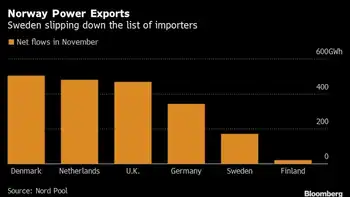
A spat over electricity supplies is heating up in northern Europe. Sweden is blocking Norway from using its grids to transfer power from producers throughout the region. That’s angered Norway, which in turn has cut flows to its Nordic neighbor.

The dispute has built up around the use of cross-border power cables, which are a key part of Europe’s plans to decarbonize since they give adjacent countries access to low-carbon resources such as wind or hydropower. The electricity flows to wherever prices are higher, informed by how electricity is priced across Europe, without interference from grid operators -- but in the event of a supply squeeze, flows can be stopped.

Sweden moved to safeguard the security of its grid after Norway started increasing electricity exports through huge new cables to Germany and the U.K. Those exports at times have drawn energy away from Sweden, resulting in the country’s system operator cutting capacity at its Nordic borders, preventing exports but also hindering imports, which it relies on to handle demand spikes during winter.

“This is not a good situation in the long run,” Christian Holtz, a energy market consultant for Merlin & Metis AB.

Norway hit back last week by cutting flows to Sweden, this will prioritize better paying customers in Europe, amid Irish price spikes that highlight dispatchable shortages, giving them access to its vast hydro resources at the expense of its Nordic neighbors. 

By partially closing its borders Sweden can’t access imports either, which it relies on to handle demand spikes during the coldest days of the winter. 

In Denmark, unusual summer and autumn winds have at times delivered extraordinarily low electricity prices that ripple through regional markets.

The Swedish grid manager Svenska Kraftnat has reduced export capacity at cables across its borders by as much as half this year to keep operations secure. Finland and Denmark rely on imports too and the cuts will come at a cost for millions of homes and industries across the four nations already contending with record electricity rates this year. 

Finland and Denmark want the European Union to end the exemption to regulations that make such reductions possible in the first place, as Europe is losing nuclear power and facing tighter supply.

“Imports from our neighboring countries ensure adequacy at times of peak consumption,” said Reima Paivinen, head of operation at the Finland’s Fingrid. “The recent surge in electricity prices throughout Europe does not directly affect the adequacy of electricity, but prices may rise dramatically for short periods.”

Svenska Kraftnat says it’s not political -- it has no choice but to cut capacity until its old grids are expanded to handle the new direction of flows, a challenge mirrored by grid expansion woes in Germany that slow integration. That could take at least until 2030 to complete, it said earlier this year. At the same time, Norway halving available export capacity to about 1,200 megawatts will increase risk of shortages. 

“If we need more we will have to count on imports from other countries,” said Erik Ek, head of strategic operation at Svenska Kraftnat. “If that is not available, we will have to disconnect users the day it gets cold.”


Related News

View more

Costa Rica hits record electricity generation from 99% renewable sources

Costa Rica Renewable Energy Record highlights 99.99% clean power in May 2019, driven by hydropower, wind, solar, geothermal, and biomass, enabling ICE REM electricity exports and reduced rates from optimized generation totaling 984.19 GWh.


Key Points

May 2019 benchmark: Costa Rica generated 99.99% of 984.19 GWh from renewables, shifting from imports to regional exports.

✅ 99.99% renewable share across hydro, wind, solar, geothermal, biomass

✅ 984.19 GWh generated; ICE suspended imports and exported via REM

✅ Geothermal output increased to offset dry-season hydropower variability


During the whole month of May 2019, Costa Rica generated a total of 984.19 gigawatt hours of electricity, the highest in the country’s history. What makes this feat even more impressive is the fact that 99.99% of this energy came from a portfolio of renewable sources such as hydropower, wind, biomass, solar, and geothermal.

With such a high generation rate, the state power company Instituto Costariccense de Electricidad (ICE) were able to suspend energy imports from the first week of May and shifted to exports, while U.S. renewable electricity surpassed coal in 2022 domestically. To date, the power company continues to sell electricity to the Regional Electricity Market (REM) which generates revenues and is likely to reduce local electricity rates, a trend echoed in places like Idaho where a vast majority of electricity comes from renewables.

The record-breaking power generation was made possible by optimization of the country’s renewable sources, much as U.S. wind capacity surpassed hydro capacity at the end of 2016 to reshape portfolios. As the period coincided with the tail end of the dry season, the geothermal quota had to be increased.

Costa Rica remains a leader in renewable power generation, whereas U.S. wind generation has become the most-used renewable source in recent years. In 2015, more than 98% of the country’s electrical generation came from renewable sources, while U.S. renewables hit a record 28% in April in one recent benchmark. Through the years, this figure has remained fairly constant despite dry bouts caused by the El Niño phenomenon, and U.S. solar generation also continued to rise.


Related News

View more

Sign Up for Electricity Forum’s Newsletter

Stay informed with our FREE Newsletter — get the latest news, breakthrough technologies, and expert insights, delivered straight to your inbox.

Electricity Today T&D Magazine Subscribe for FREE

Stay informed with the latest T&D policies and technologies.
  • Timely insights from industry experts
  • Practical solutions T&D engineers
  • Free access to every issue

Download the 2025 Electrical Training Catalog

Explore 50+ live, expert-led electrical training courses –

  • Interactive
  • Flexible
  • CEU-cerified