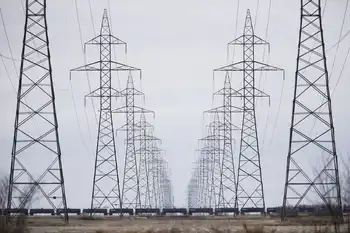
By -- Work site visits to ensure safe clearances around power lines


Arc Flash Training CSA Z462 - Electrical Safety Essentials

Our customized live online or in‑person group training can be delivered to your staff at your location.

  • Live Online
  • 6 hours Instructor-led
  • Group Training Available
Regular Price:
$249
Coupon Price:
$199
Reserve Your Seat Today
This Fall, the power company has launched several new initiatives for those most at risk, including home builders, electrical contractors and cable workers.

Measures targeting "at risk" contractor groups include:

Related News

Trudeau vows to regulate oil and gas emissions, electric car sales

Canada Oil and Gas Emissions Cap sets five-year targets to cut sector emissions toward net-zero by 2050, alongside an EV mandate, carbon pricing signals, and support for carbon capture, clean energy jobs, climate policy.


Key Points

A federal policy to regulate and reduce oil and gas emissions via 5-year targets, reaching net-zero by 2050.

✅ Regulated 5-year milestones to cut oil and gas emissions to net-zero by 2050

✅ Interim EV mandate: 50% by 2030; 100% zero-emission sales by 2035

✅ $2B fund for clean energy jobs in oil- and gas-reliant communities


Liberal Leader Justin Trudeau vowed to regulate total emissions from Canada’s oil and gas producers as he laid out his first major climate change promises of the campaign Sunday, a plan that was welcomed by several environmental and climate organizations.

Trudeau said that if re-elected, the Liberals will set out regulated five-year targets for emissions from oil and gas production to get them to net-zero emissions by 2050, a goal that, according to an IEA report will require more electricity, but also create a $2 billion fund to create jobs in oil and gas-reliant communities in Alberta, Saskatchewan and Newfoundland and Labrador.

“Let’s be realistic, over a quarter of Canada’s emissions come from our oil and gas sector. We need the leadership of these industries to decarbonize our country,” Trudeau said.

“That’s why we’ll make sure oil and gas emissions don’t increase and instead go down with achievable milestones,” while ensuring local economies can prosper.“

The Liberals are also introducing an interim electric vehicle mandate, which will require half the cars sold in Canada to be zero-emission by 2030, and because cleaning up electricity is critical to meeting climate pledges, the policy pairs with power-sector decarbonization, ahead of the final mandated target of 100 per cent by 2035.

Trudeau spoke in Cambridge, Ont., where protesters once again made an appearance amid a visible police presence. Officers carried one woman off the property when she refused to leave when asked.

Trudeau alluded to the protesters and their actions, which included sounding sirens and chanting expletives, as he defended his government’s record on climate change including progress in the electricity sector nationally, and touted its new plan.

“Sirens in the background may remind us that this is a climate emergency. That’s why we will move faster and be bolder,” he said.

Canada’s largest oilsands producers have already committed to reaching net zero greenhouse gas emissions by 2050, but the policy proposed Sunday “calls the oil companies’ bluff” by making those goals a legislated requirement, said Keith Stewart, senior energy strategist with Greenpeace Canada.

The new timeline for electric vehicles also “sends a clear signal to auto companies to get cracking (and build them here),” he said on Twitter, even as proposals like a fully renewable grid by 2030 are debated today. “We’d like to see this happen faster but the shift away from voluntary targets to requirements is big.”


Merran Smith, executive director of Clean Energy Canada, a climate program at Simon Fraser University, said clean electricity, clean transportation and “phasing out oil and gas with accountable milestones” must be key priorities over the next decade, aligning with Canada’s race to net-zero and the role of renewable energy.

“Today’s announcement, which checks all of these boxes, is not just good ambition_it’s good policy. Policy that will drive down carbon pollution and drive up clean job growth and economic competitiveness. It is policy that will drive Canada forward with cleaner cars, power Canada with clean electricity, and invest in businesses that will last such as battery manufacturing, electric vehicle manufacturing and low carbon steel,” Smith said in an email.

Michael Bernstein, executive director of the climate policy organization Clean Prosperity, said the promises laid out Sunday offer a “strong boost” to the federal government’s previous climate commitments.

He said the organization prefers market incentives such as carbon pricing, that spur innovation over further regulation. But since the largest oilsands companies have already committed to reaching net-zero emissions, he said the newly unveiled policy could provide some support.

“ First, I would encourage the Liberal Party to release independent modelling showing the types of emissions reductions they expect to achieve with their new package of policies. Second, many policies are referred to in general terms so I hope the Liberal Party will provide further details in the coming days,” he said.

“Finally, the document does not specifically mention carbon capture or carbon dioxide removal technologies but both technologies will be critical to achieve some of the pledges in today’s announcement, especially reaching net-zero emissions in the oil a gas sector.”

NDP Leader Jagmeet Singh painted the announcement as the latest in a string of “empty promises” from the Liberals on climate change, saying Canada has the highest increase in greenhouse gas emissions among all G7 countries, and that provinces like B.C. risk missing 2050 targets as well, he argued.

“Climate targets mean nothing when you don’t act on them. We can’t afford more of Justin Trudeau’s empty words on climate change,” he said in a statement.

The Trudeau Liberals submitted new targets to the United Nations in July, promising that Canada will curb emissions by 40 to 45 per cent from 2005 levels by 2030, building on the net-zero by 2050 plan announced earlier, officials say.


Related News

View more

Is Ontario's Power Cost-Effective?

Ontario Nuclear Power Costs highlight LCOE, capex, refurbishment outlays, and waste management, compared with renewables, grid reliability, and emissions targets, informing Australia and Peter Dutton on feasibility, timelines, and electricity prices.


Key Points

They include high capex and LCOE from refurbishments and waste, offset by reliable, low-emission baseload.

✅ Refurbishment and maintenance drive lifecycle and LCOE variability.

✅ High capex and long timelines affect consumer electricity prices.

✅ Low emissions, but waste and safety compliance add costs.


Australian opposition leader Peter Dutton recently lauded Canada’s use of nuclear power as a model for Australia’s energy future. His praise comes as part of a broader push to incorporate nuclear energy into Australia’s energy strategy, which he argues could help address the country's energy needs and climate goals. However, the question arises: Is Ontario’s experience with nuclear power as cost-effective as Dutton suggests?

Dutton’s endorsement of Canada’s nuclear power strategy highlights a belief that nuclear energy could provide a stable, low-emission alternative to fossil fuels. He has pointed to Ontario’s substantial reliance on nuclear power, and the province’s exploration of new large-scale nuclear projects, as an example of how such an energy mix might benefit Australia. The province’s energy grid, which integrates a significant amount of nuclear power, is often cited as evidence that nuclear energy can be a viable component of a diversified energy portfolio.

The appeal of nuclear power lies in its ability to generate large amounts of electricity with minimal greenhouse gas emissions. This characteristic aligns with Australia’s climate goals, which emphasize reducing carbon emissions to combat climate change. Dutton’s advocacy for nuclear energy is based on the premise that it can offer a reliable and low-emission option compared to the fluctuating availability of renewable sources like wind and solar.

However, while Dutton’s enthusiasm for the Canadian model reflects its perceived successes, including recent concerns about Ontario’s grid getting dirtier amid supply changes, a closer look at Ontario’s nuclear energy costs raises questions about the financial feasibility of adopting a similar strategy in Australia. Despite the benefits of low emissions, the economic aspects of nuclear power remain complex and multifaceted.

In Ontario, the cost of nuclear power has been a topic of considerable debate. While the province benefits from a stable supply of electricity due to its nuclear plants, studies warn of a growing electricity supply gap in coming years. Ontario’s experience reveals that nuclear power involves significant capital expenditures, including the costs of building reactors, maintaining infrastructure, and ensuring safety standards. These expenses can be substantial and often translate into higher electricity prices for consumers.

The cost of maintaining existing nuclear reactors in Ontario has been a particular concern. Many of these reactors are aging and require costly upgrades and maintenance to continue operating safely and efficiently. These expenses can add to the overall cost of nuclear power, impacting the affordability of electricity for consumers.

Moreover, the development of new nuclear projects, as seen with Bruce C project exploration in Ontario, involves lengthy and expensive construction processes. Building new reactors can take over a decade and requires significant investment. The high initial costs associated with these projects can be a barrier to their economic viability, especially when compared to the rapidly decreasing costs of renewable energy technologies.

In contrast, the cost of renewable energy has been falling steadily, even as debates over nuclear power’s trajectory in Europe continue, making it a more attractive option for many jurisdictions. Solar and wind power, while variable and dependent on weather conditions, have seen dramatic reductions in installation and operational costs. These lower costs can make renewables more competitive compared to nuclear energy, particularly when considering the long-term financial implications.

Dutton’s praise for Ontario’s nuclear power model also overlooks some of the environmental and logistical challenges associated with nuclear energy. While nuclear power generates low emissions during operation, it produces radioactive waste that requires long-term storage solutions. The management of nuclear waste poses significant environmental and safety concerns, as well as additional costs for safe storage and disposal.

Additionally, the potential risks associated with nuclear power, including the possibility of accidents, contribute to the complexity of its adoption. The safety and environmental regulations surrounding nuclear energy are stringent and require continuous oversight, adding to the overall cost of maintaining nuclear facilities.

As Australia contemplates integrating nuclear power into its energy mix, it is crucial to weigh these financial and environmental considerations. While the Canadian model provides valuable insights, the unique context of Australia’s energy landscape, including its existing infrastructure, energy needs, and the costs of scrapping coal-fired electricity in comparable jurisdictions, must be taken into account.

In summary, while Peter Dutton’s endorsement of Canada’s nuclear power model reflects a belief in its potential benefits for Australia’s energy strategy, the cost-effectiveness of Ontario’s nuclear power experience is more nuanced than it may appear. The high capital and maintenance costs associated with nuclear energy, combined with the challenges of managing radioactive waste and ensuring safety, present significant considerations. As Australia evaluates its energy future, a comprehensive analysis of both the benefits and drawbacks of nuclear power will be essential to making informed decisions about its role in the country’s energy strategy.


Related News

View more

Pennsylvania residents could see electricity prices rise as much as 50 percent this winter

Pennsylvania Electric Rate Increases hit Peco, PPL, and Pike County, driven by natural gas costs and wholesale power markets; default rate changes, price to compare shifts, and time-of-use plans affect residential bills.


Key Points

Electric default rates are rising across Pennsylvania as natural gas costs climb, affecting Peco, PPL, and Pike customers.

✅ PPL, Peco, and Pike raising default rates Dec. 1

✅ Natural gas costs driving wholesale power prices

✅ Consider standard offer, TOU rates, and efficiency


Energy costs for electric customers are going up by as much as 50% across Pennsylvania next week, the latest manifestation of US electricity price increases impacting gasoline, heating oil, propane, and natural gas.

Eight Pennsylvania electric utilities are set to increase their energy prices on Dec. 1, reflecting the higher cost to produce electricity. Peco Energy, which serves Philadelphia and its suburbs, will boost its energy charge by 6.4% on Dec. 1, from 6.6 cents per kilowatt hour to about 7 cents per kWh. Energy charges account for about half of a residential bill.

PPL Electric Utilities, the Allentown company that serves a large swath of Pennsylvania including parts of Bucks, Montgomery, and Chester Counties, will impose a 26% increase on residential energy costs on Dec. 1, from about 7.5 cents per kWh to 9.5 cents per kWh. That’s an increase of $40 a month for an electric heating customer who uses 2,000 kWh a month.

Pike County Light & Power, which serves about 4,800 customers in Northeast Pennsylvania, will increase energy charges by 50%, according to the Pennsylvania Public Utility Commission.

“All electric distribution companies face the same market forces as PPL Electric Utilities,” PPL said in a statement. Each Pennsylvania utility follows a different PUC-regulated plan for procuring energy from power generators, and those forces can include rising nuclear power costs in some regions, which explains why some customers are absorbing the hit sooner rather than later, it said.

There are ways customers can mitigate the impact. Utilities offer a host of programs and grants to support low-income customers, and some states are exploring income-based fixed charges to address affordability, and they encourage anyone struggling to pay their bills to call the utility for help. Customers can also control their costs by conserving energy. It may be time to put on a sweater and weatherize the house.

Peco recently introduced time-of-use rates — as seen when Ontario ended fixed pricing — that include steep discounts for customers who can shift electric usage to late night hours — that’s you, electric vehicle owners.

There’s also a clever opportunity available for many Pennsylvania customers called the “standard offer” that might save you some real money, but you need to act before the new charges take effect on Dec. 1 to lock in the best rates.

Why are the price hikes happening?
But first, how did we get here?

Energy charges are rising for a simple reason: Fuel prices for power generators are increasing, and that’s driven mostly by natural gas. It’s pushing up electricity prices in wholesale power markets and has lifted typical residential bills in recent years.

“It’s all market forces right now,” said Nils Hagen-Frederiksen, PUC spokesperson. Energy charges are strictly a pass-through cost for utilities. Utilities aren’t allowed to mark them up.

The increase in utility energy charges does not affect customers who buy their energy from competitive power suppliers in deregulated electricity markets. About 27% of Pennsylvania’s 5.9 million electric customers who shop for electricity from third-party suppliers either pay fixed rates, whose price remains stable, or are on a variable-rate plan tied to market prices. The variable-rate electric bills have probably already increased to reflect the higher cost of generating power.

Most New Jersey electric customers are shielded for now from rising energy costs. New Jersey sets annual energy prices for customers who don’t shop for power. Those rates go into effect on June 1 and stay in place for 12 months. The current energy market fluctuations will be reflected in new rates that take effect next summer, said Lauren Ugorji, a spokesperson for Public Service Electric & Gas Co., New Jersey’s largest utility.

For each utility, its own plan
Pennsylvania has a different system for setting utility energy charges, which are also known as the “default rate,” because that’s the price a customer gets by default if they don’t shop for power. The default rate is also the same thing as the “price to compare,” a term the PUC has adopted so consumers can make an apples-to-apples comparison between a utility’s energy charge and the price offered by a competitive supplier.

Each of the state’s 11 PUC-regulated electric utilities prepares its own “default service plan,” that governs the method by which they procure power on wholesale markets. Electric distribution companies like Peco are required to buy the lowest priced power. They typically buy power in blind auctions conducted by independent agents, so that there’s no favoritism for affiliated power generators

Some utilities adjust charges quarterly, and others do it semi-annually. “This means that each [utility’s] resulting price to compare will vary as the market changes, some taking longer to reflect price changes, both up and down,” PPL said in a statement. PPL conducted its semi-annual auction in October, when energy prices were rising sharply.

Most utilities buy power from suppliers under contracts of varying durations, both long-term and short-term. The contracts are staggered so market price fluctuations are smoothed out. One utility, Pike County Power & Light, buys all its power on the spot market, which explains why its energy charge will surge by 50% on Dec. 1. Pike County’s energy charge will also be quicker to decline when wholesale prices subside, as they are expected to next year.

Peco adjusts its energy charge quarterly, but it conducts power auctions semi-annually. It buys about 40% of its power in one-year contracts, and 60% in two-year contracts, and does not buy any power on spot markets, said Richard G. Webster Jr., Peco’s vice president of regulatory policy and strategy.

“At any given time, we’re replacing about a third of our supplied portfolio,” he said.

The utility’s energy charge affects only part of the monthly bill. For a Peco residential electric customer who uses 700 kWh per month, the Dec. 1 energy charge increase will boost monthly bills by $2.94 per month, or 2.9%. For an electric heating customer who uses about 2,000 kWh per month, the change will boost bills $8.40 a month, or about 3.5%, said Greg Smore, a Peco spokesperson.


Related News

View more

Ontario’s Electricity Future: Balancing Demand and Emissions 

Ontario Electricity Transition faces surging demand, GHG targets, and federal regulations, balancing natural gas, renewables, battery storage, and grid reliability while pursuing net-zero by 2035 and cost-effective decarbonization for industry, EVs, and growing populations.


Key Points

Ontario Electricity Transition is the province's shift to a reliable, low-GHG grid via renewables, storage, and policy.

✅ Demand up 75% by 2050; procurement adds 4,000 MW capacity.

✅ Gas use rises to 25% by 2030, challenging GHG goals.

✅ Tripling wind and solar with storage can cut costs and emissions.


Ontario's electricity sector stands at a pivotal crossroads. Once a leader in clean energy, the province now faces the dual challenge of meeting surging demand while adhering to stringent greenhouse gas (GHG) reduction targets. Recent developments, including the expansion of natural gas infrastructure and proposed federal regulations, have intensified debates about the future of Ontario's energy landscape, as this analysis explains in detail.

Rising Demand and the Need for Expansion

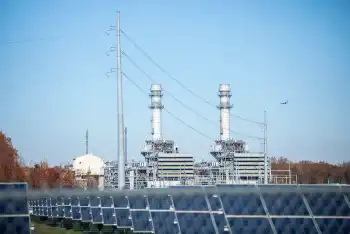
Ontario's electricity demand is projected to increase by 75% by 2050, equivalent to adding four and a half cities the size of Toronto to the grid. This surge is driven by factors such as industrial electrification, population growth, and the transition to electric vehicles. In response, as Ontario confronts a looming shortfall in the coming years, the provincial government has initiated its most ambitious energy procurement plan to date, aiming to secure an additional 4,000 megawatts of capacity by 2030. This includes investments in battery storage and natural gas generation to ensure grid reliability during peak demand periods.

The Role of Natural Gas: A Controversial Bridge

Natural gas has become a cornerstone of Ontario's strategy to meet immediate energy needs. However, this reliance comes with environmental costs. The Independent Electricity System Operator (IESO) projects that by 2030, natural gas will account for 25% of Ontario's electricity supply, up from 4% in 2017. This shift raises concerns about the province's ability to meet its GHG reduction targets and to embrace clean power in practice. 

The expansion of gas-fired plants, including broader plans for new gas capacity, such as the Portlands Energy Centre in Toronto, has sparked public outcry. Environmental groups argue that these expansions could undermine local emissions reduction goals and exacerbate health issues related to air quality. For instance, emissions from the Portlands plant have surged from 188,000 tonnes in 2017 to over 600,000 tonnes in 2021, with projections indicating a potential increase to 1.65 million tonnes if the expansion proceeds as planned. 

Federal Regulations and Economic Implications

The federal government's proposed clean electricity regulations aim to achieve a net-zero electricity sector by 2035. However, Ontario's government has expressed concerns that these regulations could impose significant financial burdens. An analysis by the IESO suggests that complying with the new rules would require doubling the province's electricity generation capacity, potentially adding $35 billion in costs by 2050, while other estimates suggest that greening Ontario's grid could cost $400 billion over time. This could result in higher residential electricity bills, ranging from $132 to $168 annually starting in 2033.

Pathways to a Sustainable Future

Experts advocate for a diversified approach to decarbonization that balances environmental goals with economic feasibility. Investments in renewable energy sources, such as new wind and solar resources, along with advancements in energy storage technologies, are seen as critical components of a sustainable energy strategy. Additionally, implementing energy efficiency measures and modernizing grid infrastructure can enhance system resilience and reduce emissions. 

The Ontario Clean Air Alliance proposes phasing out gas power by 2035 through a combination of tripling wind and solar capacity and investing in energy efficiency and storage solutions. This approach not only aims to reduce emissions but also offers potential cost savings compared to continued reliance on gas-fired generation. 

Ontario's journey toward a decarbonized electricity grid is fraught with challenges, including balancing reliability, clean, affordable electricity, and environmental sustainability. While natural gas currently plays a significant role in meeting the province's energy needs, its long-term viability as a bridge fuel remains contentious. The path forward will require careful consideration of technological innovations, regulatory frameworks, and public engagement to ensure a clean, reliable, and economically viable energy future for all Ontarians.


Related News

View more

Grounding and Bonding and The NEC - Section 250

Electrical Grounding and Bonding NEC 250 Training equips electricians with Article 250 expertise, OSHA compliance knowledge, lightning protection strategies, and low-impedance fault current path design for safer industrial, commercial, and institutional power systems.


Key Points

Live NEC 250 course on grounding and bonding, covering safety, testing, and OSHA-compliant design.

✅ Interprets NEC Article 250 grounding and bonding rules

✅ Designs low-impedance fault current paths for safety

✅ Aligns with OSHA, lightning protection, and testing best practices


The Electricity Forum is organizing a series of live online Electrical Grounding and Bonding - NEC 250 training courses this Fall:

  • September 8-9 , 2020 - 10:00 am - 4:30 pm ET
  • October 29-30 , 2020 - 10:00 am - 4:30 pm ET
  • November 23-24 , 2020 - 10:00 am - 4:30 pm ET


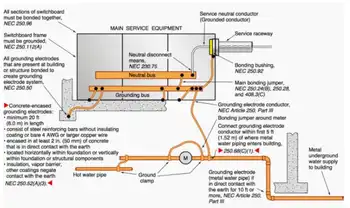
This interactive 12-hour live online instructor-led  Grounding and Bonding and the NEC Training course takes an in-depth look at Article 250 of the National Electrical Code (NEC) and is designed to give students the correct information they need to design, install and maintain effective electrical grounding and bonding systems in industrial, commercial and institutional power systems, with substation maintenance training also relevant in many facilities.

One of the most important AND least understood sections of the NEC is the section on Electrical Grounding, where resources like grounding guidelines can help practitioners navigate key concepts.

No other section of the National Electrical Code can match Article 250 (Grounding and Bonding) for confusion that leads to misapplication, violation, and misinterpretation. It's generally agreed that the terminology used in Section 250 has been a source for much confusion for industrial, commercial and institutional electricians. Thankfully, this has improved during the last few revisions to Article 250.

Article 250 covers the grounding requirements for providing a path to the earth to reduce overvoltage from lightning, with lightning protection training providing useful context, and the bonding requirements for a low-impedance fault current path back to the source of the electrical supply to facilitate the operation of overcurrent devices in the event of a ground fault.

Our Electrical Grounding Training course will address all the latest changes to  the Electrical Grounding rules included in the NEC, and relate them to VFD drive training considerations for modern systems.

Our course will cover grounding fundamentals, identify which grounding system tests can prevent safety and operational issues at your facilities, and introduce related motor testing training topics, and details regarding which tests can be conducted while the plant is in operation versus which tests require a shutdown will be discussed. 

Proper electrical grounding and bonding of equipment helps ensure that the electrical equipment and systems safely remove the possibility of electric shock, by limiting the voltage imposed on electrical equipment and systems from lightning, line surges, unintentional contact with higher-voltage lines, or ground-fault conditions. Proper grounding and bonding is important for personnel protection, with electrical safety tips offering practical guidance, as well as for compliance with OSHA 29 CFR 1910.304(g) Grounding.

It has been determined that more than 70 per cent of all electrical problems in industrial, commercial and institutional power systems, including large projects like the New England Clean Power Link, are due to poor grounding, and bonding errors. Without proper electrical grounding and bonding, sensitive electronic equipment is subjected to destruction of data, erratic equipment operation, and catastrophic damage. This electrical grounding and bonding training course will National Electrical Code.

Complete course details here:

https://electricityforum.com/electrical-training/electrical-grounding-nec


Related News

View more

Green hydrogen, green energy: inside Brazil's $5.4bn green hydrogen plant

Enegix Base One Green Hydrogen Plant will produce renewable hydrogen via electrolysis in Ceara, Brazil, leveraging 3.4 GW baseload renewables, offshore wind, and hydro to scale clean energy, storage, and export logistics.


Key Points

A $5.4bn Ceara, Brazil project to produce 600m kg of green hydrogen annually using 3.4 GW of baseload renewables.

✅ 3.4 GW baseload from hydro and offshore wind pipelines

✅ Targets 600m kg green hydrogen per year via electrolysis

✅ Focus on storage, transport, and export supply chains


In March, Enegix Energy announced some of the most ambitious hydrogen plans the world has ever seen. The company signed a memorandum of understanding (MOU) with the government of the Brazilian state of Ceará to build the world’s largest green hydrogen plant in the state on the country’s north-eastern coast, and the figures are staggering.

The Base One facility will produce more than 600 million kilograms of green hydrogen annually from 3.4GW of baseload renewable energy, and receive $5.4bn in investment to get the project off the ground and producing within four years.

Green hydrogen, hydrogen produced by electrolysis that is powered by renewables, has significant potential as a clean energy source. Already seeing increased usage in the transport sector, the power source boasts the energy efficiency and the environmental viability to be a cornerstone of the world’s energy mix.

Yet practical challenges have often derailed large-scale green hydrogen projects, from the inherent obstacle of requiring separate renewable power facilities to the logistical and technological challenges of storing and transporting hydrogen. Could vast investment, clever planning, and supportive governments and programs like the DOE’s hydrogen hubs initiative help Enegix to deliver on green hydrogen’s oft-touted potential?

Brazilian billions
The Base One project is exceptional not only for its huge scale, but the timing of its construction, with demand for hydrogen set to increase dramatically over the next few decades. Figures from Wood Mackenzie suggest that hydrogen could account for 1.4 billion tonnes of energy demand by 2050, one-tenth of the world’s supply, with green hydrogen set to be the majority of this figure.

Yet considering that, prior to the announcement of the Enegix project, global green hydrogen capacity was just 94MW, advances in offshore green hydrogen and the development of a project of this size and scope could scale up the role of green hydrogen by orders of magnitude.

“We really need to [advance clean energy] without any emissions on a completely clean, carbon neutral and net-zero framework, and so we needed access to a large amount of green energy projects,” explains Wesley Cooke, founder and CEO of Enegix, a goal aligned with analyses that zero-emissions electricity by 2035 is possible, discussing the motivation behind the vast project.

With these ambitious goals in mind, the company needed to find a region with a particular combination of political will and environmental traits to enable such a project to take off.


“When we looked at all of these key things: pipeline for renewables, access to water, cost of renewables, and appetite for renewables, Brazil really stood out to us,” Cooke continues. “The state of Ceará, that we’ve got an MOU with the government in at the moment, ticks all of these boxes.”

Ceará’s own clean energy plans align with Enegix’s, at least in terms of their ambition and desire for short-term development. Last October, the state announced that it plans to add 5GW of new offshore wind capacity in the next five years. With BI Energia alone providing $2.5bn in investment for its 1.2GW Camocim wind facility, there is significant financial muscle behind these lofty ambitions.

“One thing I should add is that Brazil is very blessed when it comes to baseload renewables,” says Cooke. “They have an incredibly high percentage of their country-wide energy that comes from renewable sources and a lot of this is in part due to the vast hydro schemes that they have for hydro dams. Not a lot of countries have that, and specifically when you’re trying to produce hydrogen, having access to vast amounts of renewables [is vital].”

Changing perceptions and tackling challenges
This combination of vast investment and integration with the existing renewable power infrastructure of Ceará could have cultural impacts too. The combination of state support for and private investment in clean energy offsets many of the narratives emerging from Brazil concerning its energy policies and environmental protections, even as debates over clean energy's trade-offs persist in Brazil and beyond, from the infamous Brumadinho disaster to widespread allegations of illegal deforestation and gold mining.

“I can’t speak for the whole of Brazil, but if we look at Ceará specifically, and even from what we’ve seen from a federal government standpoint, they have been talking about a hydrogen roadmap for Brazil for quite some time now,” says Cooke, highlighting the state’s long-standing support for green hydrogen. “I think we came in at the perfect time with a very solid plan for what we wanted to do, [and] we’ve had nothing but great cooperation, and even further than just cooperation, excitement around the MOU.”

This narrative shift could help overcome one of the key challenges facing many hydrogen projects, the idea that its practical difficulties render it fundamentally unsuitable for baseload power generation. By establishing a large-scale green hydrogen facility in a country that has recently struggled to present itself as one that is invested in renewables, the Base One facility could be the ultimate proof that such clean hydrogen projects are viable.

Nevertheless, practical challenges remain, as is the case with any energy project of this scale. Cooke mentions a number of solutions to two of the obstacles facing hydrogen production around the world: renewable energy storage and transportation of the material.

“We were looking at compressed hydrogen via specialised tankers [and] we were looking at liquefied hydrogen, [as] you have to get liquefied hydrogen very cool to around -253°, and you can use 30% to 40% of your total energy that you started with just to get it down to that temperature,” Cooke explains.

“The other aspect is that if you’re transporting this internationally, you really have to think about the supply chain. If you land in a country like Indonesia, that’s wonderful, but how do you get it from Indonesia to the customers that need it? What is the supply chain? What does that look like? Does it exist today?”

The future of green hydrogen
These practical challenges present something of a chicken and egg problem for the future of green hydrogen: considerable up-front investment is required for functions such as storage and transport, but the difficulties of these functions can scare off investors and make such investments uncommon.

Yet with the world’s environmental situation increasingly dire, more dramatic, and indeed risky, moves are needed to alter its energy mix, and Enegix is one company taking responsibility and accepting these risks.

“We need to have the renewables to match the dirty fuel types,” Cooke says. “This [investment] will really come from the decisions that are being made right now by large-scale companies, multi-billion-euro-per-year revenue companies, committing to building out large scale factories in Europe and Asia, to support PEM [hydrolysis].”

This idea of large-scale green hydrogen is also highly ambitious, considering the current state of the energy source. The International Renewable Energy Agency reports that around 95% of hydrogen comes from fossil fuels, so hydrogen has a long ways to go to clean up its own carbon footprint before going on to displace fossil fuel-driven industries.

Yet this displacement is exactly what Enegix is targeting. Cooke notes that the ultimate goal of Enegix is not simply to increase hydrogen production for use in a single industry, such as clean vehicles. Instead, the idea is to develop green hydrogen infrastructure to the point where it can replace coal and oil as a source of baseload power, leapfrogging other renewables to form the bedrock of the world’s future energy mix.

“The problem with [renewable] baseload is that they’re intermittent; the wind’s not always blowing and the sun’s not always shining and batteries are still very expensive, although that is changing. When you put those projects together and look at the levelised cost of energy, this creates a chasm, really, for baseload.

“And for us, this is really where we believe that hydrogen needs to be thought of in more detail and this is what we’re really evangelising about at the moment.”

A more hydrogen-reliant energy mix could also bring social benefits, with Cooke suggesting that the same traits that make hydrogen unwieldy in countries with established energy infrastructures could make hydrogen more practically viable in other parts of the world.

“When you look at emerging markets and developing markets at the moment, the power infrastructure in some cases can be quite messy,” Cooke says. “You’ve got the potential for either paying for the power or extending your transmission grid, but rarely being able to do both of those.

“I think being able to do that last mile piece, utilising liquid organic hydrogen carrier as an energy vector that’s very cost-effective, very scalable, non-toxic, and non-flammable; [you can] get that power where you need it.

“We believe hydrogen has the potential to be very cost-effective at scale, supporting a vision of cheap, abundant electricity over time, but also very modular and usable in many different use cases.”


Related News

View more

Sign Up for Electricity Forum’s Newsletter

Stay informed with our FREE Newsletter — get the latest news, breakthrough technologies, and expert insights, delivered straight to your inbox.

Electricity Today T&D Magazine Subscribe for FREE

Stay informed with the latest T&D policies and technologies.
  • Timely insights from industry experts
  • Practical solutions T&D engineers
  • Free access to every issue

Live Online & In-person Group Training

Advantages To Instructor-Led Training – Instructor-Led Course, Customized Training, Multiple Locations, Economical, CEU Credits, Course Discounts.

Request For Quotation

Whether you would prefer Live Online or In-Person instruction, our electrical training courses can be tailored to meet your company's specific requirements and delivered to your employees in one location or at various locations.