Electrical Ground Faults Explained
By Frank Baker, Technical Editor
By Frank Baker, Technical Editor
Our customized live online or in‑person group training can be delivered to your staff at your location.
Request for Quotation Service

Buyers Submit Free RFQs to top suppliers, no obligation.
Suppliers Browse real project RFQs directly from buyers.
Trust Electricity Forum 40 years connection buyers and suppliers.
Electrical ground faults occur when current escapes its intended path and energizes grounded metal, creating shock risk, equipment damage, and poor fault clearing when bonding, grounding conductors, or protective devices fail to control fault current.
Electrical ground faults are often misunderstood as simple wiring mistakes that immediately shut down a circuit. In practice, the most hazardous faults are the ones that do not trip anything. They persist quietly, limited by resistance, corrosion, moisture, or poor bonding, while equipment frames, conduits, or enclosures sit at elevated voltage waiting for contact.
When ground fault incidents cause injury or damage, it is rarely because no one understood the term. It is because the fault path was unpredictable, the bonding network was incomplete, or the protective device could not see enough fault current to act decisively.
Short circuits announce themselves. They are loud, fast, and usually unmistakable. Electrical ground faults often develop slowly and exhibit subtle behavior. The fault current may be limited by paint, oxidation, loose fittings, water film, or insulation that has degraded but not fully failed.
That low-level current is precisely what makes fault conditions dangerous. It can be high enough to energize metal and create shock risk, yet too low to trigger traditional overcurrent protection. That is the reason why electrical ground faults require a different mental model than “excess current equals trip.”
Faults only become manageable when the system provides a deliberate, low-impedance return path that forces fault current to flow in a way protective devices can detect. That is the practical purpose of a properly engineered grounding system.
Stay informed with our FREE Power Quality Newsletter — get the latest news, breakthrough technologies, and expert insights, delivered straight to your inbox.
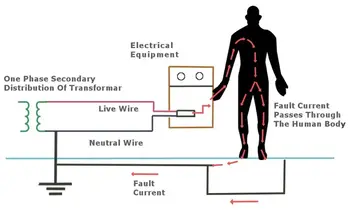
In normal operation, current returns to the intended return conductor. During an electrical ground fault, current leaves that path and seeks an alternative route through metal, bonding jumpers, equipment earthing conductors, raceways, cable trays, and sometimes structural steel or concrete.
Two consequences follow immediately. First, exposed metal that appears harmless can develop a higher voltage relative to nearby objects. A cabinet can be energized relative to a ladder, a pipe, or a floor drain, even though everything appears intact. Second, whether the fault clears depends on the impedance of that return path. High impedance means low fault current, which allows faults to linger.
That is the reason why grounding and bonding cannot be treated as separate topics. Grounding establishes system reference and stabilizes voltage. Bonding forces align the metal to the same potential and support fault clearing by keeping the return path continuous. That relationship is explored further in grounding and bonding.
Most electrical ground faults are not sudden failures. They accumulate damage.
They appear where vibration abrades insulation inside conduit, where moisture tracks through motor terminals, where outdoor enclosures lose their seals, and where temporary modifications quietly become permanent. The installation still functions, but its fault behavior has changed.
Early faults are often low current. They may only appear during rain, washdown, or temperature swings. That makes them easy to dismiss and difficult to locate, especially if troubleshooting assumes every abnormal condition is a short circuit. Fault behavior is strongly influenced by the integrity of return paths through bonded metal, which means a compromised electrical ground clamp can introduce unpredictable resistance during a fault event.
A more useful way to think about ground faults is this: they reveal where the system is willing to conduct electricity when something goes wrong.
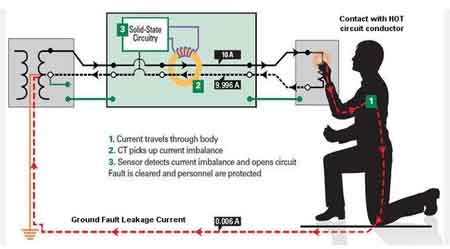
Standard breakers protect against overloads and high-current faults. They do not protect against small leakage currents that can still injure a person or energize an enclosure. That is why residual current protection, such as GFCIs, exists. These devices monitor current balance and trip when current leaves the intended circuit path.
This protection is effective against shock risk, but it does not solve every electrical ground fault problem. In larger systems, engineers also consider equipment damage, thermal stress, arc energy at the fault point, and selective coordination. GFCI at the service or feeder level is a different problem than receptacle-level protection, and confusing the two often leads to either nuisance trips or dangerous blind spots.
If there is a risk that readers misunderstand how return current and earthing interact, that distinction should be addressed directly. It is clarified in Electrical neutral vs ground.
In practical installations, electrical ground faults are often confused with arc fault events, nuisance circuit breaker trips, or general electric shock complaints tied to an electrical device rather than the system itself. When a hot wire contacts a bonded surface or metal enclosure, current may return through a neutral wire, equipment frame, or unintended bonding path, creating shock hazards even when fault circuit interrupters GFCI or GFCI outlets do not immediately respond.
GFCIs are effective at detecting imbalance, but they do not replace proper bonding, conductor integrity, or compliance with electrical code intent, especially where intermittent contact, moisture, or degraded insulation allows hazardous voltage to persist unnoticed.
Think you know Power Quality? Take our quick, interactive quiz and test your knowledge in minutes.
One of the most common misconceptions is that a “good ground” ensures electrical ground faults clear quickly. Grounding electrodes stabilize the voltage reference and manage certain fault and lightning behaviors, but they are not the primary clearing path for most branch-circuit faults.
The clearing path is the equipment grounding conductor and bonding network back to the source. If that path is resistive, discontinuous, or poorly bonded, an electrical ground fault can energize equipment indefinitely, preventing protection from tripping.
This explains why electrode connections and bonding details matter as system behavior controls, not just installation details. For readers who need that connection tightened, see: Grounding electrode conductor.
In some industrial systems, the goal is not immediate clearing of the first electrical ground fault. Instead, fault current is intentionally limited to reduce damage while alarms and procedures guide corrective action. High resistance grounding is one example.
When engineered correctly, this approach reduces arc damage and downtime while preserving fault visibility. When applied poorly, it normalizes fault operation and creates false confidence. That trade-off is part of system design, not an afterthought.
Ground faults rarely announce themselves cleanly. Warning signs include nuisance trips after rain, tingling sensations on equipment, unexplained GFCI operation during motor starts, or intermittent control faults that disappear when doors are opened or closed.
Troubleshooting becomes ineffective when every symptom is treated as a short circuit. Replacing components without understanding the fault path simply moves the problem. Effective diagnosis starts by assuming current is leaving its intended path and identifying where and when that occurs.
Electrical ground faults are common and not always dramatic. There are moments when the electrical system reveals its true behavior, not the behavior implied by drawings or labels. A well-designed G&B network turns an electrical ground fault into a fast, controlled event. A compromised one turns it into a lingering hazard that energizes metal and waits for contact.
That difference is not theoretical. It is the difference between a system that clears faults predictably and one that allows them to persist unseen.
Explore 50+ live, expert-led electrical training courses –