Open Ground Electrical Outlet
By Frank Baker, Technical Editor
By Frank Baker, Technical Editor
Our customized live online or in‑person group training can be delivered to your staff at your location.
Request for Quotation Service

Buyers Submit Free RFQs to top suppliers, no obligation.
Suppliers Browse real project RFQs directly from buyers.
Trust Electricity Forum 40 years connection buyers and suppliers.
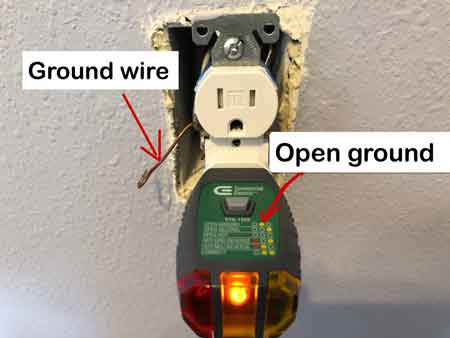
Most three-prong wall receptacles only provide real protection when the protective grounding path behind them is intact; an open ground electrical outlet means the third prong is not connected to the building’s bonded earth reference, leaving fault current without a safe return path and increasing the risk of shock and equipment damage.
An open ground electrical outlet is easy to dismiss because the devices plugged into it often appear to work normally. Lights turn on. Devices power up. There’s no obvious failure. That surface normalcy is precisely what makes the condition dangerous. Protective grounding exists for abnormal conditions, not routine operation, and an open ground removes the very safeguard intended to activate when something goes wrong.
In a properly bonded system, exposed metal parts of equipment are tied back to the grounding system reference so that a fault immediately creates a low-impedance return path. That path allows protective devices to operate quickly. When the protective conductor is missing or discontinuous, fault current may still exist, but it has nowhere to go. The risk doesn’t announce itself until the moment it matters.
For readers who want a broader grounding foundation before going deeper, understanding electrical grounding provides that context.
Despite how it’s commonly interpreted, “open ground” does not mean the outlet is floating in the air or disconnected from the building entirely. It means the equipment grounding conductor is missing, broken, or not bonded to the protective reference system in a way that can safely conduct fault current.

This distinction matters. The hot and neutral conductors may still be intact, allowing current to flow normally under load. That’s why appliances still operate. What’s missing is the protective return conductor that exists solely for abnormal conditions.
This is where confusion often arises between neutral and ground. Neutral is designed to carry return current during normal circuit operation. The safety reference conductor is not. If you need clarity on that separation, the electrical neutral vs ground article explains why the two conductors serve fundamentally different roles.
Open grounds are especially common in older structures where equipment grounding conductors were not required when the wiring was installed. In those cases, later renovations sometimes replaced two-slot receptacles with three-slot devices without adding a protective conductor. The outlet looks modern, but the safety function was never introduced.
Open grounds also occur in newer systems due to loose connections, interrupted protective conductors, or improper bonding at junction boxes or panels. A conductor that exists physically but lacks continuity back to the earth reference point is functionally no different from one that was never installed.
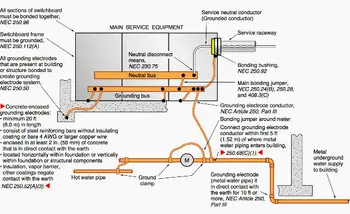
Understanding how these conductors are intended to terminate and bond helps clarify why continuity matters. grounding electrode conductor explains how protective paths ultimately connect back to the earth reference.
The most serious issue with an open ground condition is that it fails silently. There is no warning until a fault occurs. At that point, metal enclosures that should have remained at earth potential may become energized. Shock risk increases sharply, and protective devices may not operate as intended.
Equipment damage is another overlooked consequence. Many protective devices, surge suppressors, and filters rely on a functioning grounding reference to divert transient energy. Without it, that energy can remain within the equipment, degrading components over time.
Grounding exists to control where energy goes when systems stop behaving normally. electrical grounding addresses this protective role in greater depth.
Simple plug-in testers are often the first indication of an open ground, but they don’t explain why the condition exists or where the break occurs. They detect the absence of continuity, not overall system integrity. In some cases, wiring errors can even mask deeper bonding problems that only become visible under fault conditions.
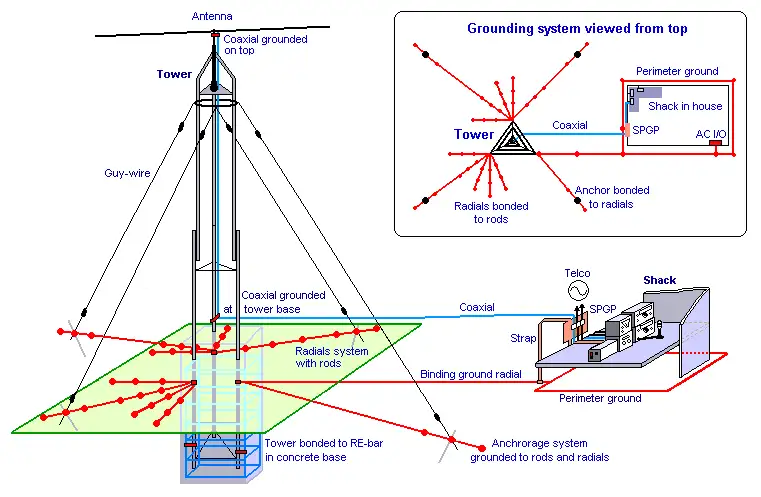
This is why grounding should be understood as a system, not a single wire. grounding system describes how conductors, electrodes, and bonding paths work together rather than independently.
Open grounds are frequently discussed without mentioning bonding, yet the two are inseparable. Bonding ensures that all conductive parts remain at the same electrical potential so that grounding can function predictably. When bonding is incomplete or compromised, protective reference effectiveness collapses even if a conductor is present.
For readers who want to understand how these functions interact rather than treating them as separate ideas, grounding and bonding offer a clearer picture.
An open ground electrical outlet is not automatically an emergency, but it is always a signal. It reveals something about the age, condition, or integrity of the electrical system. Whether that signal requires action depends on context: location, usage, connected equipment, and exposure risk.
Download our FREE Electrical Training Catalog and explore a full range of expert-led electrical training courses.

What matters most is recognizing that protective grounding is not decorative. A three-prong outlet without a functioning reference path is not “mostly safe.” It is incomplete by design. Treating it as a minor nuisance rather than a system indicator is how preventable hazards persist unnoticed.
If you want to extend this topic without repeating it, the following pages add depth rather than redundancy:
Advantages To Instructor-Led Training – Instructor-Led Course, Customized Training, Multiple Locations, Economical, CEU Credits, Course Discounts.
Request For QuotationWhether you would prefer Live Online or In-Person instruction, our electrical training courses can be tailored to meet your company's specific requirements and delivered to your employees in one location or at various locations.