By yukfyukyui
Protective Relay Training - Basic
Our customized live online or in‑person group training can be delivered to your staff at your location.
- Live Online
- 12 hours Instructor-led
- Group Training Available
By yukfyukyui
Our customized live online or in‑person group training can be delivered to your staff at your location.
Baltimore Substation Attack Plot highlights alleged neo-Nazi plans targeting electrical substations and the power grid, as FBI and DHS warn of domestic extremism threats to critical infrastructure, with arrests in Maryland disrupting potential sniper attacks.
An alleged extremist plot to disable Baltimore's power grid by shooting substations, thwarted by federal arrests.
✅ Two suspects charged in Maryland conspiracy
✅ Targets included five substations around Baltimore
✅ FBI cites domestic extremism threat to infrastructure
A neo-Nazi in Florida and a Maryland woman conspired to attack several electrical substations in the Baltimore area, federal officials say.
Sarah Beth Clendaniel and Brandon Clint Russell were arrested and charged in a conspiracy to disable the power grid by shooting out substations via "sniper attacks," according to a criminal complaint from the U.S. Attorney's Office for the District of Maryland.
Clendaniel allegedly said she wanted to "completely destroy this whole city" and was planning to target five substations situated in a "ring" around Baltimore, the complaint said. Russell is part of a violent extremist group that has cells in multiple states, and he previously planned to attack critical infrastructure in Florida, the complaint said.
"This planned attack threatened lives and would have left thousands of Marylanders in the cold and dark," Maryland U.S. Attorney Erek Barron said in a press release. "We are united and committed to using every legal means necessary to disrupt violence, including hate-fueled attacks."
The news comes as concerns grow about an increase in targeted substation attacks on U.S. substations tied to domestic extremism.
What to know about substation attacks
Federal data shows vandalism and suspicious activities at electrical facilities soared nationwide last year, and cyber actors have accessed utilities' control rooms as well.
At the end of the year, attacks or potential attacks were reported on more than a dozen substations and one power plant across five states, and Symantec documented Russia-linked Dragonfly activity targeting the energy sector earlier. Several involved firearms.
In December, targeted attacks on substations in North Carolina left tens of thousands without power amid freezing temperatures, spurring renewed focus on protecting the U.S. power grid among officials. The FBI is investigating.
Vandalism at facilities in Washington left more than 21,000 without electricity on Christmas Day, even as hackers breached power-plant systems in other states. Two men were arrested, and one told police he planned to disrupt power to commit a burglary.
The Department of Homeland Security last year said domestic extremists had been developing "credible, specific plans" since at least 2020 and would continue to "encourage physical attacks against electrical infrastructure," and the U.S. government has condemned Russia for power grid hacking as well.
Last February, three neo-Nazis pleaded guilty to federal crimes related to a scheme to attack the grid with rifles, with each targeting a substation in a different region of the U.S., even as reports that Russians hacked into US electric utilities drew widespread attention.
Site C Dam Court Ruling could halt hydroelectric project near Fort St. John, as First Nations cite Treaty 8 rights in B.C. Supreme Court against BC Hydro, reservoir flooding, and Peace River Valley impacts.
Potential B.C. Supreme Court stop to Site C, grounded in Treaty 8 rights claims by First Nations against BC Hydro.
✅ Trial expected in 2022 before planned 2023 reservoir flooding
✅ Treaty 8 rights and Peace River Valley impacts at issue
✅ Talks ongoing among B.C., BC Hydro, West Moberly, Prophet River
The Site C dam could still be stopped by an "eleventh hour" court ruling, according to the lawyer representing B.C. First Nations opposed to the massive hydroelectric project near Fort St. John.
The B.C. government, BC Hydro and West Moberly and Prophet River First Nations were in B.C. Supreme Court Feb. 28 to set a 120-day trial, expected to begin in March 2022.
That date means a ruling would come prior to the scheduled flooding of the dam's reservoir area in 2023 said Tim Thielmann, legal counsel for the West Moberly First Nation.
"The court has left itself the opportunity for an eleventh hour cancellation of the project," he said.
Construction continues
At the core of the case is First Nations arguments the multi-billion dollar BC Hydro dam will cause irreparable harm to its territory and way of life — even as drought strains hydro production elsewhere — rights protected under Treaty 8.
The West Moberly have previously warned it believes Site C constitutes a $1 billion treaty violation.
In 2018, the First Nations lost a bid for an injunction order, meaning construction of the dam is continuing despite warnings that delays could cost $600 million to the project.
First Nations 'deeply frustrated' after B.C. Supreme Court dismisses Site C injunction
The judge in the case said the ruling was made because if the First Nations lost the challenge, the project would be needlessly put into disarray.
Province, Nations enter talks to avoid litigation
Also this week the B.C. government announced it has entered into talks with BC Hydro and the two First Nations in an attempt to avoid the court process altogether, amid broader energy debates such as bridging the Alberta-B.C. electricity gap for climate goals.
Thielmann said the details of the talk are confidential, but his clients are willing to pursue all avenues in order to stop the dam from moving forward.
"They are trying to save what little is left [of the Peace River Valley]", he said.
Tim Thielmann of Sage Legal is representing the West Moberly First Nation in its lawsuit aimed at stopping Site C. (Sage Legal)
In the meantime, the parties will continue to prepare for the 2022 court dates.
The latest figure on the cost of the dam is $10.7 billion, in a billions-over-budget project that the premier says will proceed. When complete, it would power the equivalent of 450,000 homes a year, though use of Site C's electricity remains a point of debate.
Pickering Nuclear Generating Station Refurbishment will enable OPG to deliver reliable, clean electricity in Ontario, cut CO2 emissions, support jobs, boost Cobalt-60 medical isotopes supply, and proceed under CNSC oversight alongside small modular reactor leadership.
A plan to assess and renew Pickering's B units, extending safe, clean, low-cost power in Ontario for up to 30 years.
✅ Extends zero-emissions baseload by up to 30 years
✅ Requires CNSC approval and rigorous safety oversight
✅ Supports Ontario jobs and Cobalt-60 isotope production
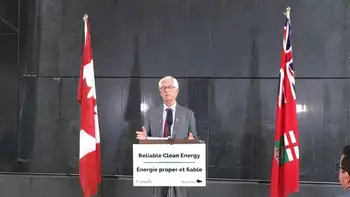
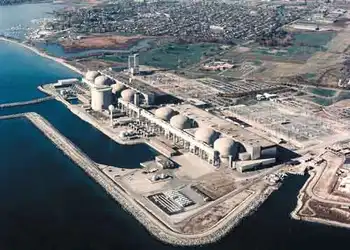
The Ontario government is supporting Ontario Power Generation’s (OPG) continued safe operation of the Pickering Nuclear Generating Station. At the Ontario government’s request, as a formal extension request deadline approaches, OPG reviewed their operational plans and concluded that the facility could continue to safely generate electricity.
“Keeping Pickering safely operating will provide clean, low-cost, and reliable electricity to support the incredible economic growth and new jobs we’re seeing, while building a healthier Ontario for everyone,” said Todd Smith, Minister of Energy. “Nuclear power has been the safe and reliable backbone of Ontario’s electricity system since the 1970s and our government is working to secure that legacy for the future. Our leadership on Small Modular Reactors and consideration of a refurbishment of Pickering Nuclear Generating Station are critical steps on that path.”
Maintaining operations of Pickering Nuclear Generation Station will also protect good-paying jobs for thousands of workers in the region and across the province. OPG, which reported 2016 financial results that provide context for its operations, employs approximately 4,500 staff to support ongoing operation at its Pickering Nuclear Generating Station. In total, there are about 7,500 jobs across Ontario related to the Pickering Nuclear Generating Station.
Further operation of Pickering Nuclear Generating Station beyond September 2026 would require a complete refurbishment. The last feasibility study was conducted between 2006 and 2009. With significant economic growth and increasing electrification of industry and transportation, and a growing electricity supply gap across the province, Ontario has asked OPG to update its feasibility assessment for refurbishing Pickering “B” units at the Nuclear Generating Station, based on the latest information, as a prudent due diligence measure to support future electricity planning decisions. Refurbishment of Pickering Nuclear Generating Station could result in an additional 30 years of reliable, clean and zero-emissions electricity from the facility.
“Pickering Nuclear Generating Station has never been stronger in terms of both safety and performance,” said Ken Hartwick, OPG President and CEO. “Due to ongoing investments and the efforts of highly skilled and dedicated employees, Pickering can continue to safely and reliably produce the clean electricity Ontarians need.”
Keeping Pickering Nuclear Generating Station operational would ensure Ontario has reliable, clean, and low-cost energy, even as planning for clean energy when Pickering closes continues across the system, while reducing CO2 emissions by 2.1 megatonnes in 2026. This represents an approximate 20 per cent reduction in projected emissions from the electricity sector in that year, which is the equivalent of taking up to 643,000 cars off the road annually. It would also increase North America’s supply of Cobalt-60, a medical isotope used in cancer treatments and medical equipment sterilization, by about 10 to 20 per cent.
OPG requires approval from the Canadian Nuclear Safety Commission (CNSC) for its revised schedule. The CNSC, which employs a rigorous and transparent decision-making process, will make the final decision regarding Pickering’s safe operating life, even though the station was slated to close as planned earlier. OPG will continue to ensure the safety of the Pickering facility through rigorous monitoring, inspections, and testing.
OSW CareerMatch Offshore Wind Job Fair convenes industry leaders, supply chain employers, and skilled candidates at IPF 2020 in Providence, Rhode Island, spotlighting workforce development, training programs, and near-term hiring for U.S. offshore wind projects.
An IPF 2020 job fair connecting offshore wind employers, advancing workforce development in Providence, RI.
✅ National job fair at IPF 2020, Providence, RI
✅ Connects supply chain employers with skilled candidates
✅ Includes a workforce development and education summit
The Business Network for Offshore Wind, the leading non-profit advocate for U.S. offshore wind at the state, federal and global levels, amid a U.S. grid warning about coronavirus impacts, will host its seventh annual International Partnership Forum (IPF) on April 21-24, 2020 in Providence, Rhode Island.
New this year: the first-ever national offshore wind industry job fair plus a half-day workforce development summit, in partnership with Skills for Rhode Island’s Future. The OSW CareerMatch, will showcase jobs at top-tier companies seeking to grow the workforce of the future, informed by young people's interest in electricity careers, and recruit qualified candidates. The Offshore Wind Workforce Development and Education Summit, an invitation-only event, will bring together educators, stakeholders, and industry leaders to address current energy training programs, identify industry employment needs, required skillsets, and how organizations can fulfill these near-term needs. CareerMatch will take place 8:30 a.m. to 1:00 p.m. on Tuesday, April 21, and the Workforce Summit from 12:30 p.m. to 4:00 p.m., both at the Rhode Island Convention Center.
“The U.S. offshore wind industry has reached the stage that, in order to successfully develop and meet new project demands, will require an available and qualified workforce,” said Liz Burdock, CEO and president of the Business Network for Offshore Wind, noting worker safety concerns in other energy sectors. “This first-ever national Job Fair will allow top-tier supply chain companies to connect with skilled individuals to discuss projects that are going on as they speak.”
“Hosting the first-of-its-kind offshore wind energy job fair in The Ocean State is apropos,” said Nina Pande, executive director of Skills for Rhode Island’s Future, as future of work investments accelerate across the electricity sector. “Our organization is thrilled to have the unique opportunity to help convene talent at OSW CareerMatch to engage with the employers across the offshore wind supply chain.”
The annual IPF conference is the premier event for the offshore wind supply chain, which is now projected to be a $70 billion revenue opportunity through 2030. Fully developing this supply chain will foster local economic growth, provide thousands of jobs, adapt to shifts like working from home electricity demand, and help offshore wind energy meet its potential. If fully built out worldwide, offshore wind could power 18 times the world’s current electricity needs.
The exhibit and conference sells out every year and is again on track to draw over 2,500 industry professionals representing over 575 companies, all focused on sharing valuable insights on how to move the emerging U.S. wind industry forward, including operational resilience such as on-site staffing plans during the outbreak. The full conference schedule may be seen online here. More details, including special guest speakers, will be announced soon.
Atlantic Canada EV adoption lags, a new poll finds, as fewer buyers consider electric vehicles amid limited charging infrastructure, lower provincial rebates, and affordability pressures in Nova Scotia and Newfoundland compared to B.C. and Quebec.
Atlantic Canada EV adoption reflects demand, shaped by rebates, charging access, costs, and the regional energy mix.
✅ Poll shows lowest purchase intent in Atlantic Canada
✅ Lack of rebates and charging slows EV consideration
✅ Income and energy mix affect affordability and benefits
Atlantic Canadians are the least likely to buy a car, truck or SUV in the next year and the most skittish about going electric, according to a new poll.
Only 31 per cent of Nova Scotians are looking at buying a new or used vehicle before December 2021 rolls around. And just 13 per cent of Newfoundlanders who are planning to buy are considering an electric vehicle. Both those numbers are the lowest in the country. Still, 47 per cent of Nova Scotians considering buying in the next year are thinking about electric options, according to the numbers gathered online by Logit Group and analyzed by Halifax-based Narrative Research. That compares to 41 per cent of Canadians contemplating a vehicle purchase within the next year, with 54 per cent of them considering going electric.
“There’s still a high level of interest,” said Margaret Chapman, chief operating officer at Narrative Research.
“I think half of people who are thinking about buying a vehicle thinking about electric is pretty significant. But I think it’s a little lower in Atlantic Canada compared to other parts of the country probably because the infrastructure isn’t quite what it might be elsewhere. And I think also it’s the availability of vehicles as well. Maybe it just hasn’t quite caught on here to the extent that it might have in, say, Ontario or B.C., where the highest level of interest is.”
Provincial rebates
Provincial rebates also serve to create more interest, she said, citing New Brunswick's rebate program as an example in the region.
“There’s a $7,500 rebate on top of the $5,000 you get from the feds in B.C. But in Nova Scotia there’s no provincial rebate,” Chapman said. “So I think that kind of thing actually is significant in whether you’re interested in buying an electric vehicle or not.”
The survey was conducted online Nov. 11–13 with 1,231 Canadian adults.
Of the people across Canada who said they were not considering an electric vehicle purchase, 55 per cent said a provincial rebate would make them more likely to consider one, she said.
In Nova Scotia, that number drops to 43 per cent.
Nova Scotia families have the lowest median after-tax income in the country, according to numbers released earlier this year.
The national median in 2018 was $61,400, according to Statistics Canada. Nova Scotia was at the bottom of the pack with $52,200, up from $51,400 in 2017.
So big price tags on electric vehicles might put them out of reach for many Nova Scotians, and a recent cost-focused survey found similar concerns nationwide.
“I think it’s probably that combination of cost and infrastructure,” Chapman said.
“But you saw this week in the financial update from the federal government that they’re putting $150 million into new charging station, so were some of that cash to be spread in Atlantic Canada, I’m sure there would be an increase in interest … The more charging stations around you see, you think ‘Alright, it might not be so hard to ensure that I don’t run out of power for my car.’ All of that stuff I think will start to pick up. But right now it is a little bit lagging in Atlantic Canada, and in Labrador infrastructure still lags despite a government push in N.L. to expand EVs.”
'Simple dollars and cents'
The lack of a provincial government rebate here for electric vehicles definitely factors into the equation, said Sean O’Regan, president and chief executive officer of O'Regan's Automotive Group.
“Where you see the highest adoption are in the provinces where there are large government rebates,” he said. “It’s a simple dollars and cents (thing). In Quebec, when you combine the rebates it’s up to over $10,000, if not $12,000, towards the car. If you can get that kind of a rebate on a car, I don’t know that it would matter much what it was – it would help sell it.”
A lot of people who want to buy electric cars are trying to make a conscious decision about the environment, O’Regan said.
While Nova Scotia Power is moving towards renewable energy, he points out that much of our electricity still comes from burning coal and other fossil fuels, and N.L. lags in energy efficiency as the region works to improve.
“So the power that you get is not necessarily the cleanest of power,” O’Regan said. “The green advantage is not the same (in Nova Scotia as it is in provinces that produce a lot of hydro power).”
Compared to five years ago, the charging infrastructure here is a lot better, he said. But it doesn’t compare well to provinces including Quebec and B.C., though Newfoundland recently completed its first fast-charging network for electric car owners.
“Certainly (with) electric cars – we're selling more and more and more of them,” O'Regan said, noting the per centage would be in the single digits of his overall sales. “But you're starting from zero a few years ago.”
The highest number of people looking at buying electric cars was in B.C., with 57 per cent of those looking at buying a car saying they’d go electric, and even in southern Alberta interest is growing; like Bob Dylan in 1965 at the Newport Folk Festival.
“The trends move from west to east across Canada,” said Jeff Farwell, chief executive officer of the All EV Canada electric car store in Burnside.
“I would use the example of the craft beer market. It started in B.C. about 15 years before it finally went crazy in Nova Scotia. And if you look at Vancouver right now there’s (electric vehicles) everywhere.”
Expectations high
Farwell expects electric vehicle sales to take off faster in Atlantic Canada than the craft beer market. “A lot faster.”
His company also sells used electric vehicles in Prince Edward Island and is making moves to set up in Moncton, N.B.
He’s been talking to Nova Scotia’s Department of Energy and Mines about creating rebates here for new and used electric vehicles.
“I guess they’re interested, but nothing’s happened,” Farwell said.
Electric vehicles require “a bit of a lifestyle change,” he said.
“The misconception is it takes a lot longer to charge a vehicle if it’s electric and gas only takes me 10 minutes to fill up at the gas station,” Farwell said.
“The reality is when I go home at night, I plug my vehicle in,” he said. “I get up in the morning and I unplug it and I never have to think about it. It takes two seconds.”
UK Nuclear Energy Ten Point Plan outlines support for large reactors, SMRs, and AMRs, funding Sizewell C, hydrogen production, and industrial heat to reach net zero, decarbonize transport and heating, and expand clean electricity capacity.
A UK plan backing large, small, and advanced reactors to drive net zero via clean power, hydrogen, and industrial heat.
✅ Funds large plants (e.g., Sizewell C) under value-for-money models
✅ Invests in SMRs for factory-built, modular, lower-cost deployment
✅ Backs AMRs for high-temperature heat, hydrogen, and industry
The UK government has just announced its “Ten Point Plan for a Green Industrial Revolution”, in which it lays out a vision for the future of energy, transport and nature in the UK. As researchers into nuclear energy, my colleagues and I were pleased to see the plan is rather favourable to new nuclear power.
It follows the advice from the UK’s Nuclear Innovation and Research Advisory Board, pledging to pursue large power plants based on current technology, and following that up with financial support for two further waves of reactor technology (“small” and “advanced” modular reactors).
This support is an important part of the plan to reach net-zero emissions by 2050, as in the years to come nuclear power will be crucial to decarbonising not just the electricity supply but the whole of society.
This chart helps illustrate the extent of the challenge faced:
Electricity generation is only responsible for a small percentage of UK emissions. William Bodel. Data: UK Climate Change Committee
Efforts to reduce emissions have so far only partially decarbonised the electricity generation sector. Reaching net zero will require immense effort to also decarbonise heating, transport, as well as shipping and aviation. The plan proposes investment in hydrogen production and electric vehicles to address these three areas – which will require, as advocates of nuclear beyond electricity argue, a lot more energy generation.
Nuclear is well-placed to provide a proportion of this energy. Reaching net zero will be a huge challenge, and industry leaders warn it may be unachievable without nuclear energy. So here’s what the announcement means for the three “waves” of nuclear power.
Who will pay for it?
But first a word on financing. To understand the strategy, it is important to realise that the reason there has been so little new activity in the UK’s nuclear sector since the 1990s is due to difficulty in financing. Nuclear plants are cheap to fuel and operate and last for a long time. In theory, this offsets the enormous upfront capital cost, and results in competitively priced electricity overall.
But ever since the electricity sector was privatised, governments have been averse to spending public money on power plants. This, combined with resulting higher borrowing costs and cheaper alternatives (gas power), has meant that in practice nuclear has been sidelined for two decades. While climate change offers an opportunity for a revival, these financial concerns remain.
Large nuclear
Hinkley Point C is a large nuclear station currently under construction in Somerset, England. The project is well-advanced, with its first reactor installed and due to come online in the middle of this decade. While the plant will provide around 7% of current UK electricity demand, its agreed electricity price is relatively expensive.
Under construction: Hinkley Point C. Ben Birchall/PA
The government’s new plan states: “We are pursuing large-scale new nuclear projects, subject to value-for-money.” This is likely a reference to the proposed Sizewell C in Suffolk, on which a final decision is expected soon. Sizewell C would be a copy of the Hinkley plant – building follow-up identical reactors achieves capital cost reductions, and setbacks at Hinkley Point C have sharpened delivery focus as an alternative funding model will likely be implemented to reduce financing costs.
Other potential nuclear sites such as Wylfa and Moorside (shelved in 2018 and 2019 respectively for financial reasons) are also not mentioned, their futures presumably also covered by the “subject to value-for-money” clause.
Small nuclear
The next generation of nuclear technology, with various designs under development worldwide are smaller, cheaper, safer Small Modular Reactors (SMRs), such as the Rolls Royce “UK SMR”.
Reactors small enough to be manufactured in factories and delivered as modules can be assembled on site in much shorter times than larger designs, which in contrast are constructed mostly on site. In so doing, the capital costs per unit (and therefore borrowing costs) could be significantly lower than current new-builds.
The plan states “up to £215 million” will be made available for SMRs, Phase 2 of which will begin next year, with anticipated delivery of units around a decade from now.
Advanced nuclear
The third proposed wave of nuclear will be the Advanced Modular Reactors (AMRs). These are truly innovative technologies, with a wide range of benefits over present designs and, like the small reactors, they are modular to keep prices down.
Crucially, advanced reactors operate at much higher temperatures – some promise in excess of 750°C compared to around 300°C in current reactors. This is important as that heat can be used in industrial processes which require high temperatures, such as ceramics, which they currently get through electrical heating or by directly burning fossil fuels. If those ceramics factories could instead use heat from AMRs placed nearby, it would reduce CO₂ emissions from industry (see chart above).
High temperatures can also be used to generate hydrogen, which the government’s plan recognises has the potential to replace natural gas in heating and eventually also in pioneering zero-emission vehicles, ships and aircraft. Most hydrogen is produced from natural gas, with the downside of generating CO₂ in the process. A carbon-free alternative involves splitting water using electricity (electrolysis), though this is rather inefficient. More efficient methods which require high temperatures are yet to achieve commercialisation, however if realised, this would make high temperature nuclear particularly useful.
The government is committing “up to £170 million” for AMR research, and specifies a target for a demonstrator plant by the early 2030s. The most promising candidate is likely a High Temperature Gas-cooled Reactor which is possible, if ambitious, over this timescale. The Chinese currently lead the way with this technology, and their version of this reactor concept is expected soon.
In summary, the plan is welcome news for the nuclear sector, even as Europe loses nuclear capacity across the continent. While it lacks some specifics, these may be detailed in the government’s upcoming Energy White Paper. The advice to government has been acknowledged, and the sums of money mentioned throughout are significant enough to really get started on the necessary research and development.
Achieving net zero is a vast undertaking, and recognising that nuclear can make a substantial contribution if properly supported is an important step towards hitting that target.
Stay informed with our FREE Newsletter — get the latest news, breakthrough technologies, and expert insights, delivered straight to your inbox.
Explore 50+ live, expert-led electrical training courses –