Electrical Ground Wire Color Codes
By Frank Baker, Technical Editor
By Frank Baker, Technical Editor

Our customized live online or in‑person group training can be delivered to your staff at your location.
Request for Quotation Service

Buyers Submit Free RFQs to top suppliers, no obligation.
Suppliers Browse real project RFQs directly from buyers.
Trust Electricity Forum 40 years connection buyers and suppliers.
In US residential and commercial wiring, the electrical ground wire color is green, green with a yellow stripe, or bare copper, per NEC rules, indicating the safety ground path and contrasting with the neutral and hot conductor colors.
Electrical wiring depends on visual clarity as much as it does on correct connections. In US residential and commercial systems, conductor color is one of the fastest ways to understand how a circuit is intended to behave. When that color language is misread or misunderstood, the risk is not theoretical. It shows up as miswired devices, nuisance faults, and systems that fail under conditions they were supposed to tolerate.
The electrical ground wire color exists to prevent that kind of ambiguity. Under NEC conventions, the grounding conductor is immediately recognizable as green, green with a yellow stripe, or bare copper, marking its role as the safety path rather than a current-carrying conductor under normal operation.
Understanding why this distinction matters begins with a broader view of how grounding functions in a system, which is explored in more depth in understanding electrical grounding.
Unlike energized conductors, the ground wire is not intended to carry current during normal operation. Its purpose is to remain electrically quiet until a fault occurs, at which point it provides a low-impedance path back to the source so protective devices can operate correctly. Giving this conductor a dedicated color prevents it from being mistaken for a neutral or repurposed as a live conductor.
This distinction becomes clearer when compared directly to the neutral, which may carry current continuously and is bonded differently within the system, a relationship explained in electrical neutral vs ground.
Download our FREE Electrical Training Catalog and explore a full range of expert-led electrical training courses.

In the United States, the NEC permits the equipment grounding conductor to be bare, covered, or insulated. When insulated, it must be green or green with one or more yellow stripes. These colors are reserved exclusively for grounding and cannot be used for any other conductor function.
Bare copper grounding conductors are common in nonmetallic sheathed cable assemblies, while green insulation is more frequently seen in conduit systems where conductors are pulled individually. Both serve the same role within the grounding system described in electrical grounding.
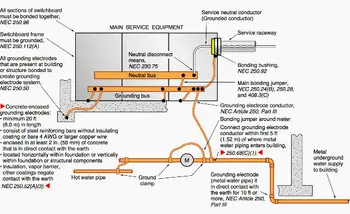
Color conventions apply most directly to the equipment grounding conductor that runs with branch-circuit and feeder conductors. The grounding electrode conductor, which connects the system to earth through rods, plates, or grids, may not always be color-coded consistently, even though its function is related.
That distinction is important in larger systems and service equipment, where conductor roles are clarified by both routing and termination, as outlined in grounding electrode conductor.
Misidentifying a grounding conductor as a neutral or vice versa can defeat protective devices and introduce circulating currents where none should exist. Color conventions serve as a visual control against such errors, especially during maintenance, renovations, or troubleshooting when the original installers are no longer involved.
This is closely tied to the broader discipline of grounding and bonding, where conductor identification supports the prediction of fault behavior and system stability.
Inside panels, enclosures, and equipment, the ground wire color continues to serve as a reference point. Green or bare conductors terminate on grounding bars, while white or gray conductors land on neutral bars, reinforcing separation even when conductors converge in tight spaces.
That physical separation reflects the structure of the overall grounding system, where each conductor has a defined role rather than a shared function.
Although color is a primary identifier, it is not the only one. Marking, routing, and termination practices also matter, particularly in industrial or modified installations. Still, the NEC color rules establish a baseline that allows professionals to interpret systems quickly and accurately.
Misinterpretations at outlets, for example, often trace back to grounding identification errors rather than device failure, a problem discussed in open ground electrical outlet.
Electrical ground wire color is not cosmetic or optional. It is a safety language that allows complex systems to be understood at a glance. When followed consistently, it reduces ambiguity, supports fault clearing, and preserves the intent of the original design long after installation.
That clarity is one of the reasons NEC grounding requirements remain foundational to US wiring practice, even as systems grow more complex.
Think you know Power Quality? Take our quick, interactive quiz and test your knowledge in minutes.
Advantages To Instructor-Led Training – Instructor-Led Course, Customized Training, Multiple Locations, Economical, CEU Credits, Course Discounts.
Request For QuotationWhether you would prefer Live Online or In-Person instruction, our electrical training courses can be tailored to meet your company's specific requirements and delivered to your employees in one location or at various locations.