By -- Source, Reuters


NFPA 70b Training - Electrical Maintenance

Our customized live online or in‑person group training can be delivered to your staff at your location.

  • Live Online
  • 12 hours Instructor-led
  • Group Training Available
Regular Price:
$699
Coupon Price:
$599
Reserve Your Seat Today
NEW YORK - Standard & Poor's today said the opening of the Ontario electricity industry to wholesale and retail competition effective May 1, 2002, will have no immediate impact on current credit ratings. Standard & Poor's analysis has taken into consideration the expected effect of competitive pressures on the various affected electric utilities. Standard & Poor's will, however, continue to monitor the evolution of electricity deregulation and the development of competitive pressures in the Ontario market.

After two false starts in 1999 and 2000, the Ontario electricity industry opened for competition. Trading proceeded in an orderly manner, and peak spot prices remained within the anticipated range for the off-peak spring season. All electricity consumers in the province, except for those serviced by 21 local distribution companies that were not "market ready" (or 5% of Ontario retail customers), can now choose their electricity supplier.

Local distribution companies such as Hamilton Utilities Corp. (A+/Stable/--) and Hydro Ottawa Holdings Inc (A/Stable--), who have intentionally chosen not to participate in retail energy marketing, will be unaffected by market pricing pressures. Regulation presently allows for the full and timely flow through of power costs associated with providing power to standard supply customers, or customers who have not chosen a retail energy provider. Hydro One Inc. (A/Stable/A-1) will be similarly unaffected, as it has recently announced the sale of its energy marketing operations.

Local distribution companies such as Toronto Hydro Corp. (A/Positive/--) and Enersource Corp. (Borealis-Enersource series bonds issued by Borealis Infrastructure Trust rated single-'A'-plus), which are actively involved in retail energy marketing, as well as Alberta-based Epcor Utilities Inc. (A-/Stable/--), which recently acquired Hydro One's Ontario energy services operations, will be subject to both market price and volume risks. Standard & Poor's will continue to closely monitor the ratings on these companies, and, in particular, the mix of higher risk unregulated businesses versus the lower risk regulated wires operations.

The rating on Ontario Power Generation Inc (BBB+/Stable/--) also reflects the risks associated with a competitive market environment, as well as the challenges the company faces relating to a major nuclear refurbishment presently under way.

Related News

Egypt's renewable energy to reach 6.6 GW by year-end

Egypt Renewable Energy Expansion targets solar and wind power projects to diversify the energy mix, adding 6.6 GW by 2020 and reaching 8,200 MW, with UK cooperation, grid upgrades, and investment in the electricity sector.


Key Points

A plan to boost solar and wind by 6.6 GW by 2020, reaching 8,200 MW and diversifying Egypt's energy mix.

✅ Adds 6.6 GW by 2020; targets 8,200 MW total capacity

✅ Focus on solar, wind, grid upgrades, and investment

✅ UK-Egypt cooperation in electricity sector projects


Egypt is planning to expand into renewable energy projects in a bid to increase its contribution to the energy mix, in step with global records being set in renewables, and amid Saudi Arabia’s 60 GW drive in the region, the country’s minister of electricity and renewable energy Mohamed Shaker said.

Renewable power is expected to add 6.6 gigawatts (GW) by the end of 2020, a scale comparable to Saudi wind expansion underway, with plans to reach 8,200 megawatts (MW) after the completion of the renewable energy projects currently under consideration, reflecting gains seen since IRENA’s 2016 record year for renewables, Shaker added in a statement on Tuesday, even as regional challenges persist.

This came during the minister’s video-conference meeting with the British ambassador to Egypt Geoffrey Adams to explore the potential means for cooperation between the two countries in the electricity sector, including lessons from the UK project backlog now affecting investments and from Ireland’s green-electricity goals being pursued.


Related News

View more

Tunisia moves ahead with smart electricity grid

Tunisia Smart Grid Project advances with an AFD loan as STEG deploys smart meters in Sfax, upgrades grid infrastructure, boosts energy efficiency, curbs losses, and integrates renewable energy through digitalization and advanced communication systems.


Key Points

A national program funded by an AFD $131.7M loan to modernize STEG, deploy smart meters, and integrate renewable energy.

✅ 430,000 smart meters in Sfax during phase one

✅ 20-year AFD loan with 7-year grace period

✅ Cuts losses, improves efficiency, enables renewables


The Tunisian parliament has approved taking a $131.7 million loan from the French Development Agency for the implementation of a smart grid project.

Parliament passed legislation regarding the 400 million dinar ($131.7 million) loan plus a grant of $1.1 million.

The loan, to be repaid over 20 years with a grace period of up to 7 years, is part of the Tunisian government’s efforts to establish a strategy of energy switching aimed at reducing costs and enhancing operational efficiency.

The move to the smart grid had been postponed after the Tunisian Company of Electricity and Gas (STEG) announced in March 2017 that implementation of the first phase of the project would begin in early 2018 and cover the entire country by 2023.

STEG was to have received funding some time ago. Last year at the Africa Smart Grid Summit in Tunis, the company said it would initiate an international tender during the first quarter of 2019 to start the project.

The French funding is to be allocated to implementation of the first phase only, which will involve development of control and communication stations and the improvement of infrastructure, where regulatory outcomes such as the Hydro One T&D rates decision can influence investment planning in comparable markets.

It includes installation of 430,000 “intelligent” metres over three years in Sfax governorate in southern Tunisia. The second phase of the project is planned to extend the programme to the rest of the country.

Smart metres to be installed in homes and businesses in Sfax account for about 10% of the total number of metres to be deployed in Tunisia.

At the beginning of 2017, the Industrial Company of Metallic Articles (SIAM), a Tunisian industrial electrical equipment and machinery company, signed an agreement with Huawei for the Chinese company to supply smart electricity metres. The value of the deal was not disclosed.

The smart grid is designed to reduce power waste, reduce the number of unpaid bills, prevent consumer fraud such as power theft in India across distribution networks, improve the ecosystem and increase competitiveness in the electricity sector.

Experts said the main difference between the traditional and smart grids is the adoption of advanced infrastructure for measuring electricity consumption and for communication between the power plant and consumers. The data exchange allows power plants to coordinate electricity production with actual demand.

STEG previously indicated that it had implemented measures to ensure the transition to the smart grid, especially since digitalisation is playing an important role in the energy sector.

The project, which translates Tunisia’s energy plans in the form of a partnership between the public and private sectors, aims at reaching 30% of the country’s electricity need from renewable sources by 2025, even as entities like the TVA face climate goals scrutiny that can affect electricity rates in other markets.

The development of the smart grid will allow STEG to monitor consumption patterns, detect abuses and remotely monitor the grid’s power supply, at a time when regulators have questioned UK network profits to spur efficiency, underscoring the value of transparency.

“The smart grid will change the face of the energy system towards the use of renewable energies,” said Tunisian Industry Minister Slim Feriani. At the forum on alternative energies, he pointed out that energy sector digitisation requires investments in technology and a change in the consumption mentality, as new entrants consider roles like Tesla electricity retailer plans in advanced markets.

Official data indicate that Tunisia’s energy deficit accounts for one-third of the country’s annual trade deficit, which reached record levels of more than $6 billion last year.

STEG, whose debts have reached $329 million over the past eight years, a situation resembling Manitoba Hydro debt pressures in Canada, has not disclosed when and how funding would be secured for the completion of the second phase. The company insists it is working to prevent further losses and to collect its unpaid bills.

STEG CEO Moncef Harrabi, earlier this year, said: “The current situation of the company has forced us to take immediate action to reduce the worsening of the crisis and stop the financial bleeding caused by losses.”

He said the company had repeatedly asked the government to pay subsidy instalments due to the company and to enact binding decisions to force government institutions and departments to pay electricity bills, while elsewhere measures like Thailand power bill cuts have been used to support consumers.

The Tunisian government has yet to disburse the subsidy instalments due STEG for 2018 and 2019, which amount to $658 million. STEG also imports natural gas from Algeria for its power plants at a cost of $1.1 billion a year.


Related News

View more

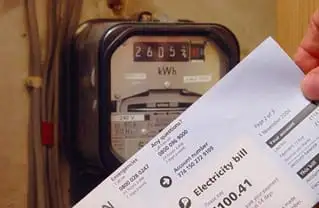
During this Pandemic, Save Money - How To Better Understand Your Electricity Bill

Commercial Electric Tariffs explain utility rate structures, peak demand charges, kWh vs kW pricing, time-of-use periods, voltage, delivery, capacity ratchets, and riders, guiding facility managers in tariff analysis for accurate energy savings.


Key Points

Commercial electric tariffs define utility pricing for energy, demand, delivery, time-of-use periods, riders, and ratchet charges.

✅ Separate kWh charges from kW peak demand fees.

✅ Verify time-of-use windows and demand interval length.

✅ Review riders, capacity ratchets, and minimum demand clauses.


Especially during these tough economic times, as major changes to electric bills are debated in some states, facility executives who don’t understand how their power is priced have been disappointed when their energy projects failed to produce expected dollar savings. Here’s how not to be one of them.

Your electric rate is spelled out in a document called a “tariff” that can be downloaded from your utility’s web page. A tariff should clearly spell out the costs for each component that is part of your rate, reflecting cost allocation practices in your region. Don’t be surprised to learn that it contains a bunch of them. Unlike residential electric rates, commercial electric bills are not based solely on the quantity of kilowatt-hours (kWh) consumed in a billing period (in the United States, that’s a month). Instead, different rates may apply to how your power is supplied, how it is delivered via electricity delivery charges, when it was consumed, its voltage, how fast it was used (in kW), and other factors.

If a tariff’s lingo and word structure are too opaque, spend some time with a utility account rep to translate it. Many state utility commissions also have customer advocates that may assist as they explore new utility rate designs that affect customers. Alternatively, for a fee, facility managers can privately chat with an energy consultant.

Common mistakes

Many facility managers try to estimate savings based on an averaged electric rate, i.e., annual electric spend divided by annual kWh. However, in markets where electricity demand is flat, such a number may obscure the fastest rising cost component: monthly peak demand charges, measured in dollars per kW (or kilo-volt-amperes, kVA).

This charge is like a monthly speeding ticket, based solely on the highest speed you drove during that time. In some areas, peak demand charges now account for 30 to 60 percent of a facility’s annual electric spend. When projecting energy cost savings, failing to separately account for kW peak demand and kWh consumption may result in erroneous results, and a lot of questions from the C-suite.

How peak demand charges are calculated varies among utilities. Some base it on the highest average speed of use across one hour in a month, while others may use the highest average speed during a 15- or 30-minute period. Others may average several of the highest speeds within a defined time period (for example, 8 a.m. to 6 p.m. on weekdays). It is whatever your tariff says it is.

Because some power-consuming (or producing) devices, including those tied to smart home electricity networks, vary in their operation or abilities, they may save money on a few — but not all — of those rate components. If an equipment vendor calculates savings from its product by using an average electric rate, take pause. Tell the vendor to return after the proposal has been redone using tariff-based numbers.

When a vendor is the only person calculating potential savings from using a product, there’s also a built-in conflict of interest: The person profiting from an equipment sale should not also be the one calculating its expected financial return. Before signing any energy project contracts, it’s essential that someone independent of the deal reviews projected savings. That person (typically an energy or engineering consultant) should be quite familiar with your facility’s electric tariff, including any special provisions, riders, discounts, etc., that may pertain. When this doesn’t happen, savings often don’t occur as planned. 

For example, some utilities add another form of demand charge, based on the highest kW in a year. It has various names: capacity, contract demand, or the generic term “ratchet charge.” Some utilities also have a minimum ratchet charge which may be based on a percent of a facility’s annual kW peak. It ensures collection of sufficient utility revenue to cover the cost of installed transmission and distribution even when a customer significantly cuts its peak demand.


Related News

View more

A new approach finds materials that can turn waste heat into electricity

Thermoelectric Materials convert waste heat into electricity via the Seebeck effect; quantum computations and semiconductors accelerate discovery, enabling clean energy, higher efficiency, and scalable heat-to-power conversion from abundant, non-toxic, cost-effective compounds.


Key Points

Thermoelectric materials turn waste heat into electricity via the Seebeck effect, improving energy efficiency.

✅ Convert waste heat to electricity via the Seebeck effect

✅ Quantum computations rapidly identify high-performance candidates

✅ Target efficient, low-thermal-conductivity, non-toxic, abundant compounds


The need to transition to clean energy is apparent, urgent and inescapable. We must limit Earth’s rising temperature to within 1.5 C to avoid the worst effects of climate change — an especially daunting challenge in the face of the steadily increasing global demand for energy and the need for reliable clean power, with concepts that can generate electricity at night now being explored worldwide.

Part of the answer is using energy more efficiently. More than 72 per cent of all energy produced worldwide is lost in the form of heat, and advances in turning thermal energy into electricity could recover some of it. For example, the engine in a car uses only about 30 per cent of the gasoline it burns to move the car. The remainder is dissipated as heat.

Recovering even a tiny fraction of that lost energy would have a tremendous impact on climate change. Thermoelectric materials, which convert wasted heat into useful electricity, can help, especially as researchers pursue low-cost heat-to-electricity materials for scalable deployment.

Until recently, the identification of these materials had been slow. My colleagues and I have used quantum computations — a computer-based modelling approach to predict materials’ properties — to speed up that process and identify more than 500 thermoelectric materials that could convert excess heat to electricity, and help improve energy efficiency.


Making great strides towards broad applications
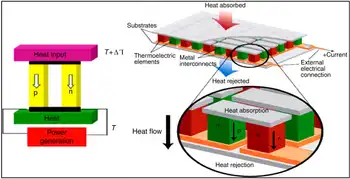
The transformation of heat into electrical energy by thermoelectric materials is based on the “Seebeck effect.” In 1826, German physicist Thomas Johann Seebeck observed that exposing the ends of joined pieces of dissimilar metals to different temperatures generated a magnetic field, which was later recognized to be caused by an electric current.

Shortly after his discovery, metallic thermoelectric generators were fabricated to convert heat from gas burners into an electric current. But, as it turned out, metals exhibit only a low Seebeck effect — they are not very efficient at converting heat into electricity.

In 1929, the Russian scientist Abraham Ioffe revolutionized the field of thermoelectricity. He observed that semiconductors — materials whose ability to conduct electricity falls between that of metals (like copper) and insulators (like glass) — exhibit a significantly higher Seebeck effect than metals, boosting thermoelectric efficiency 40-fold, from 0.1 per cent to four per cent.

This discovery led to the development of the first widely used thermoelectric generator, the Russian lamp — a kerosene lamp that heated a thermoelectric material to power a radio.


Are we there yet?
Today, thermoelectric applications range from energy generation in space probes to cooling devices in portable refrigerators, and include emerging thin-film waste-heat harvesters for electronics as well. For example, space explorations are powered by radioisotope thermoelectric generators, converting the heat from naturally decaying plutonium into electricity. In the movie The Martian, for example, a box of plutonium saved the life of the character played by Matt Damon, by keeping him warm on Mars.

In the 2015 film, The Martian, astronaut Mark Watney (Matt Damon) digs up a buried thermoelectric generator to use the power source as a heater.

Despite this vast diversity of applications, wide-scale commercialization of thermoelectric materials is still limited by their low efficiency.

What’s holding them back? Two key factors must be considered: the conductive properties of the materials, and their ability to maintain a temperature difference, as seen in nighttime electricity from cold concepts, which makes it possible to generate electricity.

The best thermoelectric material would have the electronic properties of semiconductors and the poor heat conduction of glass. But this unique combination of properties is not found in naturally occurring materials. We have to engineer them, drawing on advances such as carbon nanotube energy harvesters to guide design choices.

Searching for a needle in a haystack
In the past decade, new strategies to engineer thermoelectric materials have emerged due to an enhanced understanding of their underlying physics. In a recent study in Nature Materials, researchers from Seoul National University, Aachen University and Northwestern University reported they had engineered a material called tin selenide with the highest thermoelectric performance to date, nearly twice that of 20 years ago. But it took them nearly a decade to optimize it.

To speed up the discovery process, my colleagues and I have used quantum calculations to search for new thermoelectric candidates with high efficiencies. We searched a database containing thousands of materials to look for those that would have high electronic qualities and low levels of heat conduction, based on their chemical and physical properties. These insights helped us find the best materials to synthesize and test, and calculate their thermoelectric efficiency.

We are almost at the point where thermoelectric materials can be widely applied, but first we need to develop much more efficient materials. With so many possibilities and variables, finding the way forward is like searching for a tiny needle in an enormous haystack.

Just as a metal detector can zero in on a needle in a haystack, quantum computations can accelerate the discovery of efficient thermoelectric materials. Such calculations can accurately predict electron and heat conduction (including the Seebeck effect) for thousands of materials and unveil the previously hidden and highly complex interactions between those properties, which can influence a material’s efficiency.

Large-scale applications will require themoelectric materials that are inexpensive, non-toxic and abundant. Lead and tellurium are found in today’s thermoelectric materials, but their cost and negative environmental impact make them good targets for replacement.

Quantum calculations can be applied in a way to search for specific sets of materials using parameters such as scarcity, cost and efficiency, and insights can even inform exploratory devices that generate electricity out of thin air in parallel fields. Although those calculations can reveal optimum thermoelectric materials, synthesizing the materials with the desired properties remains a challenge.

A multi-institutional effort involving government-run laboratories and universities in the United States, Canada and Europe has revealed more than 500 previously unexplored materials with high predicted thermoelectric efficiency. My colleagues and I are currently investigating the thermoelectric performance of those materials in experiments, and have already discovered new sources of high thermoelectric efficiency.

Those initial results strongly suggest that further quantum computations can pinpoint the most efficient combinations of materials to make clean energy from wasted heat and the avert the catastrophe that looms over our planet.


Related News

View more

Six key trends that shaped Europe's electricity markets in 2020

European Electricity Market Trends 2020 highlight decarbonisation, rising renewables, EV adoption, shifting energy mix, COVID-19 impacts, fuel switching, hydro, wind and solar growth, gas price dynamics, and wholesale electricity price increases.


Key Points

EU power in 2020 saw lower emissions, more renewables, EV growth, demand shifts, and higher wholesale prices.

✅ Power sector CO2 down 14% on higher renewables, lower coal

✅ Renewables 39% vs fossil 36%; hydro, wind, solar expanded

✅ EV share hit 17%; wholesale prices rose with gas, ETS costs


According to the Market Observatory for Energy DG Energy report, the COVID-19 pandemic and favorable weather conditions are the two key drivers of the trends experienced within the European electricity market in 2020. However, the two drivers were exceptional or seasonal.

The key trends within Europe’s electricity market include:


1. Decrease in power sector’s carbon emissions

As a result of the increase in renewables generation and decrease in fossil-fueled power generation in 2020, the power sector was able to reduce its carbon footprint by 14% in 2020. The decrease in the sector’s carbon footprint in 2020 is similar to trends witnessed in 2019 when fuel switching was the main factor behind the decarbonisation trend.

However, most of the drivers in 2020 were exceptional or seasonal (the pandemic, warm winter, high
hydro generation). However, the opposite is expected in 2021, with the first months of 2021 having relatively cold weather, lower wind speeds and higher gas prices, with stunted hydro and nuclear output also cited, developments which suggest that the carbon emissions and intensity of the power sector could rise.

The European Union is targeting to completely decarbonise its power sector by 2050 through the introduction of supporting policies such as the EU Emissions Trading Scheme, the Renewable Energy Directive and legislation addressing air pollutant emissions from industrial installations, with expectations that low-emissions sources will cover most demand growth in the coming years.

According to the European Environment Agency, Europe halved its power sector’s carbon emissions in 2019 from 1990 levels.


2. Changes in energy consumption

EU consumption of electricity fell by -4% as majority of industries did not operate at full level during the first half of 2020. Although majority of EU residents stayed at home, meaning an increase in residential energy use, rising demand by households could not reverse falls in other sectors of the economy.

However, as countries renewed COVID-19 restrictions, energy consumption during the 4th quarter was closer to the “normal levels” than in the first three quarters of 2020. 

The increase in energy consumption in the fourth quarter of 2020 was also partly due to colder temperatures compared to 2019 and signs of surging electricity demand in global markets.


3. Increase in demand for EVs

As the electrification of the transport system intensifies, the demand for electric vehicles increased in 2020 with almost half a million new registrations in the fourth quarter of 2020. This was the highest figure on record and translated into an unprecedented 17% market share, more than two times higher than in China and six times higher than in the United States.

However, the European Environment Agency (EEA)argues that the EV registrations were lower in 2020 compared to 2019. EEA states that in 2019, electric car registrations were close to 550 000 units, having reached 300 000 units in 2018.


4. Changes in the region’s energy mix and increase in renewable energy generation

The structure of the region’s energy mix changed in 2020, according to the report.

Owing to favorable weather conditions, hydro energy generation was very high and Europe was able to expand its portfolio of renewable energy generation such that renewables (39%) exceeded the share of fossil fuels (36%) for the first time ever in the EU energy mix.

Rising renewable generation was greatly assisted by 29 GW of wind and solar capacity additions in 2020, which is comparable to 2019 levels. Despite disrupting the supply chains of wind and solar resulting in project delays, the pandemic did not significantly slow down renewables’ expansion.

In fact, coal and lignite energy generation fell by 22% (-87 TWh) and nuclear output dropped by 11% (-79 TWh). On the other hand, gas energy generation was not significantly impacted owing to favorable prices which intensified coal-to-gas and lignite-to-gas switching, even as renewables crowd out gas in parts of the market.


5. Retirement of coal energy generation intensify

 As the outlook for emission-intensive technologies worsens and carbon prices rise, more and more early coal retirements have been announced. Utilities in Europe are expected to continue transitioning from coal energy generation under efforts to meet stringent carbon emissions reduction targets and as they try to prepare themselves for future business models that they anticipate to be entirely low-carbon reliant.

6. Increase in wholesale electricity prices

In recent months, more expensive emission allowances, along with rising gas prices, have driven up wholesale electricity prices on many European markets to levels last seen at the beginning of 2019. The effect was most pronounced in countries that are dependent on coal and lignite. The wholesale electricity prices dynamic is expected to filter through to retail prices.

The rapid sales growth in the EVs sector was accompanied by expanding charging infrastructure. The number of high-power charging points per 100 km of highways rose from 12 to 20 in 2020.


Related News

View more

Parisians vote to ban rental e-scooters from French capital by huge margin

Paris E-Scooter Ban: Voters back ending rental scooters after a public consultation, citing road safety, pedestrian clutter, and urban mobility concerns; impacts Lime, Dott, and Tier operations across the capital.


Key Points

A citywide prohibition on rental e-scooters, approved by voters, to improve safety, order, and walkability.

✅ Non-binding vote shows about 90% support citywide.

✅ About 15,000 rental scooters from Lime, Dott, Tier affected.

✅ Cites 2022 injuries, fatalities, and sidewalk clutter.


Parisians have voted to rid the streets of the French capital of rental electric scooters, with an overwhelming 90% of votes cast supporting a ban, official results show, amid a wider debate over the limits of the electric-car revolution and its real-world impact.

Paris was a pioneer when it introduced e-scooters, or trottinettes, in 2018 as the city’s authorities sought to promote non-polluting forms of urban transport, amid record EV adoption in France across the country.

But as the two-wheeled vehicles grew in popularity, especially among young people, and, with similar safety concerns prompting the TTC winter ban on lithium-ion e-bikes and scooters in Toronto, so did the number of accidents: in 2022, three people died and 459 were injured in e-scooter accidents in Paris.

In what was billed as a “public consultation” voters were asked: “For or against self-service scooters?”

Twenty-one polling stations were set up across the city and were open until 7pm local time. Although 1.6 million people are eligible to vote, turnout is expected to be low.

The ban won between 85.77% and 91.77% of the votes in the 20 Paris districts that published results, according to the City of Paris website on what was billed as a rare “public consultation” and prompted long queues at ballot boxes around the city. The vote was non-binding but city authorities have vowed to follow the result, echoing Britain's transport rethink that questions simple fixes.

Paris’s socialist mayor, Anne Hidalgo, has promoted cycling and bike-sharing but supported a ban on e-scooters, as France rolls out new EV incentive rules affecting Chinese manufacturers.

In an interview with Agence France-Presses last week, Hidalgo said “self-service scooters are the source of tension and worry” for Parisians and that a ban would “reduce nuisance” in public spaces, with broader benefits for air quality noted in EV use linked to fewer asthma ER visits in recent studies as well.

Paris has almost 15,000 e-scooters across its streets, operated by companies including Lime, Dott and Tier. Detractors argue that e-scooter users disrespect the rules of the road and regularly flout a ban on riding on pavements, even as France moves to discourage Chinese EV purchases to shape the broader mobility market. The vehicles are also often haphazardly parked or thrown into the River Seine.

In June 2021, a 31-year-old Italian woman was killed after being hit by an e-scooter with two passengers onboard while walking along the Seine.

“Scooters have become my biggest enemy. I’m scared of them,” Suzon Lambert, a 50-year-old teacher from Paris, told AFP. “Paris has become a sort of anarchy. There’s no space any more for pedestrians.”


Another Parisian told BFMTV: “It’s dangerous, and people use them badly. I’m fed up.”

Julian Sezgin, aged 15, said he often saw groups of two or three teenagers on e-scooters zooming past cars on busy roads. “I avoid going on e-scooters and prefer e-bikes as, in my opinion, they are safer and more efficient,” he told the Guardian.

Bianca Sclavi, an Italian who has lived in Paris for years, said the scooters go “too fast” and should be mechanically limited so they go slower. “They are dangerous because they zip in and out of traffic,” she said. “However, it is not as bad as when they first arrived … the most dangerous are the drunk tourists!”


Related News

View more

Sign Up for Electricity Forum’s Newsletter

Stay informed with our FREE Newsletter — get the latest news, breakthrough technologies, and expert insights, delivered straight to your inbox.

Electricity Today T&D Magazine Subscribe for FREE

Stay informed with the latest T&D policies and technologies.
  • Timely insights from industry experts
  • Practical solutions T&D engineers
  • Free access to every issue

Live Online & In-person Group Training

Advantages To Instructor-Led Training – Instructor-Led Course, Customized Training, Multiple Locations, Economical, CEU Credits, Course Discounts.

Request For Quotation

Whether you would prefer Live Online or In-Person instruction, our electrical training courses can be tailored to meet your company's specific requirements and delivered to your employees in one location or at various locations.