By -- Source, Reuters


NFPA 70e Training - Arc Flash

Our customized live online or in‑person group training can be delivered to your staff at your location.

  • Live Online
  • 6 hours Instructor-led
  • Group Training Available
Regular Price:
$199
Coupon Price:
$149
Reserve Your Seat Today
TORONTO (Reuters) - Ontario Power Generation, the province's largest electricity generator, said Tuesday that Enron's demise had hobbled its attempts to divest assets as banks had become wary about lending to utilities, whose ratings have slid after the U.S. energy giant's spectacular collapse.

``They don't have the money to come in and invest. Not only are they withdrawing their interest, they're going home to take care of their balance sheets,'' Ron Robinson, vice-president of portfolio management at Ontario Power Generation (OPG), told an energy conference in Toronto.

Enron Corp., the energy trader that came to life during the move to power deregulation in the United States, filed for bankruptcy on Dec. 2. -- the biggest in U.S. history -- amid an accounting scandal.

Ontario's electricity market opens up to competition on May 1, nearly two years behind schedule, and OPG has been ordered by the province to divest assets to stimulate competition.

Under the plan, OPG should produce 35 percent or less of the total electricity generated in Ontario within 10 years of deregulation. Currently it produces about 80 percent.

Last year, OPG signed a C$3.2 billion lease deal giving Bruce Power the right to operate Bruce Nuclear Power facility in Southwestern Ontario until 2018. Bruce Power, a partnership between British Energy Plc and Canadian uranium supplier Cameco Corp , generates about 17 percent of the province's electricity through its two nuclear stations.

Companies that use large amounts of power, already worried that the 10-year timetable is too long and will hurt competition, said Tuesday the setback caused by the Enron scandal is a further cause for concern.

``The faster we get competition the faster we get efficiency in the market,'' said Lauri Gregg, director of energy and technical services, at Falconbridge Ltd., the world's third largest nickel producer.

``We've been advocating for a five-year plan and a formal plan should be put in place,'' Gregg added.

Canada's second largest steelmaker, Dofasco Inc., lambasted the Ontario government earlier this year for having a ''half-assed'' deregulation strategy.

Dofasco chief executive John Mayberry said he fears electricity prices will soar if the province does not order OPG to quickly sell most of its generating assets.

Falconbridge's Gregg said: ``Prices are going to rise but I don't think we're going to see a dramatic rise.

``If we create a (competitive) market we have to accept price volatility. It'll be a different environment.''

Ontario's deregulation plans also involve taking public Hydro One, the province's power distributor. The province has already named lead underwriters for Hydro One's initial public offering, which should be completed this year and is expected to raise about C$5 billion.

Hydro One is one of two main spinoffs from Ontario Hydro, the sprawling provincially owned utility that once was the largest power company in North America. OPG is the other spinoff.

($1-$1.61 Canadian)

Related News

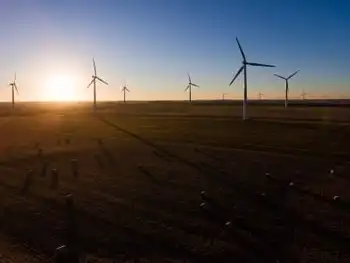
Two huge wind farms boost investment in America’s heartland

MidAmerican Energy Wind XI expands Iowa wind power with the Beaver Creek and Prairie farms, 169 turbines and 338 MW, delivering renewable energy, grid reliability, rural jobs, and long-term tax revenue through major investment.


Key Points

MidAmerican Energy Wind XI is a $3.6B Iowa wind buildout adding 2,000 MW to enhance reliability, jobs, and tax revenue.

✅ 169 turbines at Beaver Creek and Prairie deliver 338 MW.

✅ Wind supplies 36.6 percent of Iowa electricity generation.

✅ Projects forecast $62.4M in property taxes over 20 years.


Power company MidAmerican Energy recently announced the beginning of operations at two huge wind farms in the US state of Iowa.

The two projects, called Beaver Creek and Prairie, total 169 turbines and have a combined capacity of 338 megawatts (MW), enough to meet the annual electricity needs of 140,000 homes in the state.

“We’re committed to providing reliable service and outstanding value to our customers, and wind energy accomplishes both,” said Mike Fehr, vice president of resource development at MidAmerican. “Wind energy is good for our customers, and it’s an abundant, renewable resource that also energizes the economy.”

The wind farms form part of MidAmerican Energy’s major Wind XI project, which will see an extra 2,000MW of wind power built, and $3.6 billion invested amid notable wind farm acquisitions shaping the market by the end of 2019. The company estimates it is the largest economic development project in Iowa’s history.

Iowa is something of a hidden powerhouse in American wind energy. The technology provides an astonishing 36.6 percent of the state’s entire electricity generation and plays a growing role in the U.S. electricity mix according to the American Wind Energy Association (AWEA). It also has the second largest amount of installed capacity in the nation at 6917MW; Texas is first with over 21,000MW.

Along with capital investment, wind power brings significant job opportunities and tax revenues for the state. An estimated 9,000 jobs are supported by the industry, something a U.S. wind jobs forecast stated could grow to over 15,000 within a couple of years.

MidAmerican Energy is also keen to stress the economic benefits of its new giant projects, claiming that they will bring in $62.4 million of property tax revenue over their 20-year lifetime.

Tom Kiernan, AWEA’s CEO, revealed last year that, as the most-used source of renewable electricity in the U.S., wind energy is providing more than five states in the American Midwest with over 20 percent of electricity generation, “a testament to American leadership and innovation”.

“For these states, and across America, wind is welcome because it means jobs, investment, and a better tomorrow for rural communities”, he added.


Related News

View more

Electric cars will challenge state power grids

Electric Vehicle Grid Integration aligns EV charging with grid capacity using smart charging, time-of-use rates, V2G, and demand response to reduce peak load, enable renewable energy, and optimize infrastructure planning.


Key Points

Aligning EV charging with grid needs via smart charging, TOU pricing, and V2G to balance load and support renewables.

✅ Time-of-use rates shift charging to off-peak hours

✅ Smart charging responds to real-time grid signals

✅ V2G turns fleets into distributed energy storage


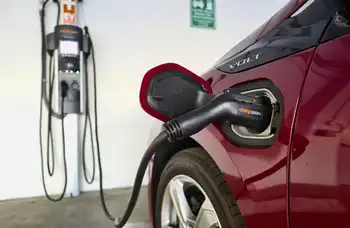
When Seattle City Light unveiled five new electric vehicle charging stations last month in an industrial neighborhood south of downtown, the electric utility wasn't just offering a new spot for drivers to fuel up. It also was creating a way for the service to figure out how much more power it might need as electric vehicles catch on.

Seattle aims to have nearly a third of its residents driving electric vehicles by 2030. Washington state is No. 3 in the nation in per capita adoption of plug-in cars, behind California and Hawaii. But as Washington and other states urge their residents to buy electric vehicles — a crucial component of efforts to reduce carbon emissions — they also need to make sure the electric grid can handle it amid an accelerating EV boom nationwide.

The average electric vehicle requires 30 kilowatt hours to travel 100 miles — the same amount of electricity an average American home uses each day to run appliances, computers, lights and heating and air conditioning.

An Energy Department study found that increased electrification across all sectors of the economy could boost national consumption by as much as 38 percent by 2050, in large part because of electric vehicles. The environmental benefit of electric cars depends on the electricity being generated by renewables.

So far, states predict they will be able to sufficiently boost power production. But whether electric vehicles will become an asset or a liability to the grid largely depends on when drivers charge their cars.

Electricity demand fluctuates throughout the day; demand is higher during daytime hours, peaking in the early evening. If many people buy electric vehicles and mostly try to charge right when they get home from work — as many now do — the system could get overloaded or force utilities to deliver more electricity than they are capable of producing.

In California, for example, the worry is not so much with the state’s overall power capacity, but rather with the ability to quickly ramp up production and maintain grid stability when demand is high, said Sandy Louey, media relations manager for the California Energy Commission, in an email. About 150,000 electric vehicles were sold in California in 2018 — 8 percent of all state car sales.

The state projects that electric vehicles will consume 5.4 percent of the state’s electricity, or 17,000 gigawatt hours, by 2030.

Responding to the growth in electric vehicles will present unique challenges for each state. A team of researchers from the University of Texas at Austin estimated the amount of electricity that would be required if every car on the road transitioned to electric. Wyoming, for instance, would need to nudge up its electricity production only 17 percent, while Maine would have to produce 55 percent more.

Efficiency Maine, a state trust that oversees energy efficiency and greenhouse gas reduction programs, offers rebates for the purchase of electric vehicles, part of state efforts to incentivize growth.

“We’re certainly mindful that if those projections are right, then there will need to be more supply,” said Michael Stoddard, the program’s executive director. “But it’s going to unfold over a period of the next 20 years. If we put our minds to it and plan for it, then we should be able to do it.”

A November report sponsored by the Energy Department found that there has been almost no increase in electricity demand nationwide over the past 10 years, while capacity has grown an average of 12 gigawatts per year (1 GW can power more than a half-million homes). That means energy production could climb at a similar rate and still meet even the most aggressive increase in electric vehicles, with proper planning.

Charging during off-peak hours would allow not only many electric vehicles to be added to the roads but also utilities to get more use out of power plants that run only during the limited peak times through improved grid coordination and flexible demand.

Seattle City Light and others are looking at various ways to promote charging during ideal times. One method is time-of-day rates. For the Seattle chargers unveiled last month, users will pay 31 cents per kilowatt hour during peak daytime hours and 17 cents during off-peak hours. The utility will monitor use at its charging stations to see how effective the rates are at shifting charging to more favorable times.

The utility also is working on a pilot program to study charging behavior at home. And it is partnering with customers such as King County Metro that are electrifying large vehicle fleets, including growing electric truck fleets that will demand significant power, to make sure they have both the infrastructure and charging patterns to integrate smoothly.

“Traditionally, our utility approach is to meet the load demand,” said Emeka Anyanwu, energy innovation and resources officer for Seattle City Light.

Instead, he said, the utility is working with customers to see whether they can use existing assets without the need for additional investment.

Numerous analysts say that approach is crucial.

“Even if there’s an overall increase in consumption, it really matters when that occurs,” said Sally Talberg, head of the Michigan Public Service Commission, which oversees the state’s utilities. “The encouragement of off-peak charging and other technology solutions that could come to bear could offset any negative impact.”

One of those solutions is smart charging, a system in which vehicles are plugged in but don’t charge until they receive a signal from the grid that demand has tapered off a sufficient amount. This is often paired with a lower rate for drivers who use it. Several smart-charging pilot programs are being conducted by utilities, although they have not yet been phased in widely, amid ongoing debates over charging control among manufacturers and utilities.

In many places, the increased electricity demand from electric vehicles is seen as a benefit to utilities and rate payers. In the Northwest, electricity consumption has remained relatively stagnant since 2000, despite robust population growth and development. That’s because increasing urbanization and building efficiency have driven down electricity needs.

Electric vehicles could help push electricity consumption closer to utilities’ capacity for production. That would bring in revenue for the providers, which would help defray the costs for maintaining that capacity, lowering rates for all customers.

“Having EV loads is welcome, because it’s environmentally cleaner and helps sustain revenues for utilities,” said Massoud Jourabchi, manager of economic analysis for the Northwest Power and Conservation Council, which develops power plans for the region.

Colorado also is working to promote electric cars, with the aim of putting 940,000 on the road by 2030. The state has adopted California’s zero-emission vehicles mandate, which requires automakers to reach certain market goals for their sales of cars that don’t burn fossil fuels, while extending tax credits for the purchase of such cars, investing in charging stations and electrifying state fleets.

Auto dealers have opposed the mandate, saying it infringes on consumer freedom.

“We think it should be a customer choice, a consumer choice and not a government mandate,” said Tim Jackson, president and chief executive of the Colorado Automobile Dealers Association.

Jackson also said that there’s not yet a strong consumer appetite for electric vehicles, meaning that manufacturers that fail to sell the mandated number of emission-free vehicles would be required to purchase credits, which he thinks would drive up the price of their other models.

Republicans in the state have registered similar concerns, saying electric vehicle adoption should take place based on market forces, not state intervention.

Many in the utility community are excited about the potential for electric cars to serve as mobile energy storage for the grid. Vehicle-to-grid technology, known as V2G, would allow cars charging during the day to take on surplus power from renewable energy sources.

Then, during peak demand times, electric vehicles would return some of that stored energy to the grid. As demand tapers off in the evening, the cars would be able to recharge.

In practice, V2G technology could be especially beneficial if used by heavy-duty fleets, such as school buses or utility vehicles. Those fleets would have substantial battery storage and long periods where they are idle, such as evenings and weekends — and even longer periods such as summer and the holiday season when school is out. The batteries on a bus, Jourabchi said, could store as much as 10 times the electricity needed to power a home for a day.


Related News

View more

Nevada on track to reach RPS mandate of 50% renewable electricity by 2030: report

Nevada Renewable Portfolio Standard 2030 targets 50% clean energy, advancing solar, geothermal, and wind, cutting GHG emissions, phasing out coal, and expanding storage, EV infrastructure, and in-state renewables under PUCN oversight and tax abatements.


Key Points

A state mandate requiring 50% of electricity from renewables by 2030, driving solar, geothermal, wind, and storage.

✅ 50% clean power by 2030; 100% carbon-free target by 2050

✅ Growth in solar, geothermal, wind; coal phase-out; natural gas remains

✅ RETA incentives spur 6.1 GW capacity, jobs, and in-state investment


Nevada is on track to meet its Renewable Portfolio Standard of 50% of electricity generated by renewable energy sources by 2030, according to the Governor's Office of Energy's annual Status of Energy Report.

Based on compliance reports the Public Utilities Commission of Nevada has received, across all providers, about 20% of power is currently generated by renewable resources, and, nationally, renewables ranked second in 2020 as filings show Nevada's investor-owned utility and other power providers have plans to reach the state's ambitious RPS of 50% by 2030, according to the report released Jan. 28.

"Because transportation and electricity generation are Nevada's two largest contributors to greenhouse gas emissions, GOE's program work in 2021 underscored our focus on transportation electrification and reaching the state's legislatively required renewable portfolio standard," GOE Director David Bobzien said in a statement Jan. 28. "While electricity generated from renewable resources currently accounts for about 25% of the state's electricity, a share similar to projections that renewables will soon provide about one-fourth of U.S. electricity overall, we continue to collaborate with the Public Utilities Commission of Nevada, electricity providers, the renewable energy industry and conservation organizations to ensure Nevada reaches our target of 50% clean energy by 2030."

The state's RPS, enacted in 1997 and last modified in 2019, requires an increase in renewable energy, starting with 22% in 2020 and increasing to 50% by 2030. The increase in renewables will reduce GHG emissions and help the state reach its goal of 100% carbon-free power by 2050, while states like Rhode Island have a 100% by 2030 plan, highlighting varying timelines.

Renewable additions
The state added 1.332 GW of renewable capacity in 2021 as part of the Renewable Energy Tax Abatement program, at a time when U.S. renewable energy hit a record 28% in April, for a total renewable capacity of 6.117 GW, according to the report.

The RETA program awards partial sales and use tax and partial property-tax abatements to eligible renewable energy facilities, which increase Nevada's tax revenue and create jobs in a growing industry. Eligible projects must employ at least 50% Nevada workers, pay 175% of Nevada's average wage during construction, and offer health care benefits to workers and their dependents.

Since its adoption in 2010, the GOE has approved 60 projects, including large-scale solar PV, solar thermal, biomass, geothermal and wind projects throughout the state, according to the report. Projects granted abatements in 2021 include:

  • 100-MW Citadel Solar Project
  • 150-MW Dry Lake Solar + Storage Project
  • 714-MW Gemini Solar Project
  • 55-MW North Valley Power Geothermal Project
  • 113-MW Boulder Flats Solar Project
  • 200-MW Arrow Canyon Solar Project

"Nevada does not produce fossil fuels of any significant amount, and gasoline, jet fuel and natural gas for electricity or direct use must be imported," according to the report. "Transitioning to domestically produced renewable resources and electrified transportation can provide cost savings to Nevada residents and businesses, as seen in Idaho's largely renewable mix today, while reducing GHG emissions. About 86% of the fuel for energy that Nevada consumes comes from outside the state."

Phasing out coal plants
Currently, more than two-thirds of the state's electricity is produced by natural gas-fired power plants, with renewables covering most of the remaining generation, according to the report. Nevada continues to phase out its remaining coal power plants, as renewables surpassed coal nationwide in 2022, which provide less than 10% of produced electricity.

"Nevada has seen a significant increase in capturing its abundant renewable energy resources such as solar and geothermal," according to the report. "Renewable energy production continues to grow, powering Nevada homes and business and serves to diversify the state's economy by exporting solar and geothermal to neighboring states, as California neared 100% renewable electricity for the first time. Nevada has more than tripled its renewable energy production since 2011."


Related News

View more

BC Hydro completes major milestone on Site C transmission line work

Site C 500 kV transmission lines strengthen the BC Hydro grid, linking the new substation and Peace Canyon via a 75 kilometre right-of-way to deliver clean energy, with 400 towers built and both circuits energized.


Key Points

High-voltage lines connecting Site C substation to the BC Hydro grid, delivering clean energy via Peace Canyon.

✅ Two 75 km circuits between Site C and Peace Canyon

✅ Connect new 500 kV substation to BC Hydro grid

✅ Over 400 towers built along existing right-of-way


The second and final 500 kilovolt, 75 kilometre transmission line on the Site C project, which has faced stability questions in recent years, has been completed and energized.

With this milestone, the work to connect the new Site C substation to the BC Hydro grid, amid treaty rights litigation that has at times shaped schedules, is complete. Once the Site C project begins generating electricity, much like when the Maritime Link first power flowed between Newfoundland and Nova Scotia, the transmission lines will help deliver clean energy to the rest of the province.

The two 75 kilometre transmission lines run along an existing right-of-way between Site C and the Peace Canyon generating station, a route that has seen community concerns from some northerners. The project’s first 500 kilovolt, 75 kilometre transmission line – along with the Site C substation – were both completed and energized in the fall of 2020.

BC Hydro awarded the Site C transmission line construction contract to Allteck Line Contractors Inc. (now Allteck Limited Partnership) in 2018. Since construction started on this part of the project in summer 2018, crews have built more than 400 towers and strung lines, even as other interties like the Manitoba-Minnesota line have faced scheduling uncertainty, over a total of 150 kilometres.

The two transmission lines are a major component of the Site C project, comparable to initiatives such as the New England Clean Power Link in scale, which also consists of the new 500 kilovolt substation and expanding the existing Peace Canyon 500 kilovolt gas-insulated switchgear to incorporate the two new 500 kilovolt transmission line terminals.

Work to complete three other 500 kilovolt transmission lines that will span one kilometre between the Site C generating station and Site C substation, similar to milestones on the Maritime Link project, is still underway. This work is expected to be complete in 2023.


Related News

View more

The CIB and private sector partners to invest $1.7 billion in Lake Erie Connector

Lake Erie Connector Investment advances a 1,000 MW HVDC transmission link connecting Ontario to the PJM Interconnection, enhancing grid reliability, clean power trade, and GHG reductions through a public-private partnership led by CIB and ITC.


Key Points

A $1.7B public-private HVDC project linking Ontario and PJM to boost reliability, cut GHGs, and enable clean power trade.

✅ 1,000 MW, 117 km HVDC link between Ontario and PJM

✅ $655M CIB and $1.05B private financing, ITC to own-operate

✅ Cuts system costs, boosts reliability, reduces GHG emissions


The Canada Infrastructure Bank (CIB) and ITC Investment Holdings (ITC) have signed an agreement in principle to invest $1.7 billion in the Lake Erie Connector project.

Under the terms of the agreement, the CIB will invest up to $655 million or up to 40% of the project cost. ITC, a subsidiary of Fortis Inc., and private sector lenders will invest up to $1.05 billion, the balance of the project's capital cost.

The CIB and ITC Investment Holdings signed an agreement in principle to invest $1.7B in the Lake Erie Connector project.

The Lake Erie Connector is a proposed 117 kilometre underwater transmission line connecting Ontario with the PJM Interconnection, the largest electricity market in North America, and aligns with broader regional efforts such as the Maine transmission line to import Quebec hydro to strengthen cross-border interconnections.

The 1,000 megawatt, high-voltage direct current connection will help lower electricity costs for customers in Ontario and improve the reliability and security of Ontario's energy grid, complementing emerging solutions like battery storage across the province. The Lake Erie Connector will reduce greenhouse gas emissions and be a source of low-carbon electricity in the Ontario and U.S. electricity markets.

During construction, the Lake Erie Connector is expected to create 383 jobs per year and drive more than $300 million in economic activity, and complements major clean manufacturing investments like a $1.6 billion battery plant in the Niagara Region that supports the EV supply chain. Over its life, the project will provide 845 permanent jobs and economic benefits by boosting Ontario's GDP by $8.8 billion.

The project will also help Ontario to optimize its current infrastructure, avoid costs associated with existing production curtailments or shutdowns. It can leverage existing generation capacity and transmission lines to support electricity demand, alongside new resources such as the largest battery storage project planned for southwestern Ontario.

ITC continues its discussions with First Nations communities and is working towards meaningful participation in the near term and as the project moves forward to financial close.

The CIB anticipates financial close late in 2021, pending final project transmission agreements, with construction commencing soon after. ITC will own the transmission line and be responsible for all aspects of design, engineering, construction, operations and maintenance.

ITC acquired the Lake Erie Connector project in August 2014 and it has received all necessary regulatory and permitting approvals, including a U.S. Presidential Permit and approval from the Canada Energy Regulator.

This is the CIB's first investment commitment in a transmission project and another example of the CIB's momentum to quickly implement its $10B Growth Plan, amid broader investments in green energy solutions in British Columbia that support clean growth.


Endorsements

This project will allow Ontario to export its clean, non-emitting power to one of the largest power markets in the world and, as a result, benefit Canadians economically while also significantly contributing to greenhouse gas emissions reductions in the PJM market. The project allows Ontario to better manage peak capacity and meet future reliability needs in a more sustainable way. This is a true win-win for both Canada and the U.S., both economically and environmentally.
Ehren Cory, CEO, Canada Infrastructure Bank

The Lake Erie Connector has tremendous potential to generate customer savings, help achieve shared carbon reduction goals, and increase electricity system reliability and flexibility. We look forward to working with the CIB, provincial and federal governments to support a more affordable, customer-focused system for Ontarians. 
Jon Jipping, EVP & COO, ITC Investment Holdings Inc., a subsidiary of Canadian-based Fortis Inc. 

We are encouraged by this recent announcement by the Canada Infrastructure Bank. Mississaugas of the Credit First Nation has an interest in projects within our historic treaty lands that have environmental benefits and that offer economic participation for our community.
Chief Stacey Laforme, Mississaugas of the Credit First Nation

While our evaluation of the project continues, we recognize this project can contribute to the economic resilience of our Shareholder, the Mississaugas of the Credit First Nation. Subject to the successful conclusion of our collaborative efforts with ITC, we look forward to our involvement in building the necessary infrastructure that enable Ontario's economic engine.
Leonard Rickard, CEO, Mississaugas of the Credit Business Corporation

The Lake Erie Connector demonstrates the advantages of public-private partnerships to develop critical infrastructure that delivers greater value to Ontarians. Connecting Ontario's electricity grid to the PJM electricity market will bring significant, tangible benefits to our province. This new connection will create high-quality jobs, improve system flexibility, and allow Ontario to export more excess electricity to promote cost-savings for Ontario's electricity consumers.
Greg Rickford, Minister of Energy, Northern Development and Mines, Minister of Indigenous Affairs

With the US pledging to achieve a carbon-free electrical grid by 2035, Canada has an opportunity to export clean power, helping to reduce emissions, maximizing clean power use and making electricity more affordable for Canadians. The Lake Erie Connector is a perfect example of that. The Canada Infrastructure Bank's investment will give Ontario direct access to North America's largest electricity market - 13 states and D.C. This is part of our infrastructure plan to create jobs across the country, tackle climate change, and increase Canada's competitiveness in the clean economy, alongside innovation programs like the Hydrogen Innovation Fund that foster clean technology.


Quick Facts

  • The Lake Erie Connector is a 1,000 megawatt, 117 kilometre long underwater transmission line connecting Ontario and Pennsylvania.
  • The PJM Interconnection is a regional transmission organization coordinating the movement of wholesale electricity in all or parts of Delaware, Illinois, Indiana, Kentucky, Maryland, Michigan, New Jersey, North Carolina, Ohio, Pennsylvania, Tennessee, Virginia, West Virginia and the District of Columbia.
  • The project will help to reduce electricity system costs for customers in Ontario, and aligns with ongoing consultations on industrial electricity pricing and programs, while helping to support future capacity needs.
  • The CIB is mandated to invest CAD $35 billion and attract private sector investment into new revenue-generating infrastructure projects that are in the public interest and support Canadian economic growth.
  • The investment commitment is subject to final due diligence and approval by the CIB's Board.


Related News

View more

Investigation underway to determine cause of Atlanta Airport blackout

Atlanta Airport Power Outage disrupts Hartsfield-Jackson as an underground fire cripples switchgear redundancy, canceling flights during holiday travel; Georgia Power restores electricity overnight while utility crews probe causes and monitor system resilience.


Key Points

A major Hartsfield-Jackson blackout from an underground fire; power restored as switchgear redundancy is investigated.

✅ Underground fire near Plane Train tunnel damaged switchgear systems

✅ Over 1,100 flights canceled; holiday travel severely disrupted

✅ Georgia Power restored service; redundancy and root cause under review


Power has been restored at the world’s busiest airport after a massive outage Sunday afternoon left planes and passengers stranded for hours, forced airlines to cancel more than 1,100 flights and created a logistical nightmare during the already-busy holiday travel season.

An underground fire caused a complete power outage Sunday afternoon at Hartsfield-Jackson Atlanta International Airport, resulting in thousands of canceled flights at the world's busiest terminal and affecting travelers worldwide.

The massive outage didn’t just leave passengers stranded overnight Sunday, it also affected travelers with flights Monday morning schedules.

According to Paul Bowers, the president and CEO of Georgia Power,  “From our standpoint, we apologize for the inconvenience,” he said. The utility restored power to the airport shortly before midnight.

Utility Crews are monitoring the fixes that restored power and investigating what caused the fire and why it was able to damage redundant systems. Bowers said the fire occurred in a tunnel that runs along the path of the underground Plane Train tunnel near Concourse E.

Sixteen highly trained utility personnel worked in the passageway to reconnect the network.“Our investigation is going through the process of what do we do to ensure we have the redundancy going back at the airport, because right now we are a single source feed,” Bowers said.

“We will have that complete by the end of the week, and then we will turn to what caused the failure of the switchgear.”

Though the cause isn’t yet known, he said foul play is not suspected.“There are two things that could happen,” he said.

“There are inner workings of the switchgear that could create the heat that caused the fire, or the splicing going into that switchgear -- that the cable had a failure on that going into the switch gear.”

When asked if age of the system could have been a failure, Bowers said his company conducts regular inspections.“We constantly inspect,” he said. “We inspect on an annual basis to ensure the reliability of the network, and that redundancy is protection for the airport.”Bowers said he is not familiar with any similar fire or outage at the airport.

“The issue for us is to ensure the reliability is here and that it doesn’t happen again and to ensure that our network is resilient enough to withstand any kind of fire,” he said. He added that Georgia Power will seek to determine what can be done in the future to avoid a similar event, such as those experienced during regional outages in other communities.


Related News

View more

Sign Up for Electricity Forum’s Newsletter

Stay informed with our FREE Newsletter — get the latest news, breakthrough technologies, and expert insights, delivered straight to your inbox.

Electricity Today T&D Magazine Subscribe for FREE

Stay informed with the latest T&D policies and technologies.
  • Timely insights from industry experts
  • Practical solutions T&D engineers
  • Free access to every issue

Download the 2025 Electrical Training Catalog

Explore 50+ live, expert-led electrical training courses –

  • Interactive
  • Flexible
  • CEU-cerified